Affordable drone training is less about finding the lowest price on a course page and more about paying for the right knowledge at the right stage. A new pilot preparing for a regulatory exam has a different training need from someone learning aerial photography, and both have a different budget from a working pilot moving into thermography or surveying.
That is useful to keep in mind when you search for affordable drone flight training classes online. Online study can reduce travel, accommodation and classroom costs, and self-paced lessons let you fit training around work. The larger saving comes from sequencing your education properly. You can begin with aviation knowledge and basic flight practice, then add a specialist course when you have a clear reason to use that skill.
This guide focuses on that progression. Regulatory requirements vary by country, so always check the aviation authority where you intend to operate.
What Affordable Drone Training Should Give You
A low course fee has little value if the material is outdated, too broad to apply or unrelated to the work you want to do. Useful training should leave you able to explain, plan or perform something more reliably than you could before.
At foundation level, that may mean understanding airspace, weather, emergency procedures, loading, performance and the operating rules around small unmanned aircraft. Later, value becomes more specific. A photography course should improve how you control exposure and compose aerial images. Surveying training should help you understand how a flight plan becomes a map or 3D model. Thermography should teach you how infrared data is collected and interpreted, including the factors that can make a thermal image misleading.
The format also affects value. Self-paced online courses are useful for subjects that benefit from replaying explanations, revisiting modules and testing your knowledge. Actual aircraft handling still needs deliberate practice. Some programs therefore separate online theory from optional practical sessions, which lets you pay for hands-on instruction when you need it rather than bundling every learner into the same format.
Start By Separating Legal Requirements From Skills Training
Before buying a course, identify what your regulator requires. In the United States, a person operating under the FAA’s Small UAS Rule, Part 107, needs a Remote Pilot Certificate. First-time applicants must be at least 16, be able to read, speak, write and understand English, be in a condition to operate safely, and pass the Unmanned Aircraft General knowledge exam. The FAA also requires certificate holders to complete recurrent online training every 24 calendar months to maintain aeronautical knowledge recency. The recurrent course is available at no cost through the FAA.
You can review the current process on the FAA Remote Pilot certification page.
Recreational U.S. flyers follow a different route. The FAA requires the Recreational UAS Safety Test, known as TRUST, for people flying under the Exception for Limited Recreational Operations. The test is online and free through FAA-approved administrators. The FAA says every approved TRUST administrator must offer it at no charge, and questions can be corrected to 100 percent before the completion certificate is issued. See the FAA TRUST guidance for the current requirements.
Paying for commercial exam preparation when you only want to fly recreationally can therefore be unnecessary. Equally, relying on TRUST when your goal is Part 107 work leaves you without the commercial credential required for Part 107 operations.
A Course Certificate Is Not The Same As A Government Pilot Credential
The word ‘certificate’ can refer to different things. A training provider may issue a course completion certificate or competency document. An aviation authority separately controls the pilot credential or operating permission required under its regulations.
Take the Part 107 separation for instance. The online program prepares you for the FAA knowledge exam, and the FAA exam is completed separately through an authorized testing provider. A certificate here is not a substitute for the FAA Remote Pilot Certificate.
For specialist subjects, a completion certificate can still be useful. It documents structured learning in a defined area. Clients and employers, however, will usually care about your regulatory status, practical ability, experience and the quality of your deliverables alongside any training document.
The Lowest Cost Entry Point For Aspiring U.S. Commercial Pilots
ABJ Part 107 Preparatory Course
For a U.S. beginner planning to fly under Part 107, exam preparation is a logical first paid training step. ABJ Drone Academy’s Part 107 Preparatory Course is currently going for $45, reduced from an original price of $100. Pricing can change, so check the course page before enrolling.
The course covers regulations, airport operations, emergency procedures, radio procedures, airspace, weather, physiological factors, maintenance and inspections, decision-making, UAS loading and performance, and crew resource topics. Those areas are relevant well beyond passing a test. Weather interpretation influences whether a small aircraft can safely complete a mission. Loading affects performance. Airspace knowledge affects where you can operate and when authorization may be required.
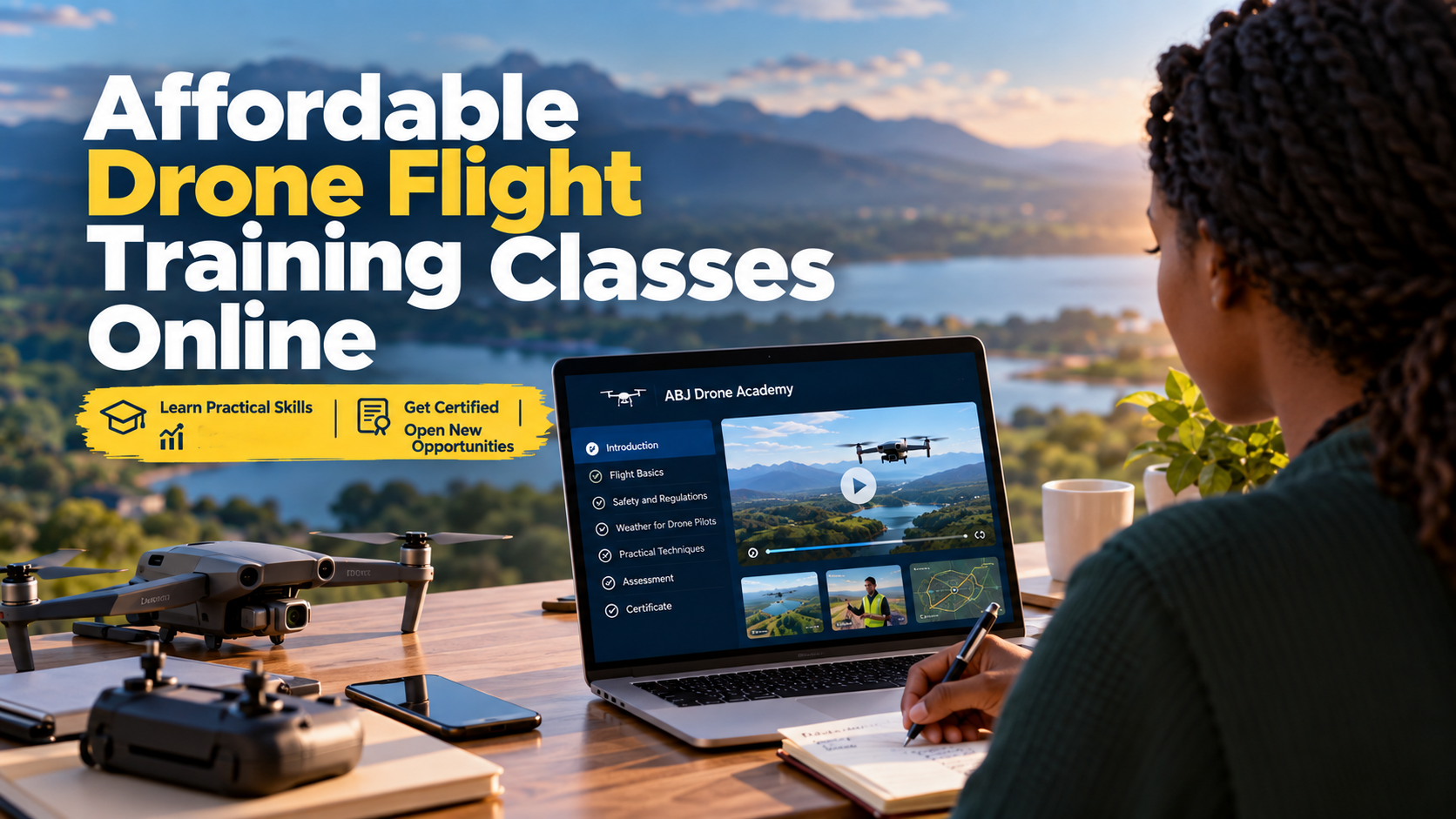
ABJ delivers the theory online and lets you work through it at your own pace on an internet-connected computer, tablet or smartphone. Sections finish with short tests. For a learner paying out of pocket, self-paced access has a practical advantage: difficult subjects can be repeated without paying for another classroom day.
The course also has an optional practical component. This includes two days with an instructor and four flight missions. Those missions progress from basic GPS-mode control and telemetry through banked patterns, figure-eight manoeuvres, non-GPS ATTI-mode flying and simulated work scenarios. Emergency exercises include loss of connectivity, GPS loss and incursions by aircraft or people.
That structure gives you a sensible way to control cost. Study the knowledge online first. Practise basic aircraft handling safely. Add instructor-led flight training where direct feedback would improve your performance.
What You Still Need To Budget For Under Part 107
A preparation course is only one part of the U.S. certification route. You still need to sit the FAA knowledge exam and complete the FAA application process. Current FAA guidance should be your source for eligibility, testing and recurrent-training requirements.
The recurrent requirement is relatively friendly to a long-term training budget. Part 107 certificate holders can complete the Part 107 Small UAS Recurrent online training course at no cost, and recency is required every 24 calendar months.
Registration and operating equipment also sit outside a training budget. Keep those categories separate when you calculate what it will cost to start offering drone services. Mixing aircraft, insurance, regulatory fees, accessories, software and education into one figure can make it difficult to see where you are actually spending.
Build Flight Skill Before Buying Several Specialist Courses
A common training mistake is collecting advanced course certificates before routine flying feels routine. Specialist work adds workload. During a mapping mission you may be thinking about overlap, altitude, battery endurance and data quality. During a video shoot you are managing aircraft movement and camera movement at the same time. An inspection can place you near structures, electromagnetic sources or other site hazards.
Basic control should therefore become familiar first. Practise stable take-offs and landings, orientation changes, straight tracks, squares, circles and figure-eight patterns. Learn what your aircraft does during return-to-home and how its obstacle sensing behaves. Read the manual for the exact model you fly.
Simulator practice can lower the cost of repetition. It lets you work on control inputs without putting an aircraft at risk each time. Real flights remain necessary because a simulator cannot fully reproduce changing wind, glare, obstacles, battery behaviour, people entering an operating area or the pressure of making decisions on site.
Choose One Skill That Can Produce A Client Deliverable
Once you have the appropriate regulatory foundation and reliable aircraft control, the next course should connect to a service you can practice and eventually deliver. ABJ’s online drone course catalog separates primary training from specialist areas, which makes it easier to build training in stages.
Drone Photography Training
Photography is one of the more accessible specialist routes because many consumer and prosumer drones already carry capable cameras. You can practice without buying a thermal or multispectral payload, and the output is easy to review.
ABJ Drone Photography Training is currently listed at $225. The course assumes basic drone flying ability and a drone with a mounted camera, while no prior photography knowledge is required. Its five-module structure covers UAS camera controls, sensors and storage, practical factors, photography and additional considerations, followed by a 30-question quiz.
For someone planning real-estate, tourism, construction-progress or marketing work, the useful part is the link between camera theory and aerial operation. ISO, shutter speed and aperture affect image quality. Environmental conditions change the settings that work. A pilot who understands those controls can diagnose an image problem rather than accepting whatever the automatic mode produces.
A good way to make the $225 training spend work harder is to build a portfolio alongside the course. Practice on locations where you have permission, then select a small set of images that demonstrate consistent exposure, composition and perspective.
Drone Videography Training
ABJ Drone Videography Training is also currently listed at $225. It is aimed at pilots who want to bring video production closer to professional client standards.
The program has five modules covering pro-level videography, understanding the mission, the shoot, producing the video and post-production, followed by a 30-question quiz. Basic flying ability and a camera-equipped drone are assumed, and prior photography knowledge is not required.
Video introduces a different set of practical demands from still photography. A technically sharp clip can still be difficult to use if the aircraft movement is abrupt, the shot has no clear beginning and end, or the footage was captured without considering the final edit. Training around mission planning and production helps you think about the finished deliverable before take-off.
For a beginner deciding between the $225 photography and videography courses, choose the format you expect to sell first. You can add the other later. Buying both immediately makes sense only when your planned service genuinely requires both.
Drone Surveying And 3D Modeling
Mapping is a more technical progression and is relevant to construction, land management, engineering, stockpile work and other geospatial applications. ABJ Drone Surveying and 3D Modeling is currently listed at $345.
The course covers map creation, 3D models, geographical data, visual photogrammetry, capture and processing methods, and surveying jobs. No previous surveying or 3D-modeling knowledge is required, although drone ownership and basic flying ability are assumed. People performing surveying jobs should be comfortable flying and hold the licence required in their region.
Surveying shows why specialist education can be worth more than another general flight course. A mapping customer wants usable data. Image overlap, capture geometry, flight planning and processing choices affect whether the final map or model is suitable for the intended purpose.
You can keep the learning budget controlled by starting with visual photogrammetry before buying more specialised sensors. Learn the data workflow first, then decide whether your target market justifies LiDAR, thermal or multispectral equipment and training.
Drone LiDAR Training
LiDAR belongs later in most pilots’ training plans because the hardware, data and workflows are more specialised. ABJ’s Drone LiDAR Made Easy provides a route for pilots moving beyond standard image-based mapping.
The economic question is straightforward. Take LiDAR training when you have a realistic use for point-cloud data or you are preparing for work where LiDAR is specified. Taking it simply because it sounds advanced can turn education into an expensive collection of unrelated topics.
Drone Thermography Level 1
Thermography is a higher-cost specialist path because the subject requires more than learning how to operate a thermal camera. Infrared science, thermal physics, camera operation and interpretation affect whether the data you collect says what you think it says.
ABJ Drone Thermography Level 1 is currently listed at $895. The program covers infrared science, thermal camera design and operation, image interpretation, thermal orthomosaics, 3D modeling and applications including infrastructure, power lines, construction and solar arrays. Its six core modules conclude with a 30-question quiz.
No prior thermography knowledge is required, though basic drone flying ability is assumed. An optional practical segment is also available for pilots who want live mission experience with infrared technology.
At $895, this is not an impulse course for a new recreational pilot. It becomes a more rational training expense when thermal inspection is part of your intended work, your employer needs the capability or you already have access to suitable equipment and projects. Training spend should follow a business or technical need.
Choose Your Drone Training Path
Build your aviation foundation, develop a specialist skill or prepare for more advanced infrastructure and inspection work. Choose the training that fits where you are heading next.
Part 107 Preparatory Online Course
Prepare for the FAA Part 107 knowledge exam with training covering regulations, airspace, weather, airport operations, emergency procedures and UAS performance.
U.S. pilots preparing for commercial drone operations.
Drone Photography Training Course
Learn camera controls, aerial composition and practical photography techniques for producing stronger commercial drone images.
Real estate, tourism, marketing and commercial aerial photography.
Drone Videography Training Course
Develop aerial video skills covering mission preparation, camera work, shooting techniques and post-production.
Commercial video, property, tourism and media production.
Drone Survey And 3D Model Training Course
Learn drone mapping, photogrammetry, data capture and processing workflows used to create maps and 3D models.
Surveying, construction, engineering and geospatial projects.
Multispectral Imaging Drone Training Course
Develop your understanding of multispectral sensors, image capture and specialist aerial data used in remote-sensing applications.
Agriculture, vegetation analysis and specialist imaging work.
Cell Tower Drone Inspection Training
Build specialist knowledge for drone operations around telecommunications infrastructure and cell tower inspection environments.
Telecom inspections and infrastructure-focused drone pilots.
Drone LiDAR For Surveying & Powerline Corridors
Develop LiDAR knowledge for survey applications and linear infrastructure projects such as powerline corridors.
Surveyors, infrastructure teams and advanced commercial pilots.
BVLOS Operations For Infrastructure Inspection
Build knowledge around beyond visual line of sight operations for larger-scale infrastructure inspection missions.
Experienced pilots and infrastructure inspection teams.
Drone LiDAR Made Easy
Build a practical foundation in drone LiDAR and understand how the technology supports professional mapping and geospatial workflows.
Pilots beginning their move into LiDAR data collection.
Thermography Level 1 Drone Training Course
Study infrared science, thermal camera operation, image interpretation and thermal inspection applications.
Solar, electrical, construction and infrastructure inspection.
Planning To Take Several Courses?
ABJ Drone Academy membership gives commercial pilots another way to access multiple training programs rather than purchasing each course separately.
Premium Membership
A monthly option for pilots who want to work through multiple ABJ Academy courses over time.
- Access to multiple professional courses
- Course updates
- Access to instructors and field operators
- Drone network access
- Member product discounts
Premium Pro Membership
Designed for pilots who want broader access across ABJ Academy's professional training catalog.
- Access across the professional course catalog
- Course updates
- Access to instructors and field operators
- Drone network access and opportunities
- Member product discounts
How To Compare Affordable Drone Flight Training Classes Online
Compare The Full Learning Cost
Course price is the first number you see, not the full cost. Add any exam fee, aircraft access, batteries, insurance, software, practical instruction, travel and specialist sensors you will need to use the skill.
Online study can reduce several of those expenses. You can train from home, avoid routine travel to a classroom and repeat material without booking another session. Specialist practical training may still justify travel when direct aircraft or sensor experience is part of the competency you need.
Check Course Access And Updates
Drone regulation and technology change, so access length and course updates have value. ABJ’s online courses include one year of access and updates.
A course that you can revisit during your first jobs may be more useful than one you finish once and immediately lose access to. This is especially relevant for technical subjects where a procedure makes more sense after you have seen it in the field.
Check The Assessment
Assessment forces you to retrieve the information rather than simply watch it. ABJ’s specialist pages commonly use a 30-question quiz, and its training catalog says successful online completion requires at least 80 percent in the theory review for its course achievement notification.
A quiz is still only one form of evidence. For flight and specialist work, add practical exercises, sample deliverables and supervised instruction where appropriate.
Check The Prerequisites Before Paying
Course prerequisites protect your budget. A surveying course that assumes basic flight competence is likely to be frustrating if you are still struggling with orientation. Videography becomes harder if every turn requires conscious attention to the sticks.
Read the prerequisite section and take it literally. Training is usually cheaper when each course builds on skills you already possess.
Check Whether The Skill Matches Local Demand
Before spending hundreds of dollars on a specialist program, look at the work around you. Construction firms may need progress imagery and mapping. Solar operators can have thermal inspection needs. Real-estate businesses may buy photography and video. Agricultural clients may use multispectral data.
Speak to potential customers, employers or experienced operators. Ask what deliverables they buy, what standards they expect, what software formats they use and what proof of competency they request. Those answers are more useful for course selection than choosing whichever technical subject looks most advanced.
A Practical Low Cost Training Path
Stage One: Use Free Regulatory Resources
Begin with your aviation authority. U.S. recreational pilots can complete TRUST for free. Aspiring Part 107 pilots can use the FAA’s official pages to understand the certification process before paying for exam preparation.
Reading official material first also helps you judge a paid course. You will recognize the core topics and notice when a course page makes a claim that conflicts with the regulator.
Stage Two: Pay For Structured Exam Preparation Where Needed
For an aspiring U.S. commercial pilot who wants more structure than self-study alone, ABJ’s currently listed $45 Part 107 preparation course is a relatively small first training expense. Work through it before scheduling the knowledge exam so you can identify weak areas early.
Use practice questions as diagnosis rather than memorizing answer patterns. Airspace, weather and operating scenarios need understanding because real missions rarely arrive in the same wording as a quiz.
Stage Three: Build Flight Time Deliberately
Create practice sessions with an objective. One session might focus on smooth landings. Another can focus on orientation changes and figure-eight patterns. Later sessions can introduce mission planning, controlled camera moves or automated mapping routes.
Short, focused sessions can produce more useful learning than repeatedly flying without a plan. Log what you practiced, the conditions and what needs work next.
Stage Four: Buy One Specialist Course
Choose photography, videography, surveying, LiDAR, thermography or another application based on the work you intend to pursue. Complete the course, then practice the complete workflow before adding another subject.
For example, a surveying learner can plan a small legal practice mission, capture an image set, process it and review the output for gaps. A photography learner can build a ten-image portfolio. A videography learner can create a short finished sequence from planning through edit. Training becomes more valuable when you turn lessons into evidence of ability.
Stage Five: Add Practical Instruction At The Right Point
Instructor time is most valuable when you know what you need feedback on. A complete beginner may need help with aircraft setup and basic control. A working pilot may need help with non-GPS flight, emergency procedures, thermal missions or a specialist sensor.
ABJ offers optional practical elements for selected courses. Check availability, location and price separately because online and practical components can have different arrangements.
Where Drone Courses Online With Certificate Fit Into A Career
Certificates can help organize your professional development. They show that you completed a defined program and passed its assessment. ABJ’s catalog covers primary preparation, surveying and 3D modeling, thermography, multispectral imaging, cell-tower inspection, photography, videography, simulator training and instructor development.
Your commercial credibility develops from several pieces working together. Hold the regulatory credential required where you fly. Build safe flight experience. Learn the specialist process. Keep examples of your work. Understand the client’s industry well enough to know what information the deliverable must contain.
A photographer needs more than a pilot certificate to produce strong images. A survey pilot needs more than a mapping certificate to understand a client’s accuracy requirements. A thermal operator needs to understand the physics behind the image as well as the aircraft carrying the sensor.
That is also the most economical way to treat certification. Use each course to close a real skill gap rather than collecting certificates for their own sake.
What Current Drone Numbers Say About Training
The commercial case for structured knowledge is easy to see in the size of the regulated pilot population. The FAA’s current public figures list 837,513 registered drones and 481,760 certificated remote pilots in the United States. The agency’s FY 2026–2046 aerospace forecast also includes dedicated forecasts for unmanned aircraft systems, Advanced Air Mobility and remote pilots.
Those numbers do not guarantee work for any individual pilot. They do show that commercial drone flying sits inside an established aviation system with a large credentialed workforce. A new operator benefits from treating training as professional development rather than simply learning how to make the aircraft move.
Specialisation can then give your training direction. A general pilot may be able to fly a mission safely. A pilot trained in photography, mapping or thermography can also understand the deliverable the customer is buying.
How To Keep Your Drone Training Budget Under Control
Set a training budget for the next skill, not for your entire future career. A beginner may begin with free regulator resources and a $45 Part 107 prep course. A pilot moving into visual media might later spend $225 on photography or videography. A mapping route can lead to the currently listed $345 surveying program. Thermography at $895 belongs at a later stage for most people.
Wait until you can explain how you will practise a course before buying it. If you cannot access a thermal camera, do not have a thermal role planned and have no route to relevant projects, another skill may provide better immediate value.
Use the equipment you already own where possible. Photography is a good example because a camera-equipped drone can support repeated practice without an additional specialist payload.
Keep software costs in view as well. Some commercial workflows depend on paid processing or editing software. Training may teach the process, yet the software subscription becomes part of the ongoing cost of delivering the service.
Finally, revisit your plan after each course. The next purchase should respond to what you learned in practice, not to a predetermined list of certificates.
Frequently Asked Questions
What Are The Most Affordable Drone Flight Training Classes Online
The most affordable option is the course that matches the exact skill or credential you need next. U.S. recreational flyers can take FAA TRUST free, while ABJ’s Part 107 Preparatory Course is currently listed at $45 for people preparing for the U.S. commercial knowledge exam. Specialist courses cost more because they cover application-specific skills.
Can I Complete Drone Flight Training Entirely Online
You can complete substantial parts of drone education online, including theory, exam preparation and many specialist subjects. Practical flight competence still requires aircraft time or structured simulator practice, and some specialist skills benefit from instructor-led field training.
Does ABJ Offer Drone Courses Online With Certificate
Yes, ABJ issues course achievement or competency documentation according to the requirements of the program. Its catalog states that online learners who achieve at least 80 percent in the theory review receive notification of their achievement, while practical and specialist certification arrangements vary by course. Check the individual course page for the exact credential.
Does The ABJ Part 107 Course Give Me An FAA Remote Pilot Certificate
No, the ABJ Part 107 course prepares you for the FAA knowledge exam; the FAA certification process is separate. First-time U.S. applicants must satisfy FAA eligibility requirements, pass the required knowledge exam and complete the FAA application process.
Which ABJ Course Should A Beginner Take First
A U.S. beginner pursuing commercial operations should normally build the Part 107 foundation before moving into a specialist course. Recreational flyers should first complete the free FAA TRUST requirement and build safe flight experience. Learners in other countries should begin with their own aviation authority’s requirements.
Is Drone Photography A Good Low Cost Specialization
Yes, drone photography can be a relatively accessible specialization for pilots who already own a camera-equipped drone. ABJ’s course is currently listed at $225 and requires basic flying ability rather than prior photography knowledge, allowing you to practice with equipment you may already have.
When Should I Take Drone Surveying Training
Take surveying training once you can fly reliably and have a reason to learn mapping or 3D-model workflows. ABJ’s $345 course assumes basic drone flying ability and covers visual photogrammetry, data capture, processing methods, maps and 3D models.
Is Drone Thermography Training Worth The Higher Cost
Thermography training can justify a higher cost when infrared inspection is part of the work you plan to perform. ABJ’s Level 1 course is currently listed at $895 and covers thermal science, cameras, interpretation, orthomosaics and inspection applications, so it is better suited to a defined technical path than casual exploration.
How Can I Spend Less On Drone Training
Use free regulator resources first, buy courses in sequence, practice each skill before adding another and pay for specialist training only when it connects to work you can realistically pursue. This keeps your budget focused on capability rather than the number of certificates you hold.