

Specialist UAS Course · ABJ Drone Academy
BVLOS Operations for Infrastructure Inspection
Your drone can already fly beyond sight. The question is whether your operation can.
Learn to build the regulatory case, risk assessment, technology choices, field procedures and business case that turn long-range flight into an approvable, repeatable infrastructure inspection service.
The Operational Shift
When The Drone Leaves Your Sight, The Safety Case Takes Over
Within visual line of sight, you are the safety system. You watch the aircraft, spot the problem and react. Beyond visual line of sight, every one of those jobs has to be handed to people, systems and procedures, and you have to show that they work.
How does the crew stay aware of the aircraft and the airspace? What happens the moment the command link drops? How do you account for aircraft you can't see? What evidence will the regulator ask for?
A longer-range drone doesn't make a BVLOS operation. A defensible operation does. This course shows you how to build one.
- Know exactly what changes when direct observation ends
- Recognise the decisions that make or break a safety case
- Match technology choices to the risks they must reduce
- Understand what it takes to fly the same corridor again and again
Where BVLOS Pays Off
Long Assets. Difficult Access.
A Better Way To Inspect.
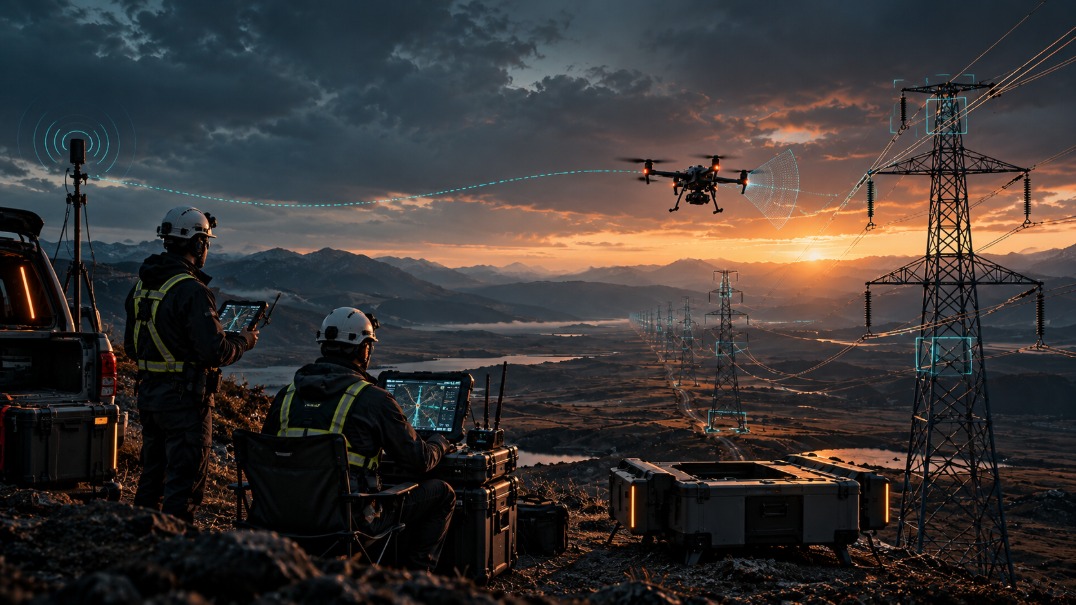
Infrastructure rarely runs beside a convenient access road. Fences, terrain, rivers and sheer distance turn repeated VLOS launches into the bottleneck. A properly authorised BVLOS programme lets you survey extended corridors and revisit them on a consistent schedule.
Is This Course For You?
Built For Professionals Ready To Move Beyond VLOS
You already know commercial drone work. Now you need to plan, specify, assess or approve more complex infrastructure missions, and defend those decisions to clients and regulators.
This Course Is For You If You Are
- An experienced commercial drone pilot ready for more complex work
- A chief pilot or operations manager planning a BVLOS capability
- A UAS programme lead at a utility or infrastructure owner
- An inspection engineer or asset-management professional
- A safety or compliance specialist reviewing BVLOS proposals
- A drone service provider weighing up BVLOS contracts
Learning Outcomes
What You'll Be Able To Do
Six capabilities that connect every decision in a professional BVLOS programme, from the first risk question to the final client proposal.
Assess BVLOS Risk
Understand how ground risk, air risk and your mitigation choices shape what you can realistically propose.
Find The Right Approval Route
Identify which authorisation pathways apply to your operation and the conditions each one brings.
Work Confidently With SORA
Apply the structured risk-assessment thinking that sits behind every credible BVLOS safety case.
Evaluate Enabling Technology
Judge command-and-control links, detect-and-avoid, conspicuity and containment against the risks they need to address.
Plan Infrastructure Corridors
Turn mission segments, crew roles, airspace coordination and contingencies into a workable flight plan.
Make The Commercial Case
Bring organisational readiness, evidence, procurement and programme economics together into a proposal that stands up.

Inside The Course
Seven Modules. One Connected Operational Structure.
Start with the principles, work through risk and technology, then put the field operation, the organisation and the business case together. Each module builds on the last.
What BVLOS Changes
Understand the shift from watching the aircraft yourself to relying on defined systems, clear responsibilities and documented evidence.
The Regulatory Map
See how the US, EU, UK and Canada approach BVLOS, and why the same corridor can need a different approval route depending on where it is.
The Working Language Of Risk
Get fluent in SORA 2.5 and the risk logic used to structure a safety case that holds up to scrutiny.
Technology That Carries The Safety Case
Examine the equipment, sensing and supporting services that have to carry the safety load once you can no longer see the aircraft.
Planning And Flying The Corridor
Bring corridor mission planning, airspace coordination, execution and recordkeeping together into one working operation.
Building The Operating Organisation
Put in place the manuals, crew training, safety management and technical configuration control a BVLOS operation depends on.
The Business Case And Client Conversation
Decide whether to build, buy or partner for BVLOS capability, and get to grips with the costs, procurement and contractual responsibilities that come with each choice.
Applied Learning
Practise The Decisions Behind The Mission
Every module pairs teaching with a practical exercise and a knowledge check. Instead of memorising rules, you'll weigh evidence and make the calls in realistic infrastructure scenarios.
Expect to work through operational value, regulatory routes, risk, technology gaps, corridor planning, organisational procedures and commercial proposals. No dock or authorisation needed to take part.
Course At A Glance
Built To Be Applied
A structured specialist package with practical exercises, scenario-based assessments, explanatory answer keys and a final applied safety-case project.
The Bigger Decision
Flying That Far Is The Easy Part
A credible infrastructure BVLOS proposal needs answers that hold up long after the demonstration flight. This course links flight capability to the approval, organisational and commercial decisions that decide whether a programme actually goes ahead.

Beyond The Online Course
Keep Building After You Finish
Ready to go further? Additional learning and optional practical pathways are available, including instructor-observed field work for professionals who want to extend their training.
Practical training and certification options are separate pathways, subject to availability, eligibility and successful assessment. They are not automatically included in the online course purchase.
Plan Your Next Stage Around Your Role
- Deepen your operational and risk-planning knowledge
- Develop field-based competency with additional practical training
- Explore related infrastructure inspection specialisations
- Check the course page for current enrolment information
Before You Enrol
Frequently Asked Questions
Who Is The Course Designed For?
Experienced commercial drone pilots, chief pilots, operations managers, UAS programme leads, infrastructure inspection professionals, and safety or compliance teams evaluating BVLOS corridor operations.
Do I Need Commercial Drone Experience Before Enrolling?
Yes, commercial flying experience is recommended. You should already be familiar with airspace, visual-line-of-sight rules and basic mission planning. This is not an introductory pilot course.
Does Completing This Course Authorise Me To Fly BVLOS?
No. The course prepares you to understand and plan for the safety, planning and authorisation requirements behind BVLOS operations. Any licences, approvals or operational authorisations must come from the relevant aviation authority.
Which Jurisdictions Are Covered?
The United States, European Union, United Kingdom and Canada, with additional discussion of other regions. Regulatory content reflects a reference date of 11 September 2026, so always check it against the current rules where you operate.
Does The Course Explain SORA?
Yes. SORA 2.5 and risk-based safety-case planning are central to the course.
Does It Cover Practical Mission Planning?
Yes. You'll work through corridor segmentation, operational planning, airspace coordination, crew roles, contingencies and recordkeeping.
How Many Modules Are Included?
Seven modules, followed by a capstone safety-case exercise and implementation-focused guidance.
How Long Should I Allow To Complete The Course?
Plan for around 12–14 hours for the theory and assessments, plus another 4–6 hours for the capstone.
Are There Assessments And Practical Exercises?
Yes. Each module has a knowledge check (72 multiple-choice questions in total) and a practical exercise. The pass mark for each module is 80%.
Better Decisions Make Better Operations
Ready To Build A BVLOS Operation That Holds Up?
Learn how regulation, risk, technology, field procedures and commercial decisions fit together for infrastructure inspection, then put it all into practice with your own capstone safety case.
Specialist training for experienced commercial UAS professionals.