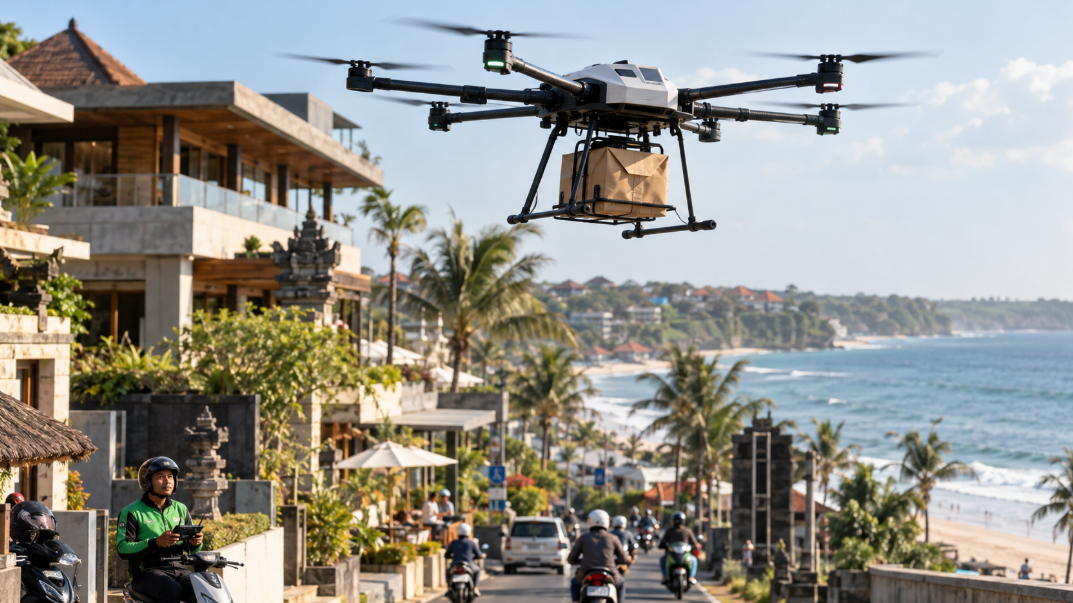
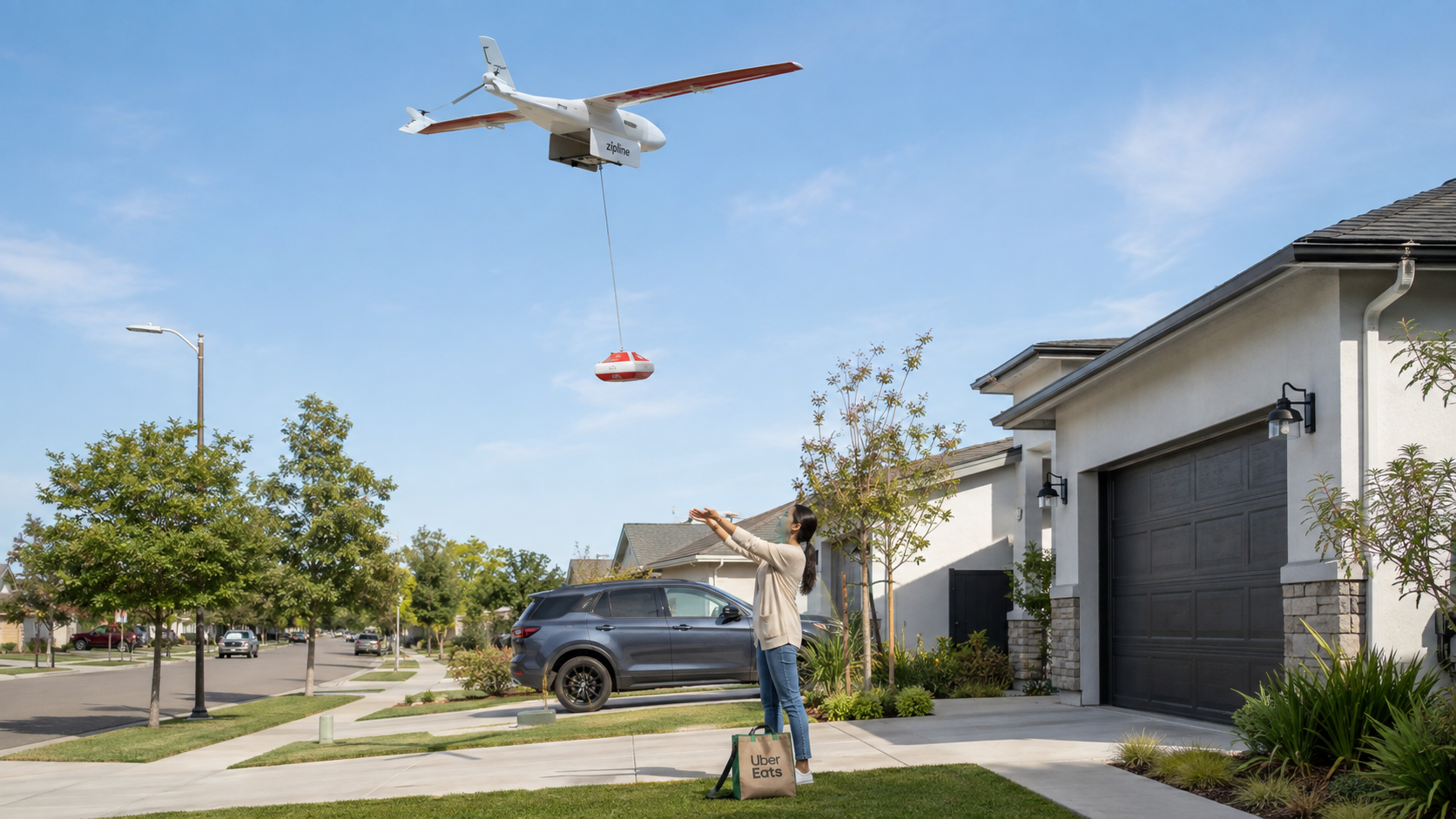
We’ve come a long way from a few thousand demonstration flights over carefully selected suburbs. Drones are becoming a routine part of how meals, groceries, medicine and small retail orders move through American cities.
Uber and Zipline have now put a new scale on the table. Yesterday, the companies announced a strategic partnership to bring Zipline drone delivery into Uber Eats, with the first deployments planned for later this year and expansion targeted across dozens of US cities. Uber is also making a strategic investment in Zipline. And the target: one million drone deliveries per day by the end of 2029.
Taken literally, that pace equals 365 million deliveries a year. Zipline says it has completed more than 2.7 million deliveries in its entire history, moving more than 20 million items and flying over 135 million autonomous miles. At one million deliveries a day, the partnership would equal Zipline’s current cumulative delivery count in about 2.7 days.
The more interesting part of the announcement sits underneath the target. Uber already owns the customer relationship, the ordering interface, merchant connections, payments and a large delivery marketplace. Zipline owns the autonomous aviation system. Put those layers together and drone delivery starts to look less like a separate consumer product and more like another transport mode inside a much larger logistics network.
For you as someone following the drone sector, that changes the questions worth asking. The aircraft still counts. So do range, payload, noise, certification and reliability. Yet commercial scale will also depend on who controls demand, who chooses the delivery mode, how merchants hand orders to autonomous systems and how thousands of aircraft are coordinated above communities.
the next frontier of delivery is above us
— Uber Eats (@UberEats) August 17, 2026
we’ve partnered with @zipline to expand autonomous drone delivery to Uber 👀 https://t.co/d9eAqP1HiQ
Mass Logistics
Zipline currently says it makes a delivery somewhere in its network every 20 seconds. If that cadence ran evenly through a full day, it would work out to about 4,320 deliveries. Reaching one million a day would therefore represent roughly 231 times that illustrative daily pace.
The target also translates to an average of about 41,667 deliveries every hour, 694 every minute and almost 12 every second across the eventual network. Real demand will not arrive evenly through 24 hours, of course. Lunch, dinner, grocery peaks and local operating windows will bunch flights into much busier periods.
Uber brings a demand base large enough to make a number of that size worth discussing. In the second quarter of 2026, the company reported 208 million monthly active platform consumers and 3.867 billion trips. Total gross bookings reached $58.0 billion, up 24% year on year, or 22% on a constant-currency basis.
Delivery alone generated $27.463 billion in gross bookings during the quarter, 26% above the same period in 2025 and 25% higher on a constant-currency basis. Delivery revenue reached $5.245 billion, up 28%, and segment operating income was $1.055 billion, up 38%.
Those numbers give the drone plan context. One million daily flights would still represent only a fraction of Uber’s overall transaction activity. Across the 91 days of the second quarter, Uber averaged roughly 42.5 million trips per day across its businesses. A million drone deliveries would be around 2.4% of that current total trip rate, although the comparison mixes mobility and delivery transactions and should be treated only as a scale reference.
The target is ambitious rather than guaranteed. It asks Zipline to move from millions of cumulative deliveries to hundreds of millions each year, and it asks regulators, merchants, communities and ground infrastructure to accommodate that expansion at the same time.
What Uber And Zipline Each Bring To The Partnership
Uber Brings Customers, Merchants And Order Flow
A drone company can build a highly capable aircraft and still face a difficult commercial problem: finding enough orders, in a tight enough geographic area, at the right times of day to keep the fleet busy. Idle aircraft do not generate delivery revenue.
Uber already has the other side of that equation. Its platform connects consumers with restaurants, grocers and retailers, handles ordering and payment, and dispatches delivery work through an existing network. The Zipline announcement refers to Uber Eats serving millions of customers and hundreds of thousands of small businesses.
That lets drone delivery appear as an option at the point where a customer is already shopping. You do not have to persuade someone to download a specialist aviation app before they can order lunch. They can place the order through Uber Eats, then the network can use Zipline where the order, address and operating conditions fit drone delivery.
Uber describes the broader strategy as a hybrid delivery network combining couriers, sidewalk robots and drones, with the delivery mode matched to the job. That structure is important. A burrito travelling four miles to a suburban house has a different transport problem from six bags of groceries going to a high-rise apartment or a large catering order travelling across town.
Zipline Brings The Aviation And Automation Stack
Zipline is much more than an aircraft supplier in this arrangement. The company has spent roughly a decade building autonomous logistics operations across four continents. According to the company’s current fact sheet, its network serves more than 5,000 hospitals and health facilities. Uber’s partnership announcement says that work contributes to saving more than 12,000 lives each year.
For US home delivery, the most relevant aircraft is Platform 2. It is designed around an eight-pound payload and a 10-mile service radius. Zipline lists a cruise speed of 70 mph and says the aircraft can make a delivery 10 miles away in as little as 10 minutes. The aircraft itself stays high above the delivery point while a smaller delivery unit descends on a tether, allowing the order to be placed precisely in a front yard, back yard, park or another suitable area.
Platform 2 can also fly up to 24 miles one way under its stated configuration. Zipline says its Dropboxes allow businesses to load orders in seconds without specialised packaging or construction, and the system can support hub-and-spoke operations or longer dock-to-dock networks with charging.
Behind the aircraft sits software for flight autonomy, fleet operations and airspace coordination. Zipline calls its onboard autonomy and perception suite FlightIQ. The company has also worked with unmanned aircraft traffic management systems so routes can be coordinated as low-altitude traffic grows.
This division of labour is the core commercial idea. Uber does not have to develop a delivery drone, certify an air carrier and build years of flight operations from zero. Zipline does not have to recreate a national food-delivery marketplace before it can access large order volumes.
The Customer Relationship Is Moving Into Larger Commerce Platforms
Drone delivery spent years being shown to consumers as a separate service: open the drone company’s app, pick from the businesses available inside its service area and place an order. That model still exists, including through Zipline’s own US app. The Uber agreement adds another route to scale by embedding aerial delivery inside a marketplace consumers already use.
You can see similar thinking elsewhere. Wing and Walmart have been building drone delivery around Walmart’s existing retail footprint. In June 2026, Wing said the companies were working toward a network of more than 270 Walmart locations reaching over 40 million Americans by 2027. Seven additional metro areas were named in that expansion: Memphis, New Orleans, Philadelphia, Phoenix, San Diego, the San Francisco Bay Area and Salt Lake City.
Wing said at the time that its total US footprint with Walmart was heading toward nearly 20 markets and that the company had completed well over one million commercial deliveries. Customers can access eligible service through Walmart’s app or website, as well as Wing’s own app.
The future of retail is landing! 📦🪽We’re expanding our partnership with @Walmart to 150 new stores, bringing drone delivery to 40M+ Americans from LA to Miami. Get your essentials in as little as 30 minutes. ✨
— Wing (@Wing) January 11, 2026
Learn more: https://t.co/7HcbC17tfz#Wing #Walmart #Innovation pic.twitter.com/7EhaVhUgcT
DoorDash has followed an even more mixed route. It works with external drone operators, including Wing, Flytrex and Manna, yet in July 2026 it also launched its own DoorDash Air programme after receiving FAA Part 135 certification. DoorDash says it became the eighth drone operator to earn that certificate.
So the trend is not a simple move from vertically integrated drone companies to outsourced aviation. You are seeing commerce platforms assemble several transport modes at once. Some will partner. Some will build in-house systems. Some will do both. The common feature is that the customer increasingly orders through a broad commerce platform, while software decides how the physical delivery gets completed.
The Economics Depend On Sending The Right Orders By Air
Drone delivery becomes much easier to understand commercially when you stop treating every last-mile order as interchangeable.
A small aircraft has strict payload and range limits. Platform 2’s eight-pound payload is well suited to many restaurant meals, medicines, convenience items and small retail purchases. It is not suited to a weekly household grocery shop weighing 40 pounds. A delivery point also needs to be compatible with the aircraft and its delivery mechanism.
Distance creates another useful filter. DoorDash disclosed a revealing statistic when it announced DoorDash Air: more than 20% of its orders in 2025 travelled three to five miles, and those orders took nearly 25% longer on average than shorter deliveries. The company attributed much of that difference to the extra time required to find a courier for mid-range trips.
That is exactly the type of order where an autonomous aircraft can change the dispatch calculation. A drone can travel in a much straighter path than a road vehicle, does not get held at traffic lights and does not have to search for parking. DoorDash reported an average drone delivery time of about 25 minutes in 2025 across its estimates, while Zipline says its aircraft can cover a 10-mile delivery in as little as 10 minutes once the aerial leg is ready to go.
There is also evidence that the new mode can affect demand. DoorDash says some participating merchant locations in its drone partner pilots saw order volume rise by roughly 30%, with that lift continuing across the nine weeks after launch. That figure comes from DoorDash’s own programme, so it should not be treated as a universal outcome. Still, it shows why restaurant and retail platforms are interested in more than the novelty of an aircraft arriving overhead.
Uber’s hybrid approach gives it room to be selective. Dense short trips can remain with couriers where batching and rapid turnover work well. Mid-range lightweight orders may fit a drone. Sidewalk robots may suit short neighbourhood routes where air operations are awkward. Heavy orders, apartments without suitable delivery areas and locations outside approved service zones can stay on the ground.
The commercial test is therefore not whether drones can deliver everything. It is whether the platform can identify enough orders where an aircraft cuts time or cost without creating extra handling that cancels the benefit.
Ground Infrastructure Could Decide Whether The Target Is Reachable
The aircraft receives most of the attention because it is the part customers see. At one million deliveries a day, the quieter work on the ground becomes just as significant.
Orders have to be picked and packed on time. A merchant needs a clean way to transfer an order to the aircraft. Batteries and aircraft need charging, inspection and maintenance. Hubs need enough physical capacity for peak periods. Software has to keep inventory, order status and flight status aligned. Exceptions need a route back to a courier or another mode when weather, airspace or an unsuitable delivery point blocks the drone.
DoorDash has said directly that the harder part of its own drone programme is the infrastructure and integration around the aircraft, including real-time inventory reconciliation and handoff systems that can work at drive-throughs, rooftops and merchant back doors. Zipline has designed its Dropbox system around the same operational problem: how to get an order from a normal business into an autonomous flight without forcing the merchant to build an aviation facility.
Manufacturing capacity also becomes a physical constraint. The Wall Street Journal reported after the Uber announcement that Zipline is doubling its manufacturing capability as it prepares for broader deployment. An order target of one million a day requires aircraft, spare parts, docks, delivery units, batteries and maintenance capacity to grow together.
Zipline entered 2026 with fresh capital for that expansion. In January, the company raised about $600 million at a $7.6 billion valuation. Reuters reported that its US deliveries had been growing by roughly 15% week on week for the preceding seven months.
That funding does not remove the scaling challenge. It does show that Zipline has access to a substantial capital base at the moment it is moving from selected delivery zones toward a much larger national network.
Regulation Is Still Part Of The Scaling Equation
A consumer can experience a drone delivery as a simple button in an app. The operator sits behind a much more demanding aviation process.
The FAA says Part 135 is currently the regulatory route for a drone operator carrying someone else’s property for compensation beyond the pilot’s visual line of sight. Applicants go through the full five-phase air-carrier certification process and also need the relevant exemptions, waivers and airspace approvals for their operation.
Zipline already has significant experience inside that framework. In September 2023, the FAA authorised the company to conduct commercial package deliveries around Salt Lake City beyond visual line of sight without visual observers. That approval built on Zipline’s Part 135 certification and gave the regulator more operational data for future policy.
The US is now trying to replace more of the case-by-case process with a repeatable BVLOS rule. The FAA and TSA proposed a new Part 108 framework in August 2025. The proposal covers low-altitude BVLOS operations, aircraft requirements, operating permits and certificates, detect-and-avoid provisions, strategic deconfliction and third-party unmanned traffic services.
The regulatory process is still active. A Federal Register update published on 14 August 2026 says the FAA and TSA are working on final rules in conjunction. The FAA also updated its package-delivery guidance in July 2026 to say that unmanned traffic management is expected to support multiple BVLOS drones operating in low-altitude airspace below 400 feet as the system develops.
For the Uber-Zipline target, regulation affects the pace at which a successful service in one metro can be reproduced in the next. A predictable framework can reduce the amount of bespoke approval work required for every expansion. Local community engagement, environmental review, airspace characteristics and site-specific operating conditions will still affect individual launches.
Competition Is Moving In The Same Direction From Different Starting Points
Wing And Walmart Are Using Stores As A Ready-Made Network
Wing’s partnership with Walmart shows the value of physical retail density. Walmart stores already hold inventory near customers. Add aircraft, launch infrastructure and software, and those stores can act as local fulfilment points for lightweight urgent orders.
Wing says its drones can fly at speeds up to 60 mph and lower packages to a customer’s yard or driveway by tether, with eligible orders arriving in as little as 30 minutes. Its planned Walmart network is aimed at more than 40 million Americans by 2027. That is a different commercial starting point from Uber Eats, yet the same principle appears: autonomous aviation is being attached to an existing high-volume consumer network.
DoorDash Is Building And Partnering At The Same Time
DoorDash gives you a useful counterexample to the idea that a delivery platform will always outsource aviation. Its new Part 135 certificate lets it operate its own commercial drone service, and the company says it is building the aircraft, ground infrastructure and handoff systems through DoorDash Labs.
At the same time, DoorDash continues to offer partner-operated drone delivery. Its customer support material lists Wing, Flytrex and Manna as partners, with service available in parts of Dallas-Fort Worth and Charlotte. The company says it has already facilitated tens of thousands of drone deliveries and more than 10 billion lifetime orders across its wider marketplace.
Our new @USDOT @FAANews Part 135 certification authorizes DoorDash to operate as an air carrier - no travel plans of your own required. 😉 We'll have more to share later this year on the aircraft, but for now, learn more here: https://t.co/0clEeCFeos
— DoorDash (@DoorDash) July 29, 2026
That suggests the future network could resemble cloud computing more than a single dedicated fleet. A platform may own some capacity, buy some from specialist operators and route orders between several modes according to availability, geography and economics.
One Million Daily Deliveries Would Change Merchant Operations Too
For a restaurant or retailer, drone delivery begins long before the aircraft arrives.
Prep time becomes more visible when the flight itself is only a few minutes. If a restaurant takes 18 minutes to prepare a meal, shaving six minutes from the transport leg cannot turn the entire order into a five-minute experience. Accurate preparation estimates, fast handoff and order readiness become tightly connected to the value of the aircraft.
Packaging also has to fit payload, dimensions and safe transport requirements. Drinks need to survive acceleration and tethered lowering. Hot meals need temperature control. Pharmacies need secure handling. Merchants need a fallback when an item is too heavy, an address has no acceptable drop area or local operating conditions stop a flight.
The advantage for a platform such as Uber is that those exceptions do not have to kill the order. The same marketplace already has ground couriers. A system that can reassign a delivery rather than cancel it is commercially more resilient than a drone-only service.
Merchants may also gain access without individually negotiating with an aviation company. Once the technical integration is built into the marketplace, expansion can become a question of whether the merchant, items and address qualify for service. That is a much easier distribution model than asking thousands of restaurants to manage separate drone contracts and software.
Couriers Are Likely To Work Alongside Drones For A Long Time
One million drone deliveries a day sounds large enough to trigger an obvious labour question. It still sits inside a delivery market with far more varied orders than small autonomous aircraft can cover.
DoorDash’s own explanation of its drone strategy is revealing here. The company sees aircraft as particularly useful for three-to-five-mile orders that take longer to assign, leaving human couriers to handle shorter routes near dense clusters of merchants. The aim is to change which vehicle gets which job rather than push every order into the air.
Uber is describing the same idea through a broader mix of couriers, robots and drones. Human delivery will retain advantages for large loads, apartment buildings, alcohol and age-verified goods, complicated handoffs, locations with restricted air operations and orders that can be efficiently batched.
Over time, courier work could shift in geography and order type. The most useful data will be actual substitution rates after the first Uber-Zipline cities launch: how many drone orders would otherwise have gone to a courier, how many are incremental orders created by faster service, and how many drone attempts fall back to ground delivery.
Speed And Sustainability Claims Need Context
Drone delivery is often promoted as both faster and cleaner than putting a small order in a car. The speed case can be strong on suitable routes. The environmental case depends more heavily on the vehicle being replaced, flight distance, payload, electricity mix and the extra infrastructure used to support the service.
A 2023 Scientific Reports study comparing drones with road transport found that large electric drones could produce lower emissions than diesel trucks in rural delivery scenarios and deliver faster at lower operating cost in the cases modelled. The same study found that drones did not beat electric trucks on emissions in its scenarios, in part because take-off and landing consume substantial energy.
Research published in 2025 on medical logistics reached another useful conclusion: very large time savings can come with cost trade-offs. A Nature Portfolio study modelled potential transit-time reductions of up to 90% with UAV access to all sites, while costs increased by 133% in that scenario. The researchers also modelled very high flight activity, up to 40 movements per hour, to achieve the strongest time savings.
Those studies are not forecasts for Uber Eats. They show why broad claims deserve scrutiny. A lightweight meal flying a straight suburban route has different economics and emissions from a heavy parcel, an electric van already carrying dozens of packages or an aircraft operating into strong headwinds.
The Uber-Zipline network has one useful structural advantage: it can compare modes rather than force every eligible order onto one vehicle type. If the dispatch system has good data on time, cost, range and operating conditions, drones can be concentrated on the routes where their characteristics fit best.
The Bigger Product Is An Automated Delivery Network
A drone is still the most visible piece of this story. Commercially, the larger product is the network around it.
Uber already knows that the customer wants dinner from a particular restaurant, knows the delivery address, handles payment and has an estimate of when the merchant will finish preparing the order. Zipline can add aircraft availability, payload limits, operating radius, weather, airspace status and a suitable delivery point. The dispatch layer can then decide whether the order belongs in the air or on the ground.
At sufficient scale, this structure turns autonomy into a logistics resource rather than a separate shopping destination. You may order from the same app and the physical transport could change from one order to the next without requiring you to understand the underlying fleet.
That is also where the competition between Uber, DoorDash, Walmart, Wing, Zipline and other operators becomes more interesting. Aircraft performance will remain important. The companies that win meaningful volume will also need dense demand, merchant integration, regulatory permissions, reliable handoffs, automated dispatch and enough fleet utilisation to make the capital work.
The one-million-a-day target gives the industry a measurable marker. By the end of 2029, we will be able to judge the partnership against an operating number rather than a vague promise that drone delivery is coming soon.
What To Watch Between Now And 2029
The first question is geographic expansion. Uber’s official announcement says deployments will begin later in 2026 across existing Zipline markets and then target dozens of US cities. Axios and The Wall Street Journal have reported Houston and Dallas among the initial launch markets. The difference between announcing dozens of cities and building dense daily order volume in those cities will be important.
Next comes order eligibility. Watch the percentage of Uber Eats orders that can actually fit the aircraft’s payload, range and delivery-area requirements. A network can cover millions of residents while a much smaller share of their purchases qualifies for air delivery.
Pricing will also reveal a lot. If drone delivery carries a large premium, it may stay concentrated around urgent or novelty purchases. If autonomous operations reduce cost enough to sit near ordinary delivery pricing, repeat usage becomes easier to build. Neither Uber nor Zipline disclosed consumer pricing for the partnership in the launch announcement.
Reliability is another metric to watch closely. Marketing figures around five-to-ten-minute delivery are attractive. Commercial networks are judged on full order time, completion rate, weather availability, failed handoffs and the frequency with which a flight has to be reassigned to a ground courier.
Finally, watch repeat customers rather than first-time trials. Wing says some users of its Walmart service order multiple times per week. DoorDash has reported sustained order-volume growth at some pilot merchant locations. If Uber starts publishing similar retention and frequency data, you will get a much clearer view of whether drone delivery is becoming routine behaviour.
Frequently Asked Questions
When Will Uber Eats Drone Delivery With Zipline Start?
The first Uber Eats deliveries with Zipline are planned to begin later in 2026. Uber and Zipline announced the partnership on 17 August 2026 and said the initial deployments would use existing Zipline markets before expansion into dozens of US cities.
Where Will The Uber And Zipline Service Launch First?
Dallas and Houston have been reported as initial launch markets, although Uber’s official announcement describes the first phase more broadly as existing Zipline markets. Axios and The Wall Street Journal reported the two Texas cities in coverage of the agreement.
How Many Drone Deliveries Are Uber And Zipline Targeting?
Uber and Zipline are targeting one million drone deliveries per day by the end of 2029. That would equal about 365 million deliveries at a full-year daily rate.
How Fast Can A Zipline Delivery Arrive?
Zipline says its Platform 2 system can make a delivery 10 miles away in as little as 10 minutes. The Uber partnership announcement says the US service is intended to deliver items in roughly five to ten minutes, although the complete customer order time will also depend on merchant preparation and handoff.
How Much Can A Zipline Platform 2 Drone Carry?
Zipline lists an eight-pound payload for Platform 2. That capacity covers many meals, medicines and convenience purchases, while heavier grocery and retail orders will still need another delivery mode.
Will Drone Delivery Replace Uber Eats Couriers?
Drone delivery is more likely to take a portion of suitable orders than replace couriers across the platform. Uber is building a mixed network of human couriers, sidewalk robots and drones, and many orders are too heavy, too complex or poorly located for current delivery aircraft.
How Is Commercial Drone Delivery Regulated In The United States?
Commercial BVLOS package delivery currently uses the FAA Part 135 air-carrier framework together with the required exemptions, waivers and operating approvals. The FAA and TSA are also working toward final rules for a new Part 108 framework intended to make routine BVLOS operations more repeatable at scale.
How Does The Uber And Zipline Partnership Compare With Wing And Walmart?
Both models connect specialist drone operations to an existing high-volume commerce network, although their starting points differ. Wing and Walmart are building around Walmart stores and aim to exceed 270 drone-delivery locations reaching more than 40 million Americans by 2027, while Uber is connecting Zipline to a marketplace spanning restaurants and other local merchants.
Is One Million Drone Deliveries Per Day Realistic?
It is technically conceivable, although reaching it would require a very large increase in fleet capacity, operating sites, eligible merchants, customer usage and approved service areas. Zipline’s current cumulative total is more than 2.7 million deliveries, so the 2029 target represents a major step in operating scale rather than an extension of today’s volume.