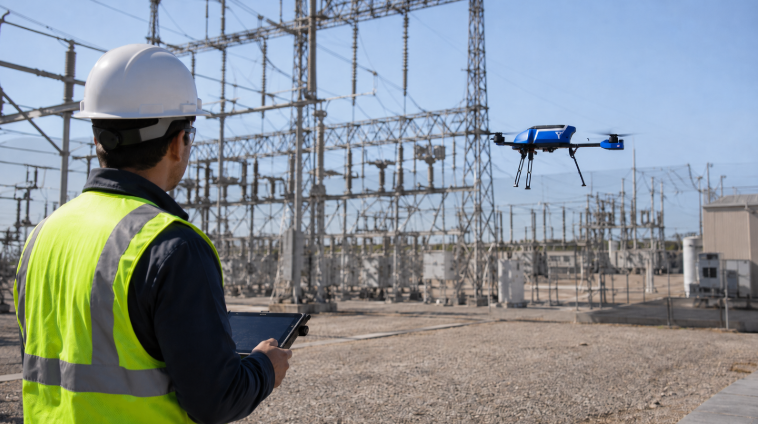
drone education
Flying confidently is only one part of becoming a commercial drone pilot. The next step is learning how to plan a job, select the right sensor, capture reliable data and deliver work that a client can use.
That's why clients are looking into certifications of contractors before hadnding them their projects. And you get this from a professional and recognized UAV academy.
Drone pilot training connects aviation knowledge with real applications such as surveying, thermography, infrastructure inspection, aerial photography and videography. So for people searching for a drone pro academy, it's not just a matter of, “Will I learn to fly?” Can the training actually help you perform a specific type of work well?
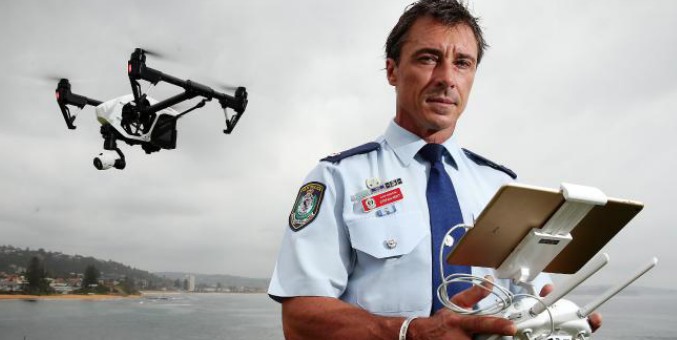
What should a professional drone academy teach?
A good academy should teach more than aircraft controls. It should help a pilot understand the complete workflow behind a commercial assignment, from the first conversation with a client to the final handover.
Consider a simple inspection flight. The drone may be airborne for less than an hour, but the job begins much earlier. Someone must define the inspection objective, assess the site, plan the mission, choose the payload, confirm the operating conditions and decide how the data will be organised. After landing, the pilot still needs to review the material, identify gaps and prepare a useful output.
That wider process is what separates casual flying from professional practice. A camera in the air can collect thousands of images. It takes training to make sure those images are sharp, correctly exposed, consistently positioned and suitable for analysis.
| Basic drone lessons | Professional drone training |
|---|---|
| Focuses mainly on controlling the aircraft | Connects flight skills to a defined commercial application |
| Introduces general camera operation | Explains sensor settings, limitations and data-quality requirements |
| Practises individual manoeuvres | Builds repeatable mission-planning and field-execution workflows |
| Ends when the drone lands | Continues through quality assurance, processing and delivery |
| Measures whether you can fly | Develops the knowledge needed to complete a specific type of job |
A useful way to think about it is this: a licence may allow you to operate, but specialist knowledge helps you decide what to capture, how to capture it and whether the result is fit for purpose.
Build the foundation before choosing a specialisation
Commercial drone training works best when it follows a logical sequence. Start with the legal and operational basics. Then move into the technical field where you want to build experience.
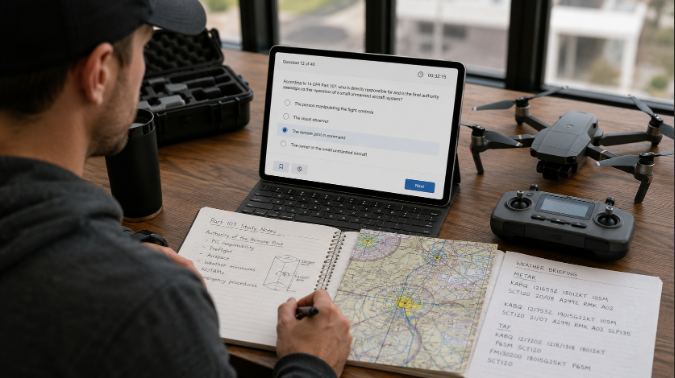
In the United States, pilots planning to fly for work generally begin by preparing for the FAA Part 107 knowledge test. ABJ Academy’s Part 107 Preparatory Course covers subjects such as regulations, airspace, weather, emergency procedures, decision-making and aircraft performance.
Theory matters, but so does familiarity with operating decisions. A commercial drone simulator can help learners practise different scenarios before placing an aircraft, payload or people at risk. It is particularly useful when you are developing control discipline, testing procedures or learning how conditions affect a flight.
Pilots outside the United States should follow the licensing or certification requirements that apply in their own country. A training course does not replace legal authorisation. It supports the knowledge and capability you need once the regulatory foundation is in place.
Commercial drone training pathways
There is no single course that prepares every pilot for every assignment. Surveying, thermal inspection and aerial filmmaking may all use drones, but they require different sensors, capture methods and deliverables.
The most efficient approach is to choose a pathway based on the work you want to perform. The options below show how ABJ Academy’s specialist courses connect to real operational goals.
Drone surveying and 3D modelling
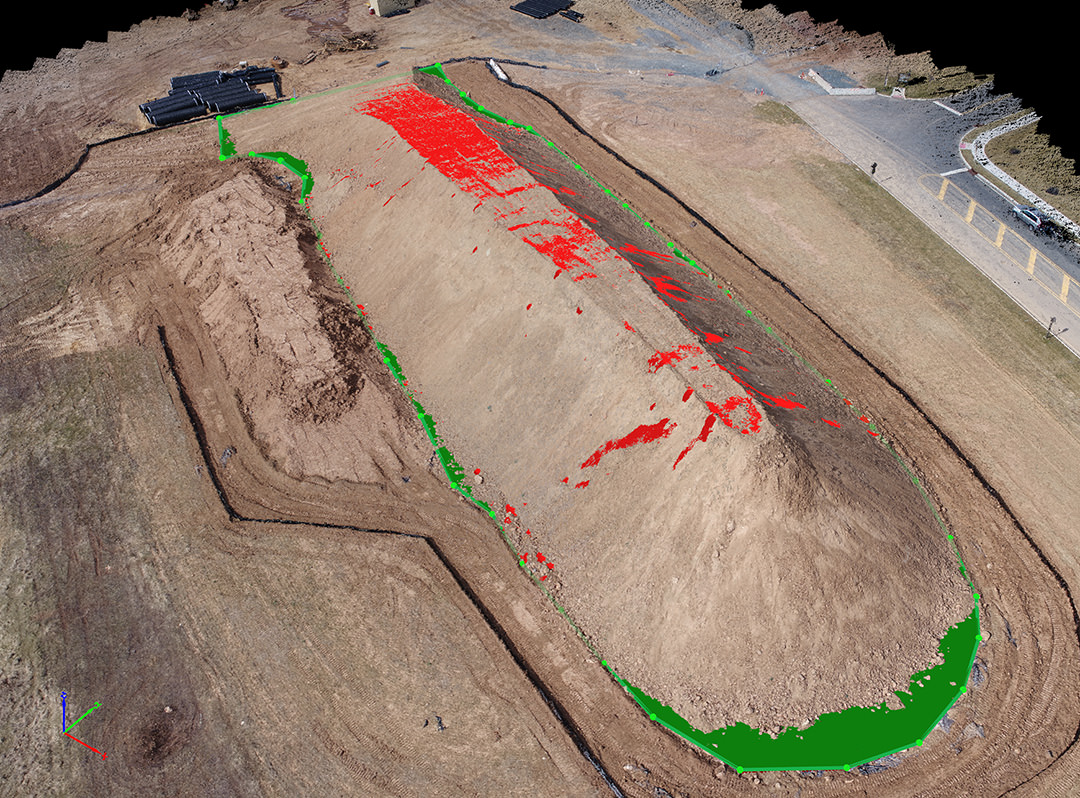
Survey work depends on consistency. Flight height, overlap, camera angle, ground conditions and processing choices can all affect the final map or model.
The Drone Surveying and 3D Modelling Course introduces mapping, photogrammetry, data capture and the creation of 2.5D and 3D outputs. It is a suitable route for pilots interested in construction, land assessment, stockpile measurement, infrastructure documentation and site progress work.
Drone thermography
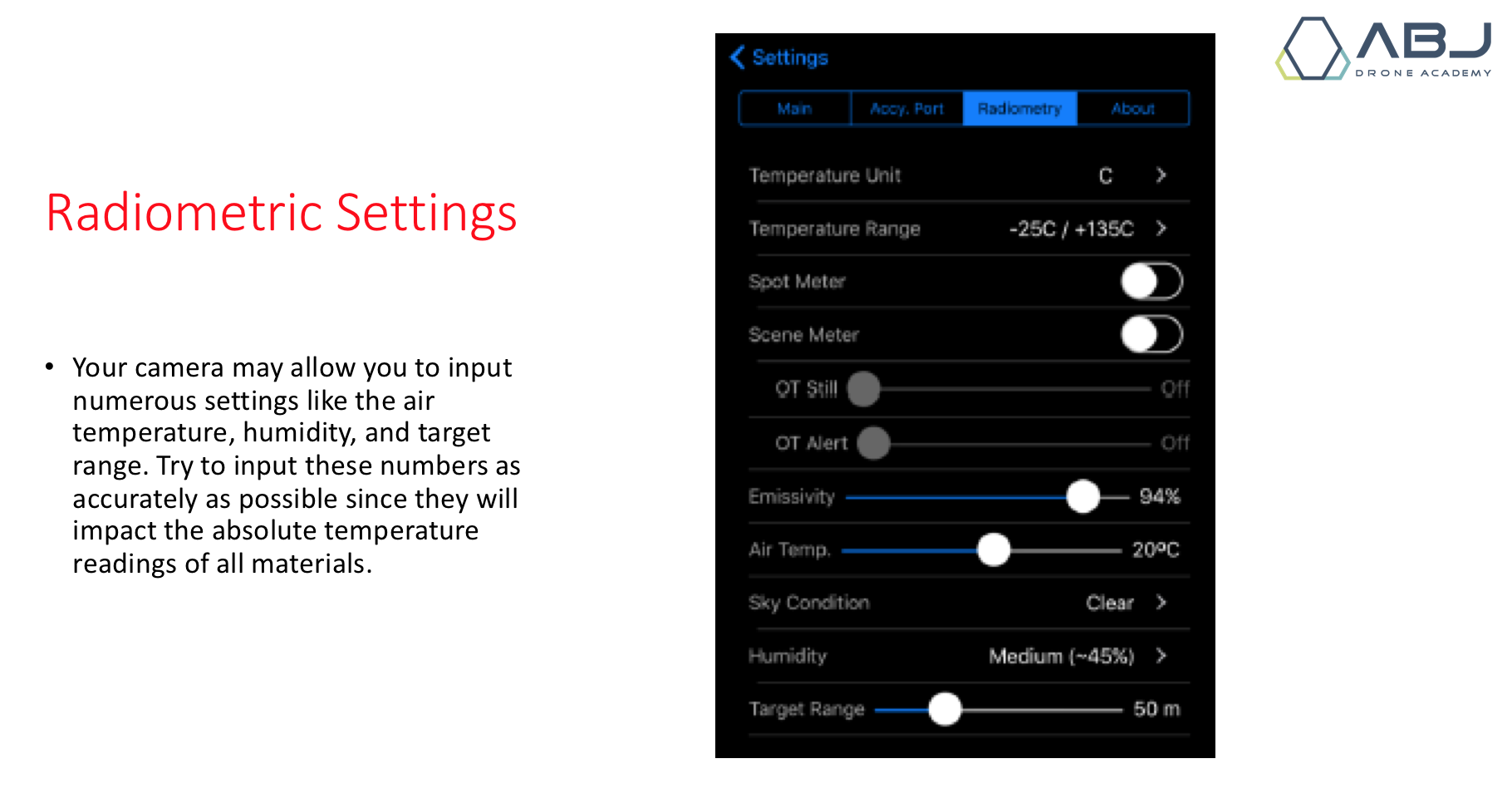
Thermal cameras do not simply show “hot” and “cold.” Reliable interpretation depends on infrared science, camera settings, environmental conditions and an understanding of the target material.
Drone Thermography Level 1 introduces thermal science, camera operation, image interpretation and inspection applications. Pilots who already understand the fundamentals can continue to Drone Thermography Level 2 for more advanced theory, software, inspection techniques and diagnosis.
Multispectral imaging
A multispectral sensor records information beyond the visible colours captured by a standard camera. The value lies in knowing how to plan the mission, collect comparable data and connect the output to an agricultural or environmental question.
The Drone Multispectral Imaging Course is designed for pilots who want to understand this specialised form of data capture and its applications.
Cell-tower inspection
Telecommunications work demands controlled positioning, complete visual coverage and careful documentation. Missing one side of a component or capturing it at the wrong angle can leave an inspection record incomplete.
ABJ Academy’s Cell Tower Inspection Course provides a specialist pathway for pilots who want to understand the requirements of telecoms inspection work.
Professional drone photography
A technically safe flight can still produce weak images. Commercial photography requires deliberate control of exposure, motion, composition, perspective, file formats and post-production.
The Drone Photography Training Course is suited to pilots who want to improve image quality and prepare more consistent material for property, tourism, marketing, events and editorial assignments.
Professional drone videography
Smooth movement is only the beginning. A client-ready video also needs visual continuity, useful shot variety, controlled pacing, clean editing and delivery in the correct format.
The Drone Videography Training Course helps experienced pilots develop the planning, capture and production skills needed for professional aerial video.
Non-destructive testing knowledge
Industrial inspection often involves more than one method. Understanding the wider non-destructive testing landscape can help a drone operator communicate with engineers, inspectors and asset owners more effectively.
Pilots moving toward technical inspection can explore NDT Techniques Level 1 and continue to NDT Techniques Level 2 as their knowledge develops.
Drone instructor development
Knowing how to perform a task is different from knowing how to teach it. Instructors need a structured way to explain procedures, assess learners and reinforce safe operating habits.
The Drone Instructor Course is intended for operators who want to develop their ability to train others. Candidates should review the course page for the current online and practical requirements.
How to choose the right drone course
Course selection should begin with the deliverable, not the aircraft. Buying a thermal drone does not automatically make someone a thermographer. Owning a high-resolution camera does not automatically produce survey-grade data or polished commercial imagery.
Before enrolling, work through these five questions.
- What work do you want to perform?
Define the application clearly: inspection, mapping, agriculture, photography, video, instruction or another specialist field. - What must the client receive?
A folder of images, a thermal report, an orthomosaic, a 3D model and an edited video are very different deliverables. - What knowledge do you already have?
Separate your aviation experience from your sensor, software, inspection and reporting experience. - What equipment will the work require?
Check payload compatibility, camera capability, positioning accuracy, processing needs and any site-specific requirements. - How will you practise after the course?
Plan small, lawful exercises that help you build a portfolio and repeat the workflow before taking on a demanding client assignment.
This approach prevents a common mistake: collecting certificates without building a coherent skill set. A stronger profile tells a clear story. For example, a pilot may combine regulatory knowledge, thermography training and solar-inspection practice. Another may pair surveying knowledge with photogrammetry software and construction-site experience.
Both are commercial pilots, but their value comes from different specialisations.
The skills clients expect from a commercial drone pilot
Clients rarely hire a pilot merely to put a drone in the air. They hire someone to solve a problem, reduce uncertainty or document an asset more efficiently.
That changes what “good performance” looks like. The pilot must understand the requested outcome and protect the quality of the data throughout the job.
- Clear scoping: confirming what is included, what is excluded and what the final delivery should contain.
- Mission planning: matching flight paths, altitude, speed, overlap, angles and timing to the assignment.
- Sensor awareness: knowing what a camera can measure, what can distort the result and which settings matter.
- Field quality assurance: checking images and data before leaving the site rather than discovering gaps later.
- Organised records: naming, sorting and linking files to the correct asset, location or inspection point.
- Professional delivery: providing the agreed format with enough context for the client to understand and use it.
These habits are transferable. A survey pilot and a videographer may use different workflows, yet both need preparation, consistency and quality control.
Who can benefit from a drone pilot academy?
Specialist training is not only for new pilots. It can also help experienced operators move into a new sector, give inspectors a better understanding of aerial data collection, or support organisations that are developing an internal drone programme.
New commercial pilots
Build a structured foundation before investing heavily in specialist equipment or advertising services you are not yet ready to deliver.
Experienced drone operators
Add a technical specialisation such as thermography, surveying, multispectral imaging or infrastructure inspection.
Engineers and inspectors
Learn how drone-based collection fits into a wider inspection, measurement or asset-management process.
Creative professionals
Strengthen aerial photography and video workflows so the finished material meets a clear creative and technical brief.
Companies and public organisations
Create a common knowledge base for team members who need to operate safely and produce consistent outputs.
Colleges and training providers
Develop structured learning pathways that connect aviation basics with industry applications and practical exercises.
Can commercial drone training work online?
Many important parts of drone education can be taught online. Regulations, infrared science, photogrammetry principles, mission planning, sensor settings, inspection theory and post-production workflows all benefit from structured lessons that learners can revisit.
Online study is especially useful when you already fly and need to understand a new application. It allows you to learn the vocabulary, review examples and prepare a field workflow before practising with equipment.
Practical experience still matters. Reading about image overlap is not the same as planning a mapping mission. Studying emissivity is not the same as seeing how weather and viewing angle affect thermal data in the field. The strongest route combines theory with lawful practice, careful review and feedback.
ABJ Academy’s online drone course catalogue lets pilots compare foundational and specialist options in one place. Those planning to take several courses can also review the ABJ Drone Academy Membership before choosing an enrolment route.
Why build your pathway with ABJ Drone Academy?
ABJ Academy is built around the idea that drone education should connect directly to the work pilots want to perform. The catalogue moves from regulatory preparation and simulator practice into mapping, thermal imaging, telecommunications, creative production, NDT knowledge and instructor development.
That range makes it possible to create a pathway rather than select isolated courses at random. A learner can begin with the operating foundation, add one specialist area and then continue into more advanced material as experience grows.
The goal is not to claim that one certificate makes someone an expert. Real capability develops through study, field practice, honest review and repeated application. Training gives that process direction. It helps you understand what good work requires before a client is depending on the result.
Start with the job you want to do. Then choose the licence preparation, technical course and practical experience that support that outcome. This is a more useful route than collecting broad drone knowledge with no clear application.
Professional drone academy FAQs
What is a professional drone academy?
A professional drone academy teaches the operational and technical skills needed for commercial drone work. Training may include regulatory preparation, mission planning, sensor operation, mapping, inspection, photography, video, data quality and professional delivery. The exact subjects should match the type of work a learner wants to perform.
Is ABJ Academy a drone pro academy?
Yes, ABJ Academy provides professional and specialist drone training for commercial pilots. Its course pathways include Part 107 preparation, drone surveying and 3D modelling, thermography, multispectral imaging, cell-tower inspection, photography, videography, NDT knowledge and instructor development.
Do I need a drone licence before taking commercial drone training?
No, you do not always need a licence before beginning a training course. Some foundational courses are designed to help you prepare for the relevant examination, while many specialist courses can be studied before you begin offering services. You must still obtain any legal authorisation required in the country where you plan to operate.
Which drone course should I take after Part 107?
The best course after Part 107 depends on the commercial service you want to provide. Choose surveying and 3D modelling for mapping work, thermography for thermal inspections, photography or videography for creative assignments, multispectral imaging for specialised agricultural data, or cell-tower training for telecommunications inspections.
Can I complete professional drone training online?
Yes, you can complete many important parts of professional drone training online. Theory-based subjects such as regulations, thermal science, photogrammetry, sensor operation, inspection methods and post-production are well suited to online learning. You should then reinforce the lessons through lawful, supervised or self-directed practical work appropriate to your experience.
What is the best drone course for inspection work?
Drone Thermography Level 1 is a practical starting point for pilots interested in thermal inspection work. The right choice still depends on the asset and inspection method. Cell-tower inspection, surveying and NDT courses may be more relevant for other technical applications.
Can a beginner join a drone pilot academy?
Yes, a beginner can join a drone pilot academy by starting with a foundational course. New learners should build regulatory knowledge, basic flight confidence and safe operating habits before moving into advanced payloads or complex commercial assignments.
Does completing a commercial drone course guarantee paid work?
No, completing a commercial drone course does not guarantee paid work. A course can strengthen your knowledge and provide a clearer route into a specialisation, but clients may also look for legal operating credentials, insurance, equipment, field experience, sample work, reporting ability and knowledge of their industry.
How do I choose between individual courses and academy membership?
Choose an individual course when you have one immediate learning goal, and review membership when you plan to follow several training pathways. Compare the current course access, support, pricing and terms on the relevant ABJ Academy pages before enrolling.
Turn drone flying into a focused professional skill
Choose the work you want to perform, identify the knowledge it requires and build your training path from there. Explore ABJ Academy courses in commercial operations, surveying, thermography, inspections, imaging and instruction.