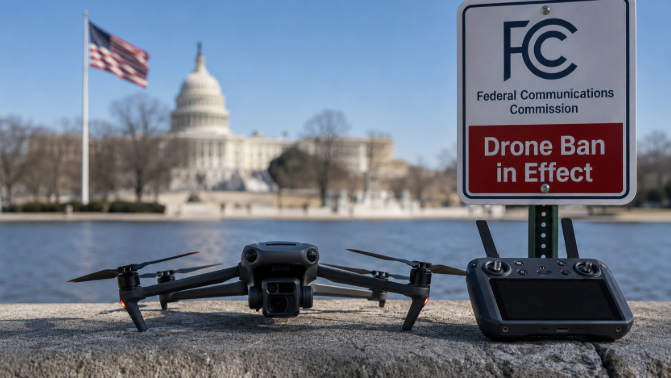
If you fly a drone for work, hobby, or anything in between, your world shifted the moment the Federal Communications Commission added all foreign-produced uncrewed aircraft systems (UAS) and UAS critical components to its Covered List. The decision, issued by the Public Safety and Homeland Security Bureau, blocked DJI, Autel Robotics, and every other non-U.S. drone manufacturer from receiving the equipment authorizations they need to legally sell new wireless gear in America.
The ripple effects have hit harder and faster than most people in the industry expected. Police departments are grounding fleets. Farmers are stockpiling spare parts. Small business operators are quietly closing shop. And drone makers from Shenzhen to Silicon Valley are scrambling to figure out what comes next.
So if you’ve been wondering what this all actually means for your wallet, your work, and your weekend flying habit, this guide walks you through everything you need to know.
How the Ban Actually Came Together
To understand the fallout, you first need to understand how the rules stacked up.
The foundation was laid years earlier with the Secure Equipment Act of 2021, which gave the FCC the authority to refuse new equipment authorizations to companies on its Covered List. That list originally targeted telecom gear from companies like Huawei and ZTE. The drone industry only got pulled in later, when Congress passed Section 1709 of the FY2025 National Defense Authorization Act (Public Law 118-159), signed into law on December 22, 2024.
Section 1709 specifically named Shenzhen Da-Jiang Innovations (DJI) and Autel Robotics and required “an appropriate national security agency” to determine within one year whether their gear posed “an unacceptable risk to the national security of the United States.” If no agency completed that review by the deadline, the equipment would be automatically added to the Covered List.
No agency completed the review. So when the clock ran out, the FCC’s Public Safety and Homeland Security Bureau acted, and it acted much more broadly than the statute strictly required.
What the Covered List Actually Does
Once your gear lands on the Covered List, 47 CFR 2.903 prohibits it from obtaining new equipment authorizations under FCC rules. Since drones rely on certified radio frequency transmitters under 47 CFR Part 15 to communicate with their controllers, no authorization means no legal sale of new models in the U.S. market.
It does not mean your existing drone is grounded. Drones already in service remain flyable, and the FAA has not issued any retroactive grounding order. No remote disablement, no surprise lockout, no automatic ban on operations. The restriction targets the future supply, not the existing fleet.
The Two-Track Restriction
The FCC’s December 22 action created two parallel sets of rules.
The first track covers every foreign-made drone and every “UAS critical component” produced outside the United States. The list of critical components is broad and includes autopilots, controllers, cameras, batteries, and motors. Final assembly happening inside the U.S. does not automatically exempt a product if the components were built abroad.
The second track is reserved for the Section 1709 entities, meaning DJI, Autel, and any subsidiary, affiliate, partner, joint venture, or company with a technology-sharing or licensing agreement with them. For these two manufacturers, the prohibition extends beyond just drone production and includes any attempt to set up production inside the United States. They cannot sidestep the ban by opening an Ohio factory or partnering with a U.S. manufacturer. The door is shut by statute, not by FCC discretion.
Two Executive Orders sit on top of all this: Restoring American Airspace Sovereignty and Unleashing American Drone Dominance, both of which the FCC cited when issuing its public notice.
The Direct Hit to American Drone Businesses
Now for the part that actually matters to you: what does this do to people running real businesses with real customers?
A survey of 8,056 active drone operators shortly after the ban took effect had some brutal findings. Nearly one in four operators said they planned to shut down their drone business outright. The agriculture sector was hit hardest, with nearly one-third of operators planning to close. And here is the stat that should give you pause: 87% of current drone operators learned to fly on a DJI drone. The training pipeline for the entire American drone industry runs through a manufacturer that can no longer sell new models here.
DJI itself has been transparent about the financial damage. In a petition filed by former FCC enforcer Travis LeBlanc, the company estimated it stands to lose roughly $1.5 billion in U.S. revenue, with 25 planned product launches frozen. That breaks down to about $700 million from FCC authorizations that were set aside for 14 existing products, and another $860 million from the 25 new drone and non-drone launches it cannot bring to market. The non-drone piece matters too because DJI also makes Osmo cameras, Ronin gimbals, and Pocket stabilizers that fall under the same prohibition.
Read the petition here:
Public Safety Agencies Caught in the Middle
If you work in law enforcement, fire, or emergency response, you are probably already feeling this. About 90% of first responder agencies use DJI equipment, according to industry estimates, and roughly 70% to 90% of public safety drone programs run on DJI or Autel hardware.
A New Jersey UAS detective put it bluntly in an interview about the ban’s impact: “You’re not only affecting police and fire. You’re affecting a lot of other industries out there: utilities, construction, agriculture.”
The math gets uglier when you look at replacement costs. DJI’s commercial-grade drones typically sell for under $5,000. American-made alternatives from Skydio, Teledyne FLIR SIRAS, Freefly, Inspired Flight, and Anzu Robotics typically cost between $10,000 and $30,000 per unit. For a department running 20 drones, that gap can swing a fleet replacement from a $100,000 line item to a $600,000 capital project.
Agriculture, Inspection, and Real Estate
Outside of public safety, the commercial side of the industry is where the bleeding really shows up. The military accounts for about 49% of the North American drone market. Law enforcement and public safety add another 15%. The remaining 36% is made up of blue-collar professionals, small businesses, and contractors who use drones as tools rather than as a business in themselves.
That 36% is enormous. It includes roofers running thermal scans for insurance claims, surveyors mapping construction sites, agricultural operators using NDVI imagery to spot pest infestations and irrigation problems, utility crews inspecting power lines and substations, and real estate photographers shooting listing videos for homes in your neighborhood. According to recent surveys, two in three businesses say they would shut down if DJI drones were banned or restricted.
A New Jersey farmer named Russell Hedrick summarized the problem in one sentence: “The US drones are not as good as the DJI ones but cost twice as much.”
Small Operators and Solo Pilots
If you are a Part 107 pilot who built a side business around aerial photography, real estate listings, inspections, or mapping, the economics start breaking when equipment costs triple. Utilities and infrastructure inspection users were the most worried operators, followed by public safety, photography and videography, and real estate. These are the people who relied on the likes of the DJI Mavic 3 Pro or Mini series to keep startup costs manageable.
Many solo operators are now treating their current DJI fleet as a depreciating asset they cannot replace. Some are buying extra batteries, propellers, and even spare drones while they can still find them on retail shelves. Others are simply running their gear into the ground and planning to exit the business when their last drone fails.
State-Level Bans Adding to the Pile
The federal action is not happening in a vacuum. State legislatures across the country have been passing their own drone restrictions, and the pile-on has gotten heavy.
Florida’s $200 Million Lesson
Florida is the most cited example, and the data behind that example is staggering. Under Senate Bill 44 (2021), now codified as Section 934.50 of Florida Statutes, state and local government agencies, including law enforcement and fire departments, are restricted to drones from a state-approved list. DJI and Autel are excluded.
The result, by the numbers: Florida were forced to ground roughly $200 million in functional public safety drones citing Chinese espionage threats, then provided only $25 million in grant funding for replacements. Some of those replacement drones have reportedly caught fire and fallen from the sky. Multiple agencies shut down their drone programs entirely because they could not afford compliant replacements or because the approved models could not perform the same missions.
The States Following Florida’s Playbook
Florida was the trailhead. A growing list of states have either passed similar restrictions or have bills in progress:
Arkansas enacted a four-year phase-out of Chinese drones for government use beginning in October 2023.
Tennessee, Texas, Nevada, and Utah have implemented various restrictions on Chinese drones for government use. Connecticut passed emergency legislation barring state agencies and municipalities from purchasing prohibited drones after October 1, 2026, and from using them after October 1, 2028.
Bills have been introduced or are under active consideration in California, New York, Georgia, North Carolina, Pennsylvania, Kansas, Missouri, and Arizona. If your state is not on either list yet, there is a reasonable chance it will be soon.
The federal companion piece is the American Security Drone Act of 2023, passed as part of the FY2024 NDAA, which prohibits the federal government from purchasing or using drones from countries designated as security threats. State laws layer on top of this federal framework, often using similar language but applying it to state and local procurement.
The American Alternatives Stepping Up
If foreign drones are being squeezed out, the obvious question is who fills the gap. The answer is a small but growing roster of U.S.-based manufacturers, most of which appear on the Department of Defense’s Blue UAS Cleared List.
Skydio sits at the front of the pack with its X10 and X10D platforms. The company built its reputation on AI-powered autonomous flight and visual-based navigation that works in GPS-denied environments. Its hardware is engineered specifically for critical infrastructure and public safety work.
BRINC Drones focuses entirely on public safety, with its Lemur 2 tactical drone deployed by over 500 agencies across all 50 states. It features two-way communication that lets negotiators talk to people inside structures, glass-breaking capability, and indoor flight.
Freefly Systems makes the Alta X heavy-lift platform for industrial mapping and high-end cinema. Anzu Robotics took a different path: founded by drone industry veteran Randall Warnas, Anzu licenses DJI’s Mavic 3 platform and rebuilds it as a U.S.-compliant product with security modifications, then sells it at a fraction of Skydio or BRINC pricing.
>>> Top 10 Companies Building the Best U.S. Drones
Why Cost Remains the Sticking Point
Here is the uncomfortable reality about American alternatives: they exist, they work, and they are not yet ready to substitute one-for-one at the scale and price point operators need. American manufacturers collectively hold approximately 13% of global market share, concentrated in defense and specialized enterprise applications. DJI ships millions of drones annually. Most American manufacturers ship in the tens of thousands.
That capacity gap matters because production volume drives prices down through scale. Until the American alternatives can ship at DJI’s scale, the price gap between sub-$5,000 DJI gear and $10,000-plus American gear will persist. And that price gap is exactly what keeps small businesses, public safety agencies, and agricultural operators from upgrading on the schedule the law assumes.
>>> The US Consumer Drone Market After DJI
The Blue UAS List and What It Means
If you work with federal contracts or sensitive infrastructure, you have probably heard of the Blue UAS Cleared List. It is maintained by the Defense Innovation Unit and identifies drones that meet NDAA compliance for federal procurement.
Being on the Blue UAS list does not automatically exempt a drone from FCC restrictions, but the FCC did grant conditional approval to several non-Chinese manufacturers in March, including SiFly, Mobilicom, ScoutDI, and Verge, willing to onshore covered components. That pathway is closed to Autel and DJI by statute under Section 1709.
For most commercial operators, drones on the Blue UAS list are the safest bet for long-term compliance, whether you are bidding for federal work or just trying to avoid future state-level restrictions.
>>> The Winners and Losers of the Blue UAS List [UPDATE]
The Legal Pushback
DJI and Autel have not gone quietly. Both companies are challenging the FCC action through every channel available to them.
DJI filed a lawsuit in the Ninth Circuit Court of Appeals on February 20, 2026, calling the FCC’s action procedurally flawed and unconstitutional. The case is active and no resolution is in sight.
Autel filed a separate reply with the FCC in ET Docket 26-23, arguing that the agency added the company to the Covered List on the basis of classified material Autel was never allowed to see and technical complaints that were originally aimed at DJI. Autel’s reply walks through sworn declarations describing how the company handles flight data and notes that flight data is stored locally by default, drone communications use AES-128 or AES-256 encryption, and no third party has been authorized to access drone operation software or customer accounts.
The FCC began hearing public appeals on its decision in early May, and public comments have flooded in. Operators across the country are arguing that affordable U.S.-made alternatives do not yet exist at the technology, software, and price point needed to replace existing fleets.
There has been one small concession. In Public Notice DA 26-454, the FCC extended its waiver allowing certain DJI drones to receive software updates in the U.S. from January 1, 2027 to at least January 1, 2029. If you own a DJI drone today, you can keep receiving security and bug-fix patches for a while longer. Foreign internet routers got the same extension.
Economic Ripple Effects Across the Country
Zoom out, and the numbers get bigger.
McKinsey has estimated that commercial drone use contributes roughly $31 billion to $46 billion per year to U.S. GDP through productivity gains in inspection, surveying, logistics, and infrastructure operations.
Then there is the value of what drones replace. They displaced helicopters and small aircraft for inspection and survey work. Helicopters burn Jet A fuel at high rates. Fixed-wing piston aircraft burn avgas. Drones do the same jobs at a fraction of the cost, with lower fuel use and lower emissions.
The global drone market is expected to grow from $69 billion to $147.8 billion over the next decade. The question is not whether drones will continue to scale globally. The question is whether the U.S. captures its share of that growth or hands it to other markets that face fewer procurement restrictions.
DJI’s hometown of Beijing actually banned the company from selling drones inside its city limits as of May 1, with new regulations covering the sale, rental, and transport of drones into China’s capital. So DJI now cannot sell new products in either Washington or Beijing, even as the company continues to dominate global market share with 54% to 80% of the consumer segment depending on how you measure it.
What This Means for You Going Forward
So where does this leave you? It depends on which side of the fence you sit on.
If you own a DJI or Autel drone, you can keep flying it. There is no grounding order, and the software waiver extension means you will continue getting updates for the foreseeable future. Stock up on spare batteries, propellers, and other parts now, because the supply chain for replacement components will tighten over time.
If you operate commercially, start mapping out a transition plan. That does not mean replacing your fleet tomorrow. It means building a budget for the day when your current drones become unrepairable and choosing a replacement path that aligns with both federal and state restrictions. If you bid for any government work, the Blue UAS Cleared List should be your reference point.
If you are a hobbyist or recreational flyer, the impact is real but smaller. You will see fewer new DJI consumer drones on shelves over time. Inventory of existing models will shrink. Used-market prices may rise as supply tightens. Your existing gear keeps working, but your next purchase will probably come from a different manufacturer.
If you are running a public safety drone program, the calculus is the toughest. Federal funding pathways increasingly favor NDAA-compliant equipment. State law may already restrict you from buying DJI or Autel. The Drones for First Responders Act, passed in June 2025, created some funding pathways for compliant replacements, but the per-unit cost difference still strains most local budgets.
The next year or two will determine whether the U.S. drone industry adapts smoothly to a domestic-first procurement model or whether the productivity losses from forced fleet replacement outweigh the security benefits the legislation was designed to achieve. Watch the Ninth Circuit case. Watch the FAA’s Part 108 rulemaking on beyond-visual-line-of-sight operations. And watch your own state legislature.
Frequently Asked Questions
Can You Still Fly Your DJI or Autel Drone in the United States?
Yes, you can still fly your existing DJI or Autel drone legally in the U.S. The FCC’s action blocks new equipment authorizations for foreign-made drones, but it does not retroactively ground drones already in operation. There is no FAA grounding order, no remote disablement, and no automatic ban on operations. You may, however, face challenges sourcing replacement parts and getting repair service over time as supply chains tighten.
What Is the FCC’s Covered List?
The FCC’s Covered List is a national security designation maintained under the Secure and Trusted Communications Networks Act of 2019 that identifies communications equipment and services deemed to pose an unacceptable risk to U.S. national security. Equipment on the list cannot receive new FCC equipment authorizations, which are required for the importation, marketing, and sale of most wireless gear in the United States. The list previously focused on telecom equipment from companies like Huawei and ZTE before expanding to cover foreign-made drones in December 2025.
What Is Section 1709 of the FY2025 NDAA?
Section 1709 is the provision of the FY2025 National Defense Authorization Act (Public Law 118-159) titled “Analysis of Certain Unmanned Aircraft Systems Entities” that specifically named DJI and Autel Robotics and required a national security agency to review their gear within one year. When no review was completed by the deadline, the equipment was added to the FCC Covered List automatically. Section 1709 also bars these companies from setting up domestic U.S. production through partnerships, joint ventures, or technology-sharing agreements.
How Much Does a U.S.-Made Drone Cost Compared to a DJI?
U.S.-made drones typically cost two to six times more than comparable DJI models. American alternatives from Skydio, Teledyne FLIR SIRAS, Freefly, Inspired Flight, and Anzu Robotics generally run $10,000 to $30,000 per unit, while DJI’s comparable commercial drones sell for under $5,000. Anzu Robotics offers the smallest price gap because it licenses DJI’s Mavic 3 platform and rebuilds it as a U.S.-compliant product.
Which U.S. States Have Banned Chinese Drones?
Florida, Arkansas, Mississippi, Tennessee, Texas, Nevada, and Utah have all passed restrictions on Chinese drones for state and local government use. Florida operates under Section 934.50 of its statutes. Connecticut has passed emergency legislation that takes effect October 1, 2026. Bills are under active consideration in California, New York, Georgia, North Carolina, Pennsylvania, Kansas, Missouri, and Arizona. State-level restrictions typically apply to government procurement rather than private commercial or recreational use.
What Happens to DJI’s Software Updates?
DJI drone software updates continue for U.S. owners under an FCC waiver that was recently extended to at least January 1, 2029. The waiver previously was set to expire on January 1, 2027. This means manufacturers are not blocked from releasing essential security or bug-fix patches to already-sold devices in the U.S. The extension applies to certain DJI drones and also covers foreign internet routers.
What Is the Blue UAS Cleared List?
The Blue UAS Cleared List is a Defense Innovation Unit program that identifies drones meeting NDAA compliance standards for federal procurement. Drones on the list have been vetted for cybersecurity, supply chain integrity, and other federal requirements. While being on the list does not automatically exempt a drone from FCC restrictions, it is the most reliable reference point for operators bidding on federal work or seeking to align with state and federal procurement rules.
Is DJI Suing the FCC?
Yes, DJI filed a lawsuit in the Ninth Circuit Court of Appeals in February, arguing that the FCC’s action was procedurally flawed and unconstitutional. The case is active with no resolution expected in the near term. Autel Robotics is pursuing a parallel challenge through an Application for Review filed with the FCC, arguing that the agency relied on classified material and technical complaints originally aimed at DJI when it added Autel to the Covered List.