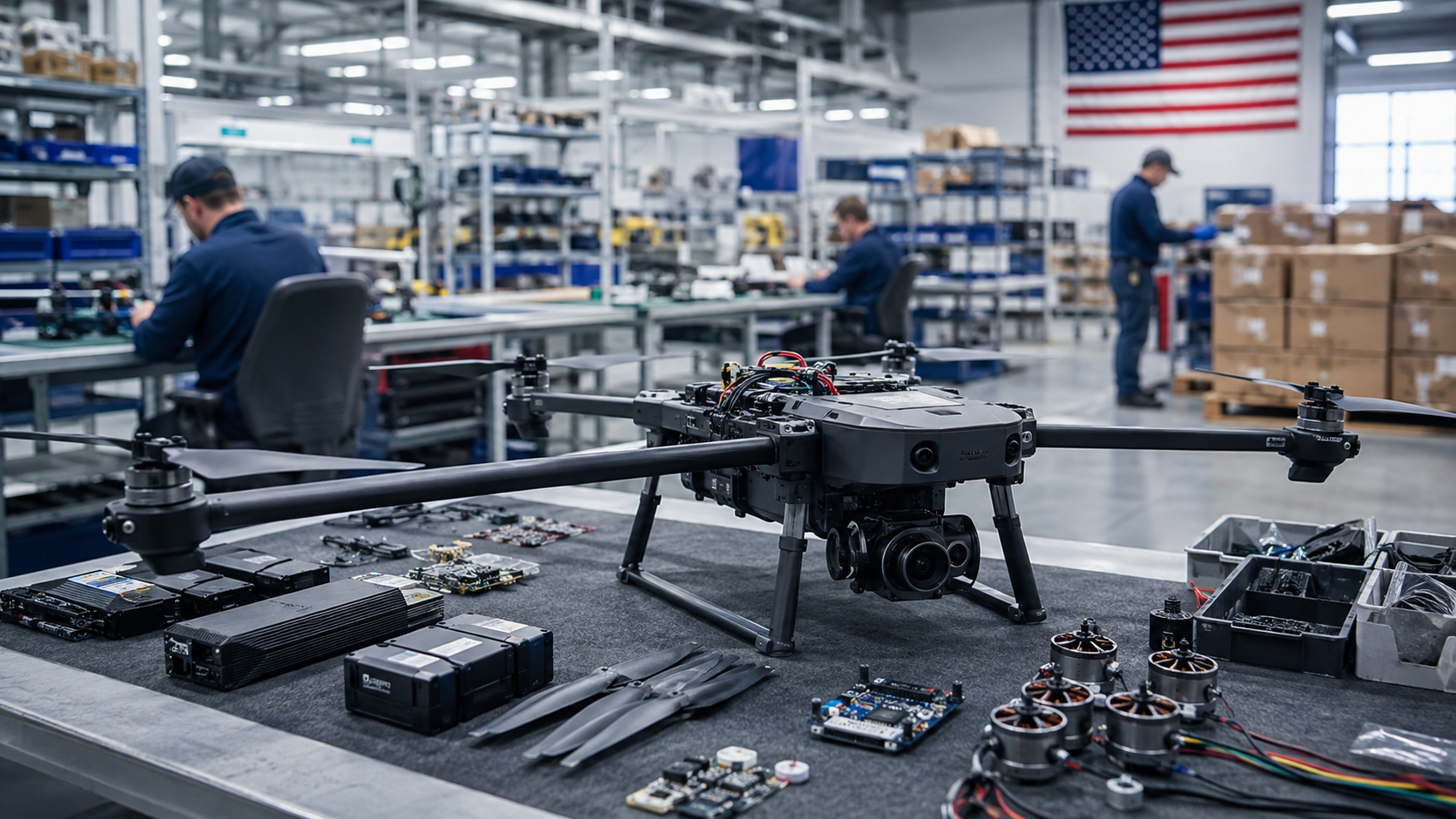
A 100% tariff is enough to turn heads. Yet the most revealing part of the United States’ new drone trade policy is not the headline number. It is the long list of things Washington now treats as part of the aircraft.
On 13 August 2026, President Donald Trump signed a Section 232 proclamation imposing new duties on imported unmanned aircraft systems, docking stations and selected components. Some covered drones will face a 100% additional tariff. Others will face 25%. The first rates take effect on 3 September 2026, only 21 days after the proclamation was signed, with another component phase beginning on 9 February 2027.
For you as a drone operator, manufacturer, distributor, inspector or fleet manager, that policy reaches much further than a customs bill at the border. It goes straight into the anatomy of a modern drone: the battery that supplies the current, the motors that turn the propellers, the electronic speed controllers that regulate those motors, the flight controller that keeps the aircraft stable, the radios that carry commands and video, the camera or thermal sensor that performs the job, and the docking station that lets the aircraft operate remotely.
The US already has a large civil drone market. The Federal Aviation Administration currently reports 837,513 registered drones and 481,760 certificated remote pilots. Its latest Aerospace Forecast also shows a commercial fleet that is still expanding, giving manufacturers a sizeable civilian customer base alongside government demand.
So the question is no longer whether America can assemble more drones. It is whether the country can produce enough of the critical pieces, at acceptable prices and in huge volumes, without relying on the same foreign supply chains the new policy is trying to reduce.
Washington Wants to Know What Is Inside Your Drone
The new tariff policy came out of a Section 232 national-security investigation opened by the Department of Commerce on 1 July 2025. The Federal Register notice asked industry for evidence on US demand, domestic manufacturing capacity, import concentration, foreign subsidies, supply vulnerabilities and whether tariffs or quotas could support American production.
More than a year later, the White House concluded that the United States was too dependent on imported UAS and components. The proclamation states that even drones produced in America often contain critical foreign-made parts, specifically naming motors, electronic speed controllers, lithium-ion batteries and docking stations among the dependencies.
That finding is central to the policy. A company can screw together an airframe in the United States and still have a supply chain whose most important electrical and propulsion parts come from overseas.
Securing American drone dominance while building our defense industrial base.
— The White House (@WhiteHouse) August 14, 2026
President Trump signed a proclamation to strengthen American drone production through tariffs, protecting our national security and ensuring American drone industry is second to none. 🇺🇸 pic.twitter.com/hmXiafK1vV
The 100% Tariff Tier
The White House fact sheet says a 100% ad valorem tariff will apply to certain larger or security-sensitive systems. The detailed Annex I covers UAS with a maximum take-off weight above 25 kilograms, UAS integrating thermal imagers, docking stations and specified UAS parts classified under listed tariff codes.
Thermal imaging is particularly significant for the commercial market. You find thermal payloads in solar inspections, electrical inspections, public-safety work, search and rescue, roof surveys, industrial maintenance, firefighting and some energy-sector operations. A thermal-equipped aircraft that falls within the covered categories can therefore be treated very differently from a similar non-thermal aircraft.
The 100% duty is calculated on the full customs value of covered goods under the annex. It is also generally additional to other applicable duties unless the proclamation provides a specific exception. A $10,000 customs value does not automatically translate into a $10,000 retail increase, since distribution structures, origin rules and existing tariffs differ, though it illustrates how quickly the economics can change when the extra duty itself equals the entered value.
The 25% Tariff Tier
The 25% schedule in Annex II covers non-thermal UAS across several weight bands up to 25 kilograms. The classifications include aircraft at or below 250 grams, aircraft above 250 grams up to 7 kilograms, and aircraft above 7 kilograms up to 25 kilograms.
Those brackets reach a large part of the civil market. They include the sort of compact aircraft used for mapping, real-estate imaging, construction records, roof inspection, basic surveying, public-safety observation and routine visual inspection.
For many buyers, 25% is substantial enough to alter a procurement comparison. A fleet owner that previously chose mainly on aircraft price, payload capability, software and reliability may now need to add country of origin, component origin and customs treatment to the spreadsheet.
The February 2027 Component Phase
A separate 25% component schedule begins on 9 February 2027, 180 days after the proclamation. Annex III and Annex IV set out tariff classifications and implementation details for the second phase.
That delay gives manufacturers and importers a short window to review suppliers, inventory, tariff classifications and production plans. It does not freeze the policy list. Commerce can recommend additional UAS components for coverage on a rolling basis, so a part that is outside the first set of tariff lines may still become relevant later.
There is another timing detail worth watching. The Secretary of Commerce must provide the President with an update within 120 days of the proclamation. That review can shape later action as the administration sees how imports, prices and domestic production respond.
Allied-Country Rates and the Onshoring Route
The policy has a different path for qualifying goods from several allies. Products of Japan, South Korea, Taiwan, Switzerland, Liechtenstein and the European Union can receive a total tariff rate capped at 15%. Qualifying UK products can receive a total rate capped at 10%.
The condition is demanding: substantially all critical components and technology must come from the United States or the named allied sources. A final assembly operation in an allied country does not automatically produce the lower rate if critical parts still come from a non-qualifying source.
The proclamation also creates an onshoring programme for companies constructing, refurbishing or expanding US production facilities. Approved companies can receive duty-free treatment for certain covered imports and necessary production equipment in volumes linked to anticipated US output during construction. Companies must commit to qualifying construction before 20 January 2029, and the government can monitor performance or recover benefits where commitments are not met.
That part of the policy is designed as a bridge. A manufacturer may still need foreign machinery or inputs while a domestic plant is being built. The programme gives Commerce a way to support the transition without charging the same tariff on every input required to create the new factory.
America’s Drone Problem Starts Below the Airframe
A drone company can put its logo on a finished aircraft. Supply-chain resilience is harder to put on a box.
The Department of War’s 2026 first-principles report on small drones breaks a typical system into propulsion, a power source, a controller, communications hardware, enabling software and payloads. Brushless DC motors are common. Lithium-polymer batteries are common. The controller may combine an inertial measurement unit, GPS, a barometer and a compass. Communications hardware connects the aircraft to the operator or a wider network. Payloads can include ordinary cameras, mapping equipment, thermal sensors or other mission hardware.
That list explains the industrial problem in a much more useful way than counting drone brands.
A factory that moulds carbon-fibre arms and performs final assembly still depends on the availability of cells, semiconductors, magnets, radio modules, optical components, connectors and production tooling. A missing $40 component can stop shipment of a multi-thousand-dollar aircraft. The final drone cannot leave the line half complete.
The commercial market also has volume. The FAA says more than one million aircraft have entered the Part 107 registry since it launched. In 2025 alone, more than 126,000 new commercial registrations were recorded. New commercial registrations averaged about 10,500 per month, and the active Part 107 fleet still grew by roughly 2,000 aircraft per month after expirations and cancellations were taken into account.
Domestic supply therefore has to be more than technically possible. It has to be repeatable at industrial volume.
What Actually Has to Be Made in the United States
No single factory has to manufacture every screw, chip and camera element. A credible US supply chain does need dependable domestic or approved-allied capacity across the components that can stop production, expose data, restrict maintenance or create a strategic dependency.
The current tariff annexes do not impose a separate tariff on every item discussed below. That distinction is important. The proclamation identifies broad foreign dependencies, the annexes cover specified UAS and tariff classifications, and Commerce can add components later. The wider industrial task is larger than today’s tariff schedule.
Batteries and Power Systems
Battery packs look simple from the outside. Inside, they combine cells, conductors, protection circuits, battery-management electronics, connectors, packaging and firmware. Drone manufacturers then build flight-time estimates, thermal limits, charging routines and safety procedures around a particular pack.
The global battery industry remains highly concentrated. The International Energy Agency reported in February 2026 that China manufactured well over 80% of all batteries in 2025. Chinese, Korean and Japanese companies together accounted for nearly all global lithium-ion cell output. The IEA also noted that battery factories in the United States and Europe still import most of their battery components, largely from China.
Capacity is expanding quickly outside China. The IEA’s Global EV Outlook 2026 puts global lithium-ion nameplate manufacturing capacity above 4 terawatt-hours at the end of 2025, about 30% higher than a year earlier. Capacity growth in the United States and European Union was around 50% year on year, faster than China’s rate of just over 25%.
Yet cell factories alone do not solve the drone problem. A drone maker needs cells with the right discharge characteristics, weight, reliability, form factor and production consistency. It also needs pack assembly, battery-management electronics and qualified suppliers able to deliver on schedule.
Skydio offered a real example of the risk before the current tariffs were announced. In late 2024, Chinese restrictions on battery supply forced the US drone maker to ration batteries for its customers, according to a Center for Strategic and International Studies analysis. The aircraft could be American-designed and American-assembled, yet battery availability still constrained deliveries.
For domestic production to become robust, you need more than pack assembly. You need competitive cell supply, pack integration, battery-management electronics, testing, charging systems, replacement capacity and material processing upstream.
Motors, Magnets and Propulsion
Most multirotor drones depend on compact brushless motors with a very high power-to-weight ratio. Those motors need copper windings, precision bearings, shafts, housings and permanent magnets. Propellers add their own materials, moulding processes, balancing requirements and quality controls.
The motor looks small relative to the aircraft. Its supply chain reaches back into mining, separation and magnet manufacturing.
That is one reason the US government is financing upstream materials. In June 2026, the Department of War announced a conditional loan of up to $725 million to Energy Fuels to increase US rare-earth separation and metallisation capacity. An earlier joint financing package announced in November 2025 included up to $700 million in conditional lending connected with expanded US production of neodymium-iron-boron permanent magnets.
Those investments serve many industries, not drones alone. Drone propulsion is one beneficiary because high-performance permanent magnets are a basic ingredient in many brushless motors.
You also need motor-control electronics. Electronic speed controllers take commands from the flight controller and rapidly switch electrical current to regulate motor speed. The White House proclamation specifically identifies electronic speed controllers as an area of foreign dependence. Domestic motor production without domestic or trusted ESC production still leaves a break in the chain.
Flight Controllers, Semiconductors and Electronic Speed Controllers
The flight controller is the aircraft’s central computing and control unit. It reads sensor data, estimates attitude and movement, accepts pilot or autonomy commands, then sends instructions to the propulsion system. A typical controller may combine processors, memory, inertial sensors, barometers, GNSS receivers, power-management circuits and interfaces to cameras or other payloads.
Here the supply question becomes more complicated than country of final assembly. Semiconductor fabrication, packaging, printed circuit board manufacturing, sensor production and firmware development can each take place in different countries.
A company trying to localise this layer needs component traceability as much as factory floor space. It must know who fabricated the chips, who assembled the board, where the firmware came from, how components were tested and whether replacements are available when a supplier changes a design.
The tariff policy and defence procurement rules are moving in this direction. They increasingly treat critical components as part of the security assessment rather than accepting a finished-aircraft origin label on its own.
Cameras, Thermal Sensors, LiDAR and Positioning Hardware
Commercial drones earn their keep through payloads. For an inspection company, the camera is often more valuable to the job than the airframe carrying it.
A visual inspection payload can contain lenses, image sensors, processors, stabilisation hardware and storage. A thermal payload adds infrared detector technology, calibration and specialised processing. LiDAR systems add lasers, detectors, timing electronics and positioning hardware. Survey systems may combine GNSS receivers, inertial measurement units and correction data.
The new US tariff treatment makes thermal imaging unusually visible. Covered UAS integrating thermal imagers sit in the 100% tier under Annex I. That creates an immediate commercial issue for operators buying aircraft for electrical inspection, solar surveys, emergency response or building diagnostics.
There is also a regulatory layer. The FCC’s drone security policy treats navigation systems, communications systems, controllers and other listed items as critical UAS components. That means hardware origin can affect market access even when the component itself is not the most expensive item on the aircraft.
For US manufacturing, payload localisation will probably develop by mission. It is easier to build a trusted supply route for a defined thermal inspection platform than to reproduce every consumer camera, industrial LiDAR unit and mapping sensor at once.
Radios, Data Links and Ground Control
Every remotely operated drone needs a communications path. That may carry command-and-control traffic, telemetry, video, payload data, software updates and identification information.
The FCC says many US drones operate in unlicensed spectrum around 900 MHz, 2.4 GHz, 5.2 GHz and 5.8 GHz. The agency also identifies 5030-5091 MHz as licensed spectrum allocated for UAS control links, with an interim access framework covering 5040-5060 MHz.
Frequency access is only one layer. The aircraft still needs radio hardware, antennas, amplifiers, modems, encryption or security features, and a ground-control device. At longer ranges, cellular or satellite connectivity can enter the system as well.
This is where supply-chain policy overlaps with cybersecurity. A trusted aircraft with an untrusted communications module still creates questions about data handling, remote access, firmware updates and network exposure. The FCC’s Covered List rules now reach critical foreign-produced UAS components, not only complete drones.
On 22 December 2025, the FCC added foreign-produced UAS and critical UAS components to its Covered List after a national-security determination. On 7 January 2026, it created temporary exemptions through 1 January 2027 for certain systems on the Blue UAS Cleared List and qualifying domestic end products. In March 2026, the commission announced its first UAS conditional approvals, showing that compliant products can still find a route to equipment authorisation under specified conditions.
Frames, Propellers, Docks and Final Assembly
Airframes are among the more visible pieces of production, so they often dominate photos of drone factories. They still require a mature supplier base. Carbon-fibre structures need fibres, resin systems, moulds, cutting, layup, curing and quality inspection. Injection-moulded parts need tooling and reliable polymers. Metal parts require machining, casting or forming.
Propellers demand tight dimensional control and balancing. Poor consistency produces vibration, noise, reduced efficiency and additional wear on motors and bearings.
Docking stations are even more complex than they appear. A remote dock can combine charging, weather protection, environmental control, networking, antennas, cameras, computing, power conversion and mechanical systems that open the enclosure or position the aircraft. The White House proclamation specifically names docking stations as a foreign dependency and puts covered docking stations into the 100% tariff tier.
For drone-in-a-box operators, that makes the ground hardware part of the sourcing decision. Buying a compliant aircraft does not settle the origin or tariff status of the dock supporting it.
Final assembly still counts. It is where a manufacturer integrates subsystems, loads software, calibrates sensors, performs functional tests and records traceability. Its strategic value rises sharply when the critical subassemblies feeding the line are also available from domestic or approved-allied suppliers.
Assembly in America Is No Longer Enough
The new policy draws a line between final assembly and substantive supply-chain origin.
For the lower allied-country tariff caps, substantially all critical components and technology must originate in the United States or the listed allies. That wording pushes manufacturers to examine bills of materials far below the top-level product name.
FCC policy points in the same direction. Its Covered List update applies to foreign-produced UAS and critical components seeking new equipment authorisations, subject to exemptions and conditional approvals. The agency’s listed critical categories include data-transmission devices, communications systems, flight controllers, ground-control stations, navigation systems, batteries, smart batteries and motors.
So a company cannot solve every regulatory and procurement problem by moving a screwdriver operation to an American warehouse.
From a commercial buyer’s perspective, the practical change is documentation. You may start seeing manufacturers publish more component-origin information, supplier declarations, Blue List status, FCC approval details and tariff classifications. Procurement teams may ask questions they rarely asked five years ago: Where was the motor made? Who built the battery cells? What modem is inside the controller? Can the thermal payload be replaced without changing the aircraft’s status? Is the dock treated separately?
The aircraft specification sheet is slowly becoming a supply-chain document as well as a performance document.
The Hard Part Is Manufacturing at Scale
America can build excellent drones. Building hundreds of thousands of low-cost systems every year is a different industrial problem.
The Department of War’s 2026 mass-production programme gives you a useful benchmark. In the first production phase, the department asked 12 vendors to collectively produce 30,000 drones at about $5,000 each, a procurement worth roughly $150 million. Later phases were designed to reduce the vendor pool from 12 to five, increase the order quantity from 30,000 to 150,000 and push unit prices down toward $2,300.
The department said roughly $1 billion would fund about 340,000 small UAS over two years. That is a major demand signal for American manufacturers and their suppliers.
Then compare the number with wartime production abroad. Reuters reported that Ukraine expected to produce 6 million to 7 million first-person-view attack drones in 2026, roughly half a million per month. The same report said a US Pentagon programme had cumulatively produced just under 200,000 drones by February and that officials still saw a multi-year gap before US industry could approach wartime production volumes.
Reuters also reported that an August US test event barred Chinese brushless motors and battery packs and that the vast majority of earlier purchases were believed to contain Chinese motors. That detail gets to the heart of the manufacturing challenge. A country can have numerous drone startups and still lack domestic volume in basic propulsion hardware.
Scale changes the maths. A prototype company can buy a few hundred motors at a premium. A programme ordering 150,000 aircraft needs hundreds of thousands of motors, controllers, propellers and battery packs, often with spares on top. Yield rates, tooling life, supplier quality, automated test equipment and inventory discipline become as important as aerodynamic design.
The civil market adds another demand curve. The FAA base forecast rises from 424,516 active non-recreational small UAS in 2025 to 540,845 in 2030, a compound annual growth rate of about 5%. The high forecast reaches 1,491,153 aircraft in 2030. Commercial manufacturers therefore need a production model that can serve government demand without starving inspection, construction, public-safety, agriculture and mapping customers of equipment or replacement parts.
The US Is Putting Capital Behind the Missing Layers
Tariffs make imported products more expensive. Factories still need money, machines, workers, qualified suppliers and purchase orders.
Washington is now pairing trade restrictions with industrial financing. On 31 July 2026, the Department of War’s Office of Strategic Capital announced a conditional loan commitment of up to $820 million to Performance Drone Works to establish high-volume US manufacturing capacity for critical drone components. The department said the output is intended to serve multiple manufacturers and platforms rather than a single aircraft programme.
That is an important design choice. Shared component capacity can help several drone companies at once. A domestic motor, controller or electronics supplier that serves ten aircraft makers gives the industry a deeper base than ten manufacturers each trying to recreate every component internally.
There is still a long gap between a conditional loan announcement and stable high-volume output. Plants have to be built or expanded, production lines commissioned, processes qualified, workers trained, components tested and customers signed. The tariffs create urgency. The financing helps with capital. Purchase commitments provide volume. All three need to line up for domestic production to compete reliably.
What the New Tariffs Mean for Commercial Drone Buyers
Your immediate exposure depends on what you buy, where it comes from, how it is classified and whether an exception applies.
A small non-thermal aircraft may fall into a 25% category. A covered thermal aircraft can face the 100% tier. A qualifying UK or other named allied product may receive a lower capped rate if its critical components and technology meet the origin conditions. A docking station can have its own tariff treatment. Parts ordered separately can face different timing from the finished aircraft.
That makes purchasing less straightforward, particularly for fleets built around thermal inspection or remote docks.
Pricing is the first concern, though it will not move uniformly. Importers can absorb part of a tariff, manufacturers can shift sourcing, distributors can change margins, currencies can move and customers can switch models. Some products will become materially more expensive. Others may change source or configuration before the full tariff reaches the end user.
Availability is the second concern. Manufacturers may rush inventory into the United States before 3 September 2026, reclassify or redesign products where lawful, change suppliers, move assembly, seek onshoring treatment or pursue qualifying allied production routes. Any major component change can trigger engineering work and fresh testing.
Serviceability comes next. A fleet is useful only if you can get batteries, motors, propellers, payloads and controller parts after the initial sale. The component tariff phase beginning in February 2027 gives you a reason to ask distributors about spare-part origin and future stock rather than focusing only on today’s aircraft price.
Thermal operators have an extra calculation. A public-safety agency, solar inspection company or electrical contractor may need thermal capability for the mission itself. Substituting a cheaper visual-only aircraft is not a like-for-like solution. Buyers may therefore look harder at US-made and qualifying allied thermal systems, separate payload architectures, leasing, service contracts and longer replacement cycles.
Remote operations face a similar issue with docks. If you are planning fixed-site inspection at substations, rail corridors, mines, wind farms or construction sites, the aircraft and docking system should now be evaluated as one sourcing programme. The dock can carry a different customs exposure, different electronics and a different supplier chain from the drone sitting inside it.
Existing aircraft are not automatically grounded by the tariff proclamation. Tariffs apply to covered imports. Separately, the FCC has said equipment that was already authorised can generally continue under its existing authorisation, while restrictions affect new authorisations for covered foreign-produced UAS and critical components. Procurement rules for federal agencies and defence customers can be stricter than the rules applying to a private operator using equipment it already owns.
Who Is Best Positioned to Gain
US drone manufacturers with transparent component sourcing have an obvious opening. The same is true for suppliers making motors, electronics, batteries, radio hardware, optical payloads, propellers and dock components inside the United States.
Allied manufacturers can also be well placed if their critical parts and technology meet the proclamation’s origin conditions. The 10% UK cap and 15% caps for the European Union, Japan, South Korea, Taiwan, Switzerland and Liechtenstein create a different cost structure from the 25% and 100% tiers applied to covered goods outside those arrangements.
Component specialists may have the most interesting opportunity. A drone brand sells one finished product line. A reliable motor or flight-controller producer can supply many platforms, spreading factory costs across military, public-safety and commercial demand.
Testing and traceability businesses should see more work as well. Origin claims, cybersecurity assessments, radio authorisations, component substitutions and quality records become more valuable when one supplier change can affect tariff treatment or procurement eligibility.
Pressure will be greatest on companies whose competitiveness depends on low-cost imported components and whose products cannot quickly be redesigned around qualifying alternatives. Thermal systems and automated docking products deserve particular attention because the new tariff structure singles them out so clearly.
What to Watch Between September 2026 and 2027
Commerce’s rolling component review deserves close attention. The first annexes are a starting point rather than a fixed list. A later addition involving a widely used control, communications or power component could affect many aircraft models at once, including products whose initial tariff treatment looked relatively manageable.
The department’s required 120-day update is another useful checkpoint. Look for evidence on import volumes, domestic production commitments, requests for onshoring treatment and any changes to the covered component list. Those details will show whether the policy is prompting factory investment or mainly changing import costs.
FCC exemptions are moving on a separate clock. The commission’s January 2026 action provided temporary exemptions through 1 January 2027 for certain Blue UAS systems and qualifying domestic end products. Conditional approvals also have their own terms and expiry dates. A drone that is commercially available in August 2026 therefore needs to be checked again when you plan a 2027 fleet purchase.
Factory evidence will tell you more than announcements alone. Useful signals include completed production lines, monthly component output, signed customers, delivery lead times, defect rates, replacement-part availability and lower unit costs as volumes rise. Shared suppliers are especially worth tracking because one qualified motor, electronics or battery producer can support several aircraft brands.
Civil orders will provide a second test of durability. Defence procurement can fill factories quickly, though inspection, construction, public safety, agriculture and mapping give manufacturers demand outside a single government budget cycle. A supplier that can serve both groups has a better chance of keeping production lines busy between large military orders.
What an American Drone Supply Chain Would Look Like
A genuinely resilient US drone industry would not require every raw material to come from inside the country’s borders. Modern electronics are too interconnected for that to happen quickly, and the tariff policy itself recognises a role for trusted allies.
A more practical target is a supply network where no single foreign source can stop production of a critical aircraft class. Motors could come from several US and allied suppliers. Battery cells and packs could be sourced from qualified plants with enough spare capacity to respond to a disruption. Flight controllers could use traceable electronics and maintain alternative component paths. Radios and navigation systems could meet FCC requirements without depending on prohibited suppliers. Payload makers could offer thermal, visual and mapping options with documented origins. Docking systems could be built from maintainable parts with long-term spares.
That kind of redundancy costs money. It can also reduce the chance that one export restriction, factory shutdown, sanctions change or diplomatic dispute freezes a production line.
The new tariffs therefore act as a very expensive test of US industrial depth. Raising the border price is relatively quick. Creating an efficient motor factory, qualifying a battery pack, securing rare-earth magnets, scaling printed circuit board production and building a supplier quality system takes much longer.
For you as a buyer, the transition may feel messy. Prices can move, familiar product choices can change, and product availability may vary from one quarter to the next. The useful question to put to a supplier is simple: which critical parts can you keep shipping if your main foreign source disappears tomorrow?
A manufacturer that can answer with specific suppliers, production locations, alternatives and inventory policies is much closer to the resilient model Washington is trying to create.
Frequently Asked Questions
Which Drones Will Face the 100% US Tariff?
Covered drones above 25 kilograms, covered drones integrating thermal imagers and certain other UAS goods listed in Annex I can face the 100% additional tariff. The proclamation also places covered docking stations and specified UAS parts in the 100% schedule, subject to the exact tariff classification, origin and exceptions. For a purchase decision, you should check the product’s customs classification and origin rather than relying only on its marketing name.
When Do the New US Drone Tariffs Start?
The first 100% and 25% drone tariffs are scheduled to start on 3 September 2026. A separate 25% schedule for listed components begins on 9 February 2027, following the 180-day delay in the proclamation. Some qualifying products and companies can receive different treatment under the allied-country, Blue UAS, FCC or onshoring provisions.
Are All Foreign Drones Now Banned in the United States?
No, the tariff proclamation does not ban every foreign drone. It changes the import cost of covered products and creates different rates or exceptions depending on product type, origin and qualifying conditions. Separate FCC rules restrict new equipment authorisations for covered foreign-produced UAS and critical components, so market access also depends on communications regulation, not customs policy alone.
Will a Drone I Already Own Stop Working Because of the Tariffs?
No, the tariff proclamation does not ground a drone you already own. It applies to covered imports entering the United States. Existing equipment can still be affected by availability and price of replacement parts, software support, procurement rules or separate regulatory restrictions, so fleet owners should still check long-term service plans.
Are Batteries and Motors Directly Covered by the New Tariffs?
Some UAS parts fall under the tariff annexes, though the current proclamation should not be read as a simple 25% or 100% tariff on every battery or motor sold for a drone. The policy specifically identifies batteries, motors and electronic speed controllers as foreign dependencies, and Commerce can add UAS components over time. FCC policy also lists batteries and motors among critical UAS components, which adds a separate regulatory reason to track their origin.
Can Drones From US Allies Get Lower Tariff Rates?
Yes, qualifying products from named allies can receive lower total tariff caps if the origin conditions are met. The cap is 10% for qualifying UK products and 15% for qualifying goods from the European Union, Japan, South Korea, Taiwan, Switzerland and Liechtenstein. Substantially all critical components and technology must originate in the United States or those qualifying sources.
Will Commercial Drone Prices Rise?
Some imported commercial drone prices are likely to rise, especially where a product is directly exposed to the 25% or 100% tariff and the importer passes part of the cost to buyers. The size of a retail increase will vary with inventory, supplier changes, origin, currency, distributor margins and whether a manufacturer can qualify for a lower rate or onshoring treatment. Thermal inspection systems and docking products deserve close attention because they sit in the highest tariff tier under the current policy.
Can the United States Replace Chinese Drone Components Quickly?
No, replacing high-volume foreign component supply will take time even with tariffs, financing and large government orders. The US Department of War is targeting roughly 340,000 small UAS over two years under one production programme, yet Reuters reported that Ukraine expects to make 6 million to 7 million FPV drones in 2026 alone. Building motors, batteries, electronics and sensors at that kind of volume requires new factories, trained workers, tooling, qualification and dependable upstream material supply.