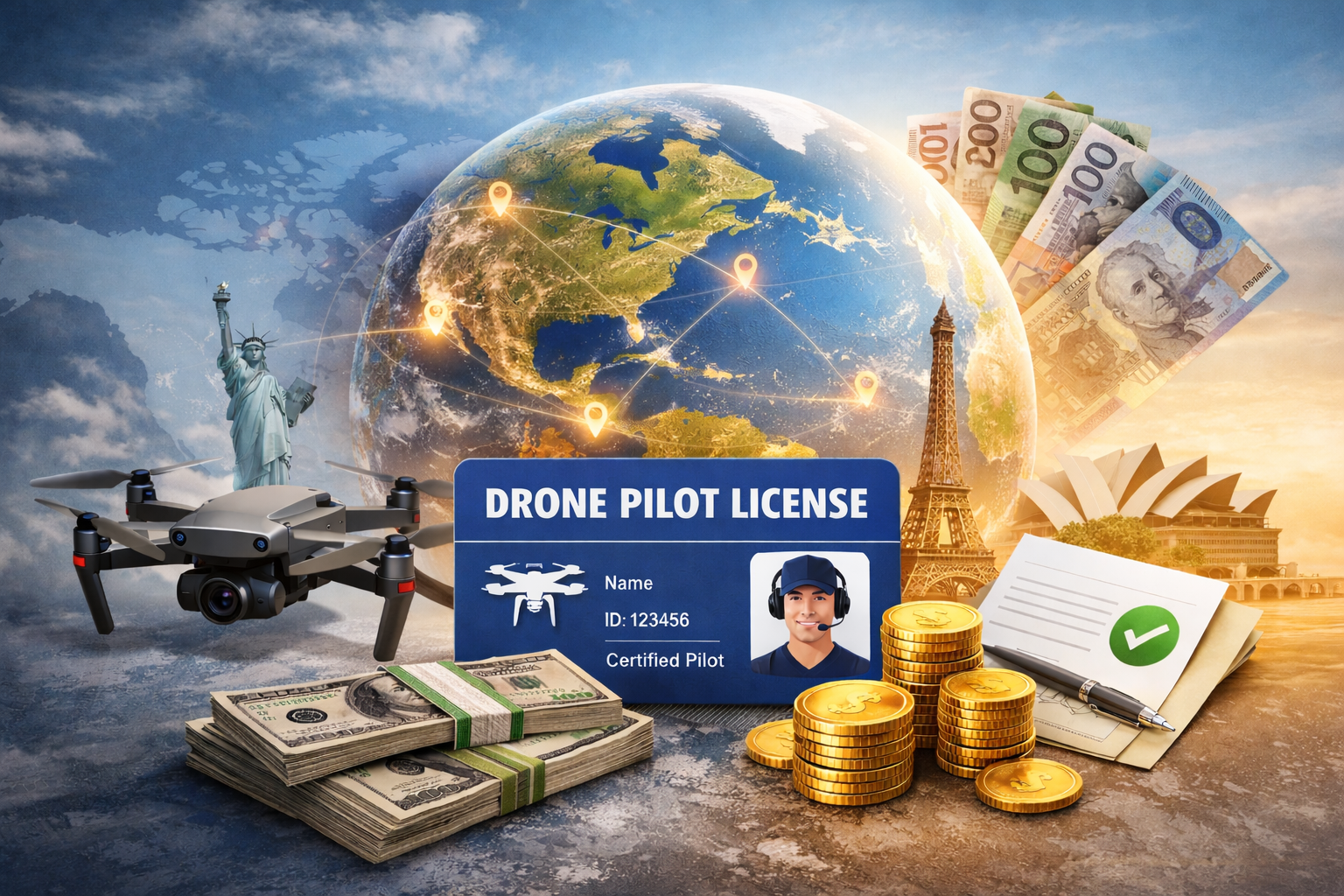
Every country has its own rules, fees, and required training for drone pilots. In this guide, we’ll break down the costs of obtaining a drone pilot license (or certification). We’ll look at all the required tests, mandatory training courses, exam fees, drone registration charges, and license renewals in each region.
We’ll also explore advanced drone certifications like aerial mapping, inspections, thermography (infrared imaging), BVLOS (Beyond Visual Line of Sight) operations, and night flying. These specialized certifications can enhance your skills and open up new career opportunities as a drone pilot.
First, a summary:
| Region | Pilot License Exam & Training | Drone Registration | Renewals & Notes |
|---|---|---|---|
| United States (FAA) | Part 107 knowledge exam: $175 fee. Optional Part 107 prep course: ~$100–300 (e.g., ABJ’s course $125). |
$5 per drone (valid 3 years). | Free online renewal every 24 months (no test fee). Night flying allowed after free training. No extra cost for license card itself. |
| United Kingdom (CAA) | Flyer ID online test: £0 (free). A2 CofC course & exam: ~£100–£250. GVC course (incl. flight test): ~£600–£1,000. |
£11.79 per year (Operator ID) (covers all drones). | Flyer ID valid 5 years (free renewal). A2/GVC certificates don’t expire, but Operational Authorization costs £500/year for Specific category ops. |
| Europe (EASA) | A1/A3 basic online exam: €0–€30 (varies by country; e.g. €25 in Germany, free in others). A2 cert exam: ~€10–€50 (or €100–€250 with training). |
€0–€30 in many countries (one-time or 5-year UAS operator registration). | Certificates valid 5 years. Renewal typically requires refresher (often online). Specific category authorizations involve additional (often higher) fees case-by-case. |
| Canada (Transport Canada) | Basic Operations exam: C$10 (~$7 USD). Advanced exam: C$10. Flight Review (Advanced): ~C$150–300 (avg. C$200). Advanced cert application: C$25. Optional ground school: ~C$100–300. |
C$10 per drone (valid 1 year) (was C$5 for 3 years, now increased). | Pilot certificates do not expire (no recurrent fees). New BVLOS “Complex” exam C$125 for advanced ops. |
| Australia (CASA) | Recreational: Free online accreditation for ≥250g. Commercial: RePL course ~A$1,500–2,500 (e.g. A$1,800+GST) for full license. Optional <2kg exclusion: free accreditation. ReOC (business certificate) ~A$1,000–1,500 initial if needed. |
A$40 per drone/year if >500g; Free if ≤500g (commercial use). Recreational: no reg. fee (registration currently not required for hobbyists). |
RePL does not expire (maintain recency). ReOC annual renewal ~$300+. No license needed for sub-2kg “excluded” ops (just free accred. + reg.). Night/BVLOS require additional approvals (cost varies). |
Let’s go over each of these in detail:
Drone Pilot License Costs in the United States (FAA Part 107)
In the United States, most commercial drone pilots earn their wings under the FAA’s Part 107 Remote Pilot Certificate – commonly just called the “drone license.” Here’s a breakdown of what it costs:
-
FAA Knowledge Test Fee
To get certified, you must pass the FAA’s Part 107 aeronautical knowledge exam. This is a proctored test taken in-person at an authorized testing center. The exam fee is approximately $175 each attempt. This cost is paid to the testing center (like PSI), not the FAA directly. Keep in mind this is a one-time fee for when you pass; if you don’t pass on the first try, you’ll have to pay again for a retake.
-
Training Course (Optional)
While not mandatory, many people choose to enroll in a Part 107 preparatory course to study for the exam. These courses can range from $100 to $300 (some are online, others in-person) depending on the provider. You can self-study using free FAA materials, but a structured course can improve your chances of passing on the first attempt. For example, ABJ Drone Academy offers an in-depth Part 107 prep course (online, self-paced)that’s currently discounted to $125. This includes all the topics you’ll need for the test, practice quizzes, and a certificate of completion – a good investment if you want guided learning.
-
FAA Drone Registration
Apart from the pilot license, every drone you fly under Part 107 must be registered with the FAA. Registration is done through the FAA DroneZone website and costs $5 per drone, valid for 3 years. This is a nominal fee, but it’s important – flying an unregistered drone can result in fines. (Recreational flyers also need to register drones above 250 g, at the same $5 rate, unless flying under a community organization.) Once registered, you’ll receive a registration number to label on your drone.
-
Certification Issuance
After passing the Part 107 exam, there is no additional FAA fee to issue your Remote Pilot Certificate itself. You’ll apply through the IACRA system and get a temporary certificate online, followed by a hard copy card in the mail. The $175 testing fee covered the certification process.
-
License Renewal (Currency) Costs
Good news – the Part 107 certificate does not expire in the way a driver’s license does. However, to remain current, you used to need to pass a recurrent knowledge test every 24 months (which cost another $150 each time). But as of 2021, the FAA updated the rules: you can maintain your Part 107 currency by completing a free online training module on the FAA website (every 24 months), instead of paying for an in-person test. This means no recurring exam fees for renewals. So, once you’ve paid the initial costs (exam + registration), keeping your license current is free – you just need to take the online refresher training and print the new completion certificate.
-
Additional Considerations
If you plan to fly at night or over people under Part 107, you must complete the updated training (which is free) and equip your drone with anti-collision lights for night ops. No extra license fee is required for these operations – they are allowed under Part 107 rules as long as you meet the conditions. Flying beyond visual line of sight (BVLOS), however, still requires a special FAA waiver as of 2026, since there isn’t yet a routine BVLOS certification (the FAA is working on future rules, often referred to as “Part 108” for advanced drone operations). Waivers have no direct fee, but they are complex to obtain and often require significant experience and safety case documentation.
So for a typical person starting from scratch, expect to pay $180 total mandatory fees in the first 3 years, with optional training to ensure you pass the exam adding to the final amount.
How Much U.S. Drone Pilot License Cost (FAA Part 107)
Summary breakdown of expected costs, grouped into mandatory fees, optional prep, and ongoing costs.
Part 107 Knowledge Test (in-person)
Mandatory
FAA Drone Registration (per drone, valid for 3 yrs)
Mandatory
Exam Prep e.g. ABJ Academy Part 107 Online Course
Optional
Drone Pilot License Costs in the United Kingdom
The UK’s drone regulations are structured differently from the U.S., with a focus on operator and pilot IDs and a tiered system of qualifications depending on the type of operations. Here’s how the costs break down in the UK:
-
Operator ID (Registration)
Anyone flying a drone or model aircraft weighing 250 g or more (or any drone with a camera, regardless of weight) in the UK must register as a UAS Operator with the Civil Aviation Authority (CAA). This provides you with an Operator ID number that you must affix to your aircraft. The registration costs £11.79 per year (renewed annually). That’s roughly $14–$15 USD. This applies to hobbyists and commercial operators alike. The fee covers all drones under your ownership (you get one operator ID for yourself, not per drone).
-
Flyer ID (Basic Pilot Certificate)
The person flying the drone needs a Flyer ID if the drone is 250 g or heavier (or has a camera, which covers most drones aside from toys). Getting a Flyer ID involves passing a free online theory test on the CAA’s website. There is no cost for the test or the Flyer ID certificate – it’s completely free and valid for 5 years. The test is 40 multiple-choice questions about basic drone safety and regulations. So for basic hobbyist use, the only required cost is the £11.79 Operator registration; the pilot’s test is free. Many recreational pilots stop at this level (Flyer ID + Operator ID).
-
A2 Certificate of Competency (A2 CofC)
This is an optional intermediate certificate for operating in the Open category’s A2 subcategory (i.e. flying small drones closer to people than normally allowed under basic rules). It’s useful if you want to fly a drone up to 2 kg in weight in urban or populated areas (with certain distance restrictions). While not a “license” per se, it’s a recognized competency certificate that is awarded by CAA-approved providers, called Recognised Assessment Entities (RAEs).
Cost: Training and testing for an A2 CofC typically ranges from £100 to £250 (about 130–320 USD) in the UK. Many CAA-recognized training organizations offer an online course plus a theory exam (which can often be taken online from home). For example, some providers charge around £99 (often plus VAT) for an online A2 CofC course/exam, whereas others might charge up to £200 if it includes extra training materials or in-person classes.
After passing the exam, you get an A2 CofC certificate that currently has no expiry (though you’re expected to stay up to date on any changes in the rules).
- GVC (General Visual Line of Sight Certificate)
The GVC is the UK’s primary certification for more advanced or higher-risk drone operations, especially if you want to operate in the Specific category (which replaced the old “PfCO” permission for commercial ops). Training for the GVC is more intensive – it includes a theory course and exam, plus a practical flight assessment.
Cost: GVC courses typically cost around £600 to £1,000. The price depends on the training provider and whether the course is online or in-person. Online GVC courses might be on the lower end (~£600-£700), whereas classroom courses with flight training can be closer to £1,000. This fee usually covers the ground school, study materials, the theory exam, and the practical flight test. USD equivalent: roughly $750 – $1,250. It’s a significant investment, but the GVC is the standard qualification needed to apply for an Operational Authorization from the CAA (which is what actually lets you do things like fly in built-up areas or other specific scenarios commercially).
-
Operational Authorization (PDRA/Specific Category)
After obtaining a GVC, to fly in the Specific category (e.g. for most commercial jobs in urban areas, or other situations not allowed under the basic Open category rules), you must apply to the CAA for an Operational Authorization. The most common is a PDRA-01 authorization, which essentially allows GVC holders to do standard VLOS commercial operations.
The CAA charges a fee for this application and annual renewal. Recently, these fees increased: as of 2025, a standard PDRA01 Operational Authorization costs £500 per year. (Previously it was around £250; the CAA has significantly raised it to cover their admin costs.) This is an annual cost if you continue operating in the Specific category. Think of it like an annual license fee for commercial operation permissions. In USD, £500 is roughly $640. If you’re a freelance operator or company, you need to budget for this recurring fee to keep your OA active.
(Note: If you only fly under Open category conditions, you don’t need an Operational Authorization or to pay this fee. It’s specifically for those higher-risk operations that require CAA’s sign-off.)
-
Drone Registration (again)
For completeness, remember that even GVC-certified pilots still need to maintain the £11.79/year operator registration for their drones. There’s no extra drone registration cost beyond that, no matter how many advanced certificates you hold.
-
Renewals and Validity
The Flyer ID theory test is valid for 5 years, after which you’d need to re-take the free test to renew it (ensuring pilots refresh their knowledge). The A2 CofC certificate currently does not have an expiration in the UK – once you have it, it’s yours (regulations could change in the future, but as of now it’s indefinite). The GVC is similarly not something you renew; however, the Operational Authorization that you get from the CAA (using your GVC) must be renewed yearly with the fee as noted. If you let the OA lapse, you’d have to reapply (and pay the application fee again).
-
Optional Training Costs
Many pilots do a combined course for GVC + A2 CofC together (some training companies bundle them). Often the bundle is only slightly more than GVC alone, or even the same price, so it’s common to get both. Some typical bundles are ~£650-£800 including both certifications. If you go this route, you might save a bit versus doing them separately. Also, if you’re completely new, you might take a basic drone training course first (covering fundamental flight skills). Basic courses are ~£150 on average in the UK. They’re not required, but can be a stepping stone if you want hands-on flying practice before doing the GVC flight test.
At minimum, becoming a legal drone operator in the UK requires £11.79/year for registration and a free online test. For professional use, you’re likely looking at around £700-£1,000 (~$900-$1,300) total upfront for training and exams (to get A2 CofC + GVC), plus £500/year (~$640) for the Operational Authorization from the CAA. It’s certainly a higher cost than in the U.S., but it comes with the benefit of being able to operate in more complex environments. Always ensure you train with a CAA-approved entity so your certifications are recognized.
How Much Drone Pilot License Costs In The United Kingdom
Quick summary of the key costs.
Operator ID Registration
Required for most drones. One Operator ID covers all your drones.
Flyer ID Online Test
Free online test. Valid for 5 years.
A2 CofC
Optional upgrade for Open category flying closer to people with small drones.
GVC
Typical path toward Specific category work. Includes theory + practical assessment.
Operational Authorization PDRA-01
You only pay this if you fly in the Specific category.
Minimum Legal Setup Cost
Example Professional Upfront Split
Mandatory Annual Costs
A2 CofC and GVC are usually one-time; the big recurring professional cost is the £500/year Operational Authorization if you fly in the Specific category.
(Tip: If you only need to do basic, lower-risk work, sometimes just the A2 CofC is enough – which keeps costs low – but most serious commercial work in the UK will demand the GVC and OA.)
Drone Pilot License Costs in Europe (EASA Countries)
Europe has a unified drone regulatory framework under EASA (European Union Aviation Safety Agency) rules. This means most European countries (EU member states and a few others that adopted EASA rules) follow the same basic structure for drone licenses, often referred to as the EU Drone Certificate or EU Drone Licence. There are different categories (Open, Specific, Certified), but let’s focus on the Open category requirements since that’s where most pilots start. Costs can vary slightly by country (each country’s civil aviation authority administers the exams and registration), but here’s a general breakdown with examples:
-
Drone Operator Registration
In EASA countries, if you have a drone that weighs 250 g or more, or has a camera, you must register as a UAS operator with your national aviation authority. This is usually done online and gives you a unique registration number valid across Europe. The registration process and fee differ by country:
- Some countries, like France, currently have no fee for online registration (it’s free to sign up on the AlphaTango platform, managed by the Direction Générale de l’Aviation Civile (DGAC).
- Others have a small fee. For example, the Netherlands charges about €23 for a new operator number (handled through RDW). The pilot licence application itself costs €10. In Italy, registration and related services run through D-Flight, and the cost varies by the specific service you’re paying for. Your minimum cost to become compliant as an operator is typically a D-Flight subscription, starting at €7/year for Base or €28/year for Pro, and then €7 per drone for a Base UAS QR code if you need additional QR codes beyond the one included at first activation.
Generally, expect anywhere from €0 to €30 for operator registration in most EU countries (that’s roughly $0 to $33 USD). It’s often a one-time or multi-year fee (e.g. valid for 5 years in some cases). Once registered, your operator number can be used in all other EASA member states if you fly there.
You only register once as an operator (not per drone), and then you put the same ID on all your drones.
-
A1/A3 Open Category Basic Certificate
To legally fly in the Open category (for any drone 250 g or above, or any drone with a camera), you need to obtain a Remote Pilot Certificate of Competency for A1/A3. This is the basic EU drone pilot license covering the lowest-risk subcategories (A1 and A3). Getting this involves online training and an exam. Key points:
- The training material is provided by the aviation authority (often free). The exam is typically 40 multiple-choice questions, and you must score at least 75% to pass.
- Cost: Many countries offer the A1/A3 exam for free or a token fee online. For instance, in Germany, the Luftfahrt-Bundesamt (LBA) provides an online course and exam for A1/A3 for €25.00. In Estonia, you submit an application and pay a €10 state fee, then take the online test. In Spain and France, the online exam is free. In Italy, ENAC lists a €31 fee for issuing the certificate, separate from D-Flight’s subscription charges. So it ranges from €0 to about €30 at most, depending on the country.
- Once you pass, you get a certificate (often a PDF) that is valid for 5 years. After 5 years, you’d need to re-take the test to renew (by then it might be updated with new regs).
- If you obtain your certificate in one EASA country, it’s recognized in all other member states (you don’t need to re-do it if you move or fly elsewhere in Europe).
- USD equivalent: €25 is about $28. So the basic license is very affordable – sometimes essentially free – in Europe. The aim is to make sure every drone pilot learns the rules, without cost being a barrier.
-
A2 Certificate of Competency
For more advanced operations in the Open category, pilots can optionally get an A2 CofC, which allows flying a drone up to 2 kg in weight closer to people (down to 5–30 meters from uninvolved people, under certain conditions). This certificate is useful for professionals or advanced hobbyists who want more freedom than A3 category provides. The process:
- You typically do some self-practical training (flying supervised by yourself to gain experience) and then pass a theoretical exam that is a bit more advanced than the A1/A3 test. The exam might be administered by the aviation authority or an approved training entity, and often it must be taken in person (or in a monitored setting) rather than online at home.
- Cost: There is usually a fee for the A2 exam/issue. For example, in Estonia, the state fee for the A2 certificate application is €10 (and you take the exam at their service center). In Germany, many pilots go through private training companies that offer online A2 prep courses and then arrange an exam sitting. A full A2 course+exam package in Germany might be around €150–€300, but if you only count the exam fee it’s lower. Some countries (like Spain) have the exam free but require attending an approved training course (which might cost ~€100).
On average, if you self-study and just pay an exam fee, €10-€30 is common. If you take a course, €100-€250 is the range (similar to the UK’s range, because some UK organizations also offer EASA courses in English for other countries). €100 is about 110 USD. So even with training, the A2 is not hugely expensive. And many people bundle it with A1/A3 studies.
Once you have the A2 Certificate, you effectively hold what people informally call the “EU Drone License” (A1/A3 + A2). This also is valid 5 years. Renewal in 5 years might involve doing some refresher training or another exam; for instance, Germany now offers an online refresher course so you can renew the A2 without a full re-exam.
-
Specific Category (for advanced operations)
If your operations can’t fit the Open category (e.g. heavier drones, flying over uninvolved people, BVLOS flights), you move into the Specific category, which usually means you need an operational authorization from your country’s aviation authority. The process here can involve doing a risk assessment (SORA) and possibly having a higher level of training. There are also Standard Scenarios (STS) with predefined risk mitigations that require a pilot to have an STS Remote Pilot Certificate. These advanced certifications and permissions come with additional costs:
- For example, to fly a Standard Scenario STS-01 or STS-02 (which cover certain BVLOS or urban operations), a remote pilot might need to undergo a special training course and exam for the STS certificate. These are typically offered by approved training organizations and could cost several hundred euros because they include specialized content (like how to manage emergencies BVLOS, etc.).
- Additionally, authorities charge fees to process Specific category permissions, and in many cases these fees are hundreds to thousands of euros, depending on the type of application. In Italy, ENAC lists an €355 advance payment for issuing a Specific category operational authorisation under Article 12. In Ireland, the Irish Aviation Authority’s UAS fee schedule (effective 1 January 2026) lists €1,797 for a PDRA operational authorisation (initial, renewal, or amendment) and €3,595 for a SORA application (SAIL I and II), all valid for two years.
Most people won’t go ito into Specific category costs unless they have a very particular operation in mind. (If you do, be prepared that it’s more of a case-by-case cost and often requires consultation with the authority, possibly costing anywhere from €200 to over €1,000 if complex.)
As mentioned, operator registration is mandatory and typically low-cost. Unlike the U.S., you don’t register each drone with a fee in most EU countries (you register yourself and list your drones under that). Some countries might charge if you add a new drone to the system, but generally it’s just one operator fee. Also note that Remote ID requirements are rolling out in the EU: since January 2024, newly sold drones need to broadcast the operator’s ID, so having that registration is crucial (but this doesn’t add cost beyond possibly buying a Remote ID module if your drone is older).
So becoming a legal drone pilot in Europe is quite inexpensive in terms of fees:
- Operator registration: ~€0–€30 (once, or per few years).
- A1/A3 basic certificate: often free, sometimes ~€20.
- A2 certificate: could be free to ~€10 for just the exam, or up to ~€200 with training.
In total, even if you took a paid course, you might spend under €200 (~$220) for all your exams and paperwork. Many hobbyist pilots will spend little or nothing beyond maybe €25. This low cost is by design – regulators want pilots to comply and get certified, so they’ve kept fees minimal.
If you go into Specific category operations, costs increase (specific training courses, authorization fees), but that’s a step beyond the basic “license.”
Here is a summary:
How Much Drone Pilot License Costs In Europe EASA Countries
Quick overview of costs
Operator Registration
€0–€30Register once as an operator and use the same ID across EASA countries.
A1 A3 Basic Certificate
€0–€31Usually free or a small fee. Valid 5 years in the EU system.
A2 Certificate
€10–€250Low exam-only fees in some countries. Courses can raise the total.
Register As A UAS Operator
Required if your drone is 250 g or more or has a camera. Cost varies by country.
Get The A1 A3 Certificate
Online learning and a multiple-choice exam. Often free or a small fee.
Add A2 If You Need More Flexibility
Optional upgrade for flying closer to people with small drones.
Open Category Cost Snapshot
Country Examples And Official Platforms
| Country | What You Pay | Source |
|---|---|---|
| France | Operator registration can be €0 online via AlphaTango. | AlphaTango |
| Netherlands | €23 for a new operator number. €10 for pilot licence application. | RDW |
| Italy | D-Flight subscription €7 Base or €28 Pro per year. QR code services include €7 per UAS Base QR code. | D-Flight Tariffs |
| Germany | A1 A3 online course and exam example €25. | LBA OpenUAV |
| Italy | ENAC lists €31 for issuing the A1–A3 certificate. | ENAC UAS Fees |
| Ireland | Specific category fees can be high. PDRA €1,797. SORA €3,595 (valid 2 years). | IAA UAS Fees Schedule |
Specific category is where costs jump. Training and authorisations are operation-dependent and can run from hundreds to thousands of euros.
One thing to remember: Europe doesn’t differentiate recreational vs commercial in licensing – it’s based on risk category. So even as a pure hobby flyer with a DJI Mavic Air, you must get the A1/A3 cert if it’s over 250g, which contrasts with say the U.S. where hobbyists don’t need a license. Fortunately, Europe made that process easy and cheap. And if you do want to use your drone professionally, adding the A2 and possibly Specific permissions is straightforward once you have the basics.
Check your national aviation authority’s website for the exact process, as there are slight local nuances (for example, the language of exams, or the platforms used). Overall though, the EU “drone license” is one of the most affordable certifications to obtain in the drone world – it just requires a bit of study time.
Drone Pilot License Costs in Canada
Canada categorizes drone operations into Basic and Advanced, with corresponding pilot certification requirements for each. The country has recently updated its fee structure (in 2025) to support more complex operations like BVLOS, so it’s a good time to break down the costs of getting certified. Let’s look at what you’ll spend to become a drone pilot in Canada:
Basic Operations Certificate
If you’ll be flying in what Transport Canada defines as “Basic” conditions (for example, in uncontrolled airspace, at least 30 m away from bystanders, and never over people), you need to obtain a Pilot Certificate – Basic Operations. To get this:
- You must pass the Small Basic Exam, which is an online exam available on the Transport Canada drone portal. It’s 35 questions, multiple-choice.
- Exam Fee: C$10 per attempt. This is a nominal fee paid online when you take the test. If you pass, that’s it – you’re certified for basic operations. If you fail, you can retry (after 24 hours) for another $10.
- Once you pass, your Basic pilot certificate is issued immediately in your online account (you can print it out). Transport Canada does not charge an additional processing or licensing fee beyond the exam fee for the Basic certificate.
- No expiration: The Basic certificate doesn’t expire. However, you are expected to keep your knowledge current. There isn’t a formal recurrent exam for Basic pilots, but staying up to date with any rule changes is your responsibility. (In practice, if major regulations change, Transport Canada might introduce new exam requirements, but none so far since 2019.)
Advanced Operations Certificate
If you need to fly in riskier situations – e.g., in controlled airspace, within 30 m of bystanders, over people (with a small drone), or any operation that doesn’t meet Basic conditions – you’ll need the Pilot Certificate – Advanced Operations. Getting this is a multi-step process:
- Advanced Exam: First, you must pass the Small Advanced Exam (50 questions online). This also costs C$10 per attempt (just like the Basic exam). It’s a bit more challenging, covering additional topics like airspace and regulations in more depth.
- Flight Review: Next, you need to pass an in-person Flight Review with a Transport Canada-authorized reviewer. This is essentially a practical test of your flying skills and ability to conduct procedures like planning, checks, emergency handling, etc. The Flight Review is not administered by the government directly; instead, private individuals or organizations (flight schools, clubs) are accredited to do it, and they set their own fees.
- Cost: Flight reviews typically cost anywhere from C$150 to C$300. In some areas it might be a flat fee around C$200 (approximately $150 USD). For example, a reviewer might charge ~C$200 + tax. Some drone training schools offer an Advanced package that includes a prep course + the flight review for maybe C$300 total. It’s worth shopping around or getting a referral to a reviewer.
- Application Fee: After passing the flight review, you must apply to Transport Canada to be issued your Advanced Operations certificate (through the Drone Management Portal). As of the latest update, Transport Canada charges a C$25 application processing fee for the Advanced certificate. Once you pay this and submit proof of passing the exam and flight review, they will issue your Pilot Certificate – Advanced Operations through the Drone Management Portal. (which you can then download/print).
So, in total for the Advanced certificate: exam $10 + flight review (say $200) + cert fee $25. That’s about C$235 (~$175 USD) in direct costs, assuming one exam attempt. If you needed multiple tries on the exam, add $10 each try (but most pass by the second attempt with study).
Like the Basic, the Advanced certificate does not expire – it’s valid indefinitely, though you must follow any future rule changes. (There’s talk of possibly requiring refresher training every 5 years, but currently no recurrent exam is mandated for drone pilots in Canada.)
NEW: Complex Operations (BVLOS) Certification
Canada is introducing new categories for BVLOS (Beyond Visual Line of Sight) operations. The “Level 1 Complex Operations” certificate being rolled out involves additional ground school (at least 20 hours) and a separate exam and flight review for BVLOS privileges. This is beyond the scope of basic licensing, but for completeness:
The new Complex exam (for BVLOS) will cost C$125 (one-time). And likely another flight review, which might be more expensive than the VLOS one.
This is optional and only for those needing to fly routine BVLOS in rural areas (starting November 2025 as per new rules). Most pilots won’t need this initially, but it’s great that Canada is providing a path without case-by-case waivers.
Drone Registration
Regardless of Basic or Advanced, any drone weighing 250 g or more must be registered with Transport Canada. The cost was C$5 per drone for a 3-year registration, but in 2025 this fee was increased to C$10. Each drone you own needs to be registered (serial number or self-assigned if custom build). Registration is done online and the number must be marked on the drone. The registration is valid for 1 year (as of the new scheme – previously 3 years, but the updated rules moved to annual, with a higher fee). USD equivalent: C$10 is about $7–$8 USD. Still quite affordable. If you sell or transfer a drone, the new owner registers it anew (and pays the fee again).
Other Fees
In the past, if you needed something not covered by Basic/Advanced, you’d apply for an SFOC (Special Flight Operations Certificate). Under the new fee schedule, SFOC applications now have fees too: C$75 for a low complexity SFOC, and C$475 for a high complexity SFOC. Most people won’t need an SFOC unless doing something unusual (e.g., very heavy drones, or flying in ways not yet covered by the new rules). But it’s good to know in case you ever need a one-time permission.
Training (Optional)
Many Canadians take an online ground school course to prepare for the Advanced exam and flight review. These courses range from ~C$100 to C$300. They’re optional but can be very helpful, especially for learning air law and map reading for the exam. Some providers bundle the course with the flight review. If you are brand new to aviation, a course is recommended to avoid multiple exam attempts or failing the flight review (which would mean paying again to re-do it).
How Much Drone Pilot License Costs In Canada
Summary of Basic, Advanced, BVLOS-ready and one-time permissions, plus the recurring registration cost.
Basic Certificate
C$10Online exam per attempt.
Advanced Certificate
~C$235Exam + flight review + application fee.
Registration
C$10 / droneApplies to drones 250 g or more.
Canada’s costs are relatively low for the knowledge exams (only $10 each). The flight review is the biggest variable cost, often around $200 CAD. There’s no ongoing renewal fee for your pilot certificate – once you have it, it’s yours for life. The only recurring cost is drone registration (and possibly, in the future, if you go for the new advanced BVLOS certificate, that might have renewal requirements – to be seen).
The recent fee increases (registration doubling to $10, introduction of a $125 complex exam) are aimed at funding improved services, but for most Part IX (<=25 kg) drone pilots, the impact is minor. So you can become a fully certified Advanced drone pilot in Canada for well under $300 USD including some training – a solid investment considering it lets you operate in more scenarios (and now BVLOS is on the horizon) without having to request special permissions each time.
Drone Pilot License Costs in Australia
Australia’s drone regulations are governed by CASA (Civil Aviation Safety Authority) under Part 101. The requirements and costs differ for recreational versus commercial usage, and also by the weight of the drone and complexity of operations. Let’s break down what you might spend to fly legally in Australia:
Recreational Flyers
If you’re strictly flying for fun with no commercial intent, Australia currently does not require you to have a license or certification (as of 2025). CASA provides a free online education course for recreational pilots which is recommended for anyone flying drones 250 g or heavier. In fact, if you plan to fly a drone heavier than 250 g recreationally, CASA rules introduced an accreditation requirement – basically an online quiz on safety rules – but they paused making it mandatory after feedback. Even so, it’s free of charge and a good idea to do it. So, recreationally, you might not pay anything: there’s no license fee or test to pay for if just flying for fun (just follow the standard rules: 120 m height, line-of-sight, 30 m from people, etc., which are similar to other countries’ basic rules).
However, if you are a recreational/hobby flyer with a drone over 250 g, keep an eye on CASA updates. They had proposed requiring registration for larger recreational drones, but as of March 2025 they decided recreational drones do not need registration for now. So currently, a hobbyist pays $0 in fees. This might change in the future (they initially planned a AU$20 flat fee for rec pilots annually, but it was not implemented).
Commercial Operations
If you’re flying for or as part of a business, Australia has a tiered system:
-
“Excluded” Category (Sub-2 kg or private land)
Small drones under 2 kg can be used commercially without a Remote Pilot Licence (RePL), as long as you notify CASA and follow standard operating conditions (day VLOS, <120 m, etc.). Instead of a RePL, you need to get a Remote Pilot Accreditation, which is basically a short online course and quiz similar to the hobby one. The Accreditation is free and done through CASA’s myCASA portal. So if you’re a solo real estate photographer using a Mavic Air (for example) which is under 2 kg, you could operate under this excluded category with no licensing cost – just the free accreditation. You also must register the drone (see registration costs below).
-
Remote Pilot Licence (RePL)
For more flexibility – for example, if you want to fly drones heavier than 2 kg, or do more complex operations (or simply to have formal credentials) – you’ll need a RePL. The RePL is essentially the “drone license” in Australia for professional pilots. It requires going through a CASA-approved training course. These courses cover theory (air law, weather, navigation, flight performance, etc.) and practical flight training.
Find a certified RePL training provider
The cost of a RePL course varies by provider and location, but generally runs around AUD $1,500 to $2,500. You can get express courses for closer to $1,300 for sub-25kg only, while comprehensive courses (25 kg category, including some additional endorsements like night flying) can be $2.5k+. This fee includes the CASA theory exam and issuance of your RePL at the end of training – you don’t pay CASA separately; the training provider handles it.
AUD $2,000 is about $1,340 USD (as of the mid-2020s). So it’s a significant investment. The upside is that once you have a RePL, you can operate drones commercially under someone’s ReOC (more on that next) and fly larger drones (up to 25 kg with basic RePL, and even larger if you get type-specific training).
Note: The RePL itself doesn’t expire, but CASA requires that to exercise its privileges you should have recent experience (like having flown in the last 90 days). If not, you might need a quick check flight to show you’re still proficient (no fee to CASA for that, it’s just an internal thing).
-
Remote Operator’s Certificate (ReOC)
This is more for the business/operator (like a company license) rather than the individual pilot. If you’re an individual planning to operate completely on your own (not under an existing company’s certification) and do work outside the excluded category, you’ll need to obtain a ReOC from CASA. The ReOC involves submitting an operations manual, procedures, etc., and essentially getting approval to operate commercially. Many training providers assist with this process too (often as an add-on when you get your RePL).
While some CASA services are fixed-fee, many are billed using hourly rate charges, and you’ll receive an estimate once they open your application. CASA’s published hourly rates are:
- A$190/hour (senior/specialist services)
- A$160/hour (other technical services)
- A$100 or A$130/hour (mostly admin services)
Budget around A$1,175 for CASA’s ReOC certification assessment fee (Proposed by CASA in Senate submission). Additional fees can apply, for example if an inspector needs to travel to conduct an onsite assessment. CASA may charge for time spent on travel at the relevant hourly rate.
Many training companies bundle the ReOC preparation for something like A$1,500 (including helping you write the manual). You’ll need around A$480 for a ReOC renewal (based on CASA’s published historical average charge), but CASA will provide payment instructions/amount during the renewal process.
If you work as a remote pilot for an organization that already has a ReOC, you personally don’t need to get one. You’d just operate under their umbrella. In that case, your main cost was getting the RePL.
Drone Registration
Since 2021, CASA mandates registration for all drones used commercially, regardless of weight, and for recreational drones above 500 g. The fees are:
- Commercial operations: AUD $40 per drone, per year for drones over 500 g. Drones 500 g or under (like the DJI Mini series) that are used commercially must be registered but the fee is $0 (free). This is nice because it encourages use of safer, lighter drones – no cost to register sub-500g commercially.
- Recreational: As mentioned, currently $0 regardless of weight (they paused the recreational reg requirements). If it resumes, it might be a flat fee per person.
- You register via the myCASA portal. If you have multiple drones commercially, it’s $40 each annually (for >500g). CASA’s registration year runs July to June, I believe, but you renew each drone annually based on when you registered it.
AUD $40 is about $27 USD. Not too bad, but if you have, say, 5 drones in your fleet over 500g, that’s $200 AUD/year.
Special Training/Endorsements
If you want to expand your operational scope, there are some endorsements in Australia that require additional training (often done as part of a RePL or later):
- Night flying: You can get a night flying approval added if you train for it (some RePL courses include this, others charge extra).
- Flying >25 kg drones: Requires specific training on that class and possibly a heavier license.
- BVLOS: Currently requires an R&D or specific approval – CASA was running some trials. If routine BVLOS opens up, expect that to require an endorsement (with significant training costs) and probably an ReOC with a safety case.
Refreshers
CASA might require you to undergo a flight review or theory refresher if you’ve been out of the game for a while, but typically no recurring fee for RePL holders.
How Much Drone Pilot License Costs In Australia
Summary: Find your path, see what it costs, and understand when you need RePL or ReOC.
Cheapest Legal Commercial Path
A$0 licenceExcluded category (sub-2 kg) with free accreditation. Registration may still apply.
Biggest Upfront Cost
A$1.5k–A$2.5k+RePL training set by providers. More scope usually means higher cost.
Most Common Recurring Cost
A$40 per droneCommercial drones over 500 g. Sub-500 g commercial registration is free.
| Path | When This Applies | What You Must Do | Typical Cost | Ongoing Costs |
|---|---|---|---|---|
| Recreational Flying | Flying for fun with no commercial intent. | Follow standard rules (120 m, VLOS, keep distance from people). Free online education is recommended for 250 g or heavier. | A$0 | A$0 today (recreational registration is paused). |
| Excluded Category Commercial | Paid work with a small drone under 2 kg under excluded category conditions. | Notify CASA, operate day VLOS under standard limits, and complete free accreditation in myCASA. | A$0 licence | Registration for business drones applies. A$40 per drone per year if over 500 g. Free if 500 g or under. |
| RePL Professional Licence | Heavier drones, more complex operations, or formal professional credentials. | Complete training with a CASA-certified provider (theory + practical). Provider handles exam and issuance. | A$1,500–A$2,500 (express options can be ~A$1,300; larger scope can be A$2.5k+) | No formal RePL renewal fee, but you should keep recent experience (may require a check flight if inactive). |
| ReOC Business Certificate | Running your own commercial operation outside excluded category. | Submit ops manual and procedures. CASA issues a fee estimate. Extra costs can apply for onsite assessment or travel. | ~A$1,175 (plus optional prep support ~A$1,500) | ~A$480 renewal budget (historical average planning number). Plus any registration costs for your fleet. |
| Drone Registration For Business | All drones used commercially must be registered. | Register each drone in myCASA and keep it current. | A$40 per drone per year for drones over 500 g | Annual per-drone cost continues while you operate. |
| Extra Scope Endorsements | Night ops, heavier classes, BVLOS-like work, or special approvals. | Additional training and approvals depending on the operation. | Varies | May require extra reviews, manuals, and safety cases depending on scope. |
Fastest Way To Start Paid Work
Use excluded category with free accreditation if your drone is under 2 kg and your jobs fit the standard limits.
What Usually Costs The Most
RePL training and ReOC business approval are the main upfront cost drivers.
So getting fully licensed and certified could be around $1,500 AUD = $1,000 USD and up. It’s one of the more expensive regions to get started due to the training requirements. But once you’ve got your RePL, you’re set – it’s recognized nationally and you join a relatively elite group (because not everyone gets a RePL unless they need to).
One thing to note: Australia’s rules allow a lot under the excluded category to lower the barrier for small operators (no course fee). Many real estate or farming drone users take advantage of that. But if you want to scale up operations or work on bigger projects, the RePL/ReOC route is necessary. Also, CASA’s strictness means you really do want to invest in quality training – you’ll learn about airspace, charts, aviation radio, etc., which is useful if you eventually want to fly beyond the basic scenarios.
Now that we’ve covered the core licensing costs by region, let’s look at advanced drone certifications. Beyond the basic legal licenses, many drone pilots pursue specialized training – from aerial mapping to thermal imaging – to enhance their skills and marketability.
What do those cost, and what value do they bring? Let’s explore.
Advanced Drone Certifications and Specializations – Are They Worth It?
Getting your basic drone pilot license is just the first step. The drone industry is incredibly diverse – and so are the skills you might need for different jobs. This is where advanced or specialized drone certifications come into play. These are courses or credentials beyond the government-required license that signal expertise in a particular domain: aerial mapping and surveying, infrastructure inspections, agricultural multispectral imaging, thermography (infrared scanning), nighttime operations, and more.
Why Specialize as a Drone Pilot?
Once you have your license, you can legally fly for work. Now, what kind of work do you want to do? Drones are used in photography/cinematography, 3D mapping and construction surveys, utility inspections (power lines, cell towers, bridges), precision agriculture (crop health analysis), public safety and search & rescue, environmental monitoring, thermal inspections (like finding roof heat leaks or solar panel faults), and even emerging areas like drone deliveries.
Each of these niches requires specific knowledge and skills. Basic pilot training doesn’t cover, say, how to create an orthomosaic map or how to interpret a thermal image. That’s why pilots often seek additional training and certifications in specialized areas.
Benefits of obtaining specialized drone certifications or taking advanced courses include:
- Enhanced career opportunities: With specialized skills, you can offer services that generalist pilots cannot. This can set you apart in the job market or help you start a unique business. For example, being certified in thermal imaging can qualify you for contracts inspecting solar farms or substations that others might not get.
- Higher earning potential: Generally, the more advanced the skill, the higher the rate you can charge. Aerial mapping for a construction company or doing a 3D modeling survey typically pays more than basic real estate photos, because it delivers higher-value data.
- Global credibility: Certifications from well-known training organizations or academies can be recognized internationally (even if the drone license itself might not be). Having a certificate that says you trained to a certain standard (often aligned with ISO or other industry standards) gives clients and employers confidence.
- Hands-on experience: Many advanced training programs include practical projects. This is critical – clients hiring you for, say, a precision agriculture survey will expect you not only to know the theory but to have done it before. Good courses will simulate real missions.
- Staying current with tech: Drones and sensors evolve quickly. Specialized courses (and their communities) help you stay on top of the latest software, processing techniques, and equipment in that field (like learning Pix4D or DroneDeploy for mapping, FLIR cameras for thermography, etc.).
So while not required by law, these certifications are like finishing school for drone pilots – turning a licensed pilot into a subject matter expert for a given application.
Examples of Specialized Drone Certifications (and Their Costs)
There are many providers out there, from universities to private companies, offering drone courses. We’ll highlight a few common specializations and use ABJ Drone Academy as a prime example of what’s available, because we offer a range of professional courses that cover multiple industries. ABJ’s programs are known for being industry-aligned and globally accessible, and we have some current pricing from them as a reference.
Here are some popular specialization areas:
1. Aerial Mapping & Surveying Certification
Drones have revolutionized surveying, mapping, and GIS (geographic information systems). With a mapping certification, you learn to create accurate maps and 3D models from drone imagery (using techniques like photogrammetry).
Real-world applications include surveying land for construction, volumetric measurements of stockpiles, creating topographic maps, or disaster site mapping for emergency response.
- Training Content: You’ll learn mission planning for mapping (grid flights, proper overlap), using software like Pix4D, DroneDeploy, or Agisoft Metashape to stitch photos into orthomosaics and 3D models, and how to interpret/measure from those outputs. Also, understanding coordinate systems and possibly using ground control points (GCPs) for accuracy.
- Benefits: Allows you to work in construction, mining (measuring excavation volumes), urban planning (mapping developments), and more. Clients value accurate data – you could save surveyors days of work by providing a high-res map in hours.
ABJ offers an online Drone Surveying and 3D Modeling Certification course that covers how to create maps, 3D models, and other geospatial data from drone imagery. It’s designed for licensed pilots who want to add surveying to their skillset (they recommend you have your Part 107 or equivalent first).
This course is divided into modules on map creation, 3D model generation, and data capture techniques. It even touches on using different sensors like thermal or multispectral in mapping context (e.g., thermal mapping of agriculture fields).
The course currently costs $345 USD for the online training. (It was originally higher, but now priced around $345, which is a common price point for such advanced courses.) In other currencies, that’s roughly €310 or £270. For a professional development course, a few hundred dollars is pretty reasonable, especially compared to in-person workshops that can cost $1k+.
Outcome: Students get a certificate upon scoring 80% or higher on the module quizzes. More importantly, they gain a portfolio piece – e.g., you might actually produce a sample 3D model or map as part of the course. ABJ courses are aligned with ISO standards and taught by experienced industry pilots, so the skills are immediately applicable. After this training, you’d be comfortable taking on jobs like surveying a property or creating a 3D model of a building for an architect.
2. Infrastructure Inspection Certification
This encompasses courses on inspecting specific assets: cell towers, power lines, wind turbines, solar panels, bridges, pipelines, etc. Each has unique challenges. For example, a cell tower inspection requires knowing how to circle a tower to get detailed shots of antennas, understanding RF safety (staying outside radio frequency danger zones), and how to document findings. Power line inspection involves dealing with electromagnetic interference and understanding what to look for (e.g., damaged insulators).
- Training Content: Includes how to plan flights around structures, data capture techniques (photos vs video vs thermal imagery if needed), safety considerations (distance from high voltage or rotating turbine blades), and data management (creating reports for clients). Often these courses are taught by people who have done real inspections and can share checklists and standard operating procedures.
>> Drones Are Taking Over Cell Tower Inspections—See How You Can Earn From It
- Benefits: Certifications here can help you get contracts in utilities and telecom. These industries often require proof of specialized training before allowing contractors on-site (for safety and liability reasons). So having a certificate in, say, cell tower inspection can be a door-opener.
ABJ Drone Academy actually has a dedicated series on Telecom Tower Inspections (Telecom 1 and 2), each going for $345.00. The Level 1 Telecom course covers the basics of electromagnetic energy, radio frequency hazards, and how they impact drones and pilots. Level 2 goes into wireless infrastructure details – tower types, antennae, and identifying what components might be hazardous or need inspection.
Get Cell Tower Inspection Training 1 – RF Awareness
Get Drone Drone Cell Tower Inspection Training 2 – Wireless Infrastructure
3. Thermography (Infrared Imaging) Certification
Thermography means using a thermal camera to measure temperature differences. Drones equipped with FLIR or similar infrared cameras are game-changers for finding anomalies invisible to the naked eye. A Drone Thermography certification trains you in the science of infrared and how to conduct thermal inspections.
- Applications: Solar farm inspections (finding hot cells in solar panels which indicate failures), building inspections (detecting heat leaks, insulation issues, water intrusion), power line and substation inspections (hot spots that could indicate failing components), firefighting and search & rescue (locating people or hotspots in wildfires), agriculture (water stress in crops), etc.
- Training Content: A good thermography course will cover the fundamentals of how thermal cameras work, how to interpret thermal images (and avoid common misinterpretations), the concept of emissivity and reflectivity, environmental factors (sun, wind can affect readings), and standard procedures for various use cases. It should also align with standards (like ISO 18434 for condition monitoring, or RESNET standards for building thermography).
ABJ has a Drone Thermography Level 1 Certification course designed as an introduction to drone-based IR inspections, aligning with international standards. It covers IR science, camera operation, and practical knowledge for inspecting things like solar panels (a key use case). Then they offer a Level 2 course which delves into advanced concepts, data analysis, and more complex operations.
Cost: These are high-end courses. Level 1 is currently $895 USD (on a limited time sale, marked down from $2,250). Level 2 is similarly $895 USD now. So together, if you did both levels, it’s about ~$1,790. That might sound steep, but consider that professional thermographers often pay $1,500-$2,000 for certification courses in manned thermography. ABJ’s pricing is actually in line with industry-grade training, and they were originally much higher (the discount makes it more accessible). In other currencies, $895 is roughly £715 or €820.
Outcome: Completing Level 1 and 2 with ABJ would make you quite qualified in drone thermography. You’d know how to operate and troubleshoot a thermal drone sensor, how to collect good data (e.g., best times of day for thermal contrast), and how to interpret the imagery correctly to identify issues.
ABJ courses include practical segments – even though the course is online, they encourage an optional in-person segment to actually fly missions with IR. With this cert, you could confidently market yourself for jobs like solar farm inspections – a single solar inspection contract could easily pay back the training cost. Also, ABJ’s course being aligned with ISO standards is a big plus; clients worldwide respect that.
4. Multispectral Imaging for Agriculture Certification
Agriculture is a huge market for drones. Multispectral cameras capture specific bands of light (like near-infrared) that can reveal plant health via indices like NDVI. A multispectral imaging course teaches you how to use these specialized sensors to help farmers and agronomists.
- Applications: Crop health monitoring (detecting stress, disease, or nutrient deficiencies early), precision agriculture (varying fertilizer or irrigation based on maps), environmental monitoring (like checking wetland vegetation), etc.
- Training Content: Covers how multispectral cameras work (often they capture 4–5 bands including NIR, red edge, etc.), how to calibrate them (using radiometric targets), how to fly survey patterns, and how to process the data into useful maps. You’d also learn about the agricultural concepts like crop vigor indices and perhaps some basics of agronomy so you know what your results imply for the farmer.
ABJ offers a Drone Multispectral Imaging Course geared towards agricultural work. It teaches the principles of multispectral sensors and how to apply them in farming – from flight planning to analysis of data for crop management.
Cost: Originally around $1,400, it’s now offered at $345 USD (75% off). So very similar cost to their mapping course. In terms of value, even a single paid project doing crop analysis on a large farm could cover that investment.
After such a course, you’d be able to produce maps showing where crops are healthy or struggling. Farmers or agricultural consultants could hire you to regularly survey fields, and you could provide actionable data (like “this section of the field is under stress, maybe check for pests or irrigation issues”). Since the course is global, ABJ likely touches on different crop types and scenarios. Also, with ABJ’s program no prior knowledge of the subject is required – meaning they bring you from ground zero to a point where you can confidently deploy a multispectral drone.
>> How Multispectral Imaging Works for Drones in Agriculture
-
Beyond Visual Line of Sight (BVLOS) and Night Operations Training
These are more regulatory-focused specializations, but very important. Flying BVLOS means flying the drone further than you can see it, which is typically not allowed without special permission. However, many industrial applications (pipeline inspection, large agriculture surveys, long-range deliveries) need BVLOS. Specialized training for BVLOS would include aviation knowledge akin to manned pilots: using observers, detect-and-avoid systems, emergency procedures for lost link, etc.
Some countries require you to take a BVLOS course to get a BVLOS authorization. Even when not strictly required, doing one greatly improves safety and the chance of approval.
- Night operations: While some places (like the US Part 107) now allow night flight with just a free online module, others require special training or authorization. Flying at night has its own challenges – you can easily lose orientation, you need anti-collision lighting, and you have to be more cautious about airspace and obstacles. Courses on night ops teach how to prep your drone (and yourself) for darkness, how to use visual observers effectively, and how to handle the technical aspects (like camera settings for low light or thermal cameras at night).
There are a few standalone BVLOS courses out there. In the US, companies have offered 2-3 day BVLOS ground schools for around $1,000. In Europe, some training for Specific category cover BVLOS scenarios. Night training might be a short module (some UAS academies include it in a general course for a small add-on fee).
>> Guide To BVLOS Drone Operations In The UK
Being BVLOS-capable is huge for certain jobs: e.g., mapping a 5,000-acre ranch or inspecting many miles of power lines. It’s a niche skill right now, but growing. Night capability is more common (e.g., a lot of drone wedding photography or cinematography happens at night, as do police and fire operations). If you plan to do night work (even something like nighttime real estate shots or thermal building scans which are best done at night when the building cools), training will help you do it safely and legally.
What You Get With ABJ Academy Advanced Drone Training
Membership Available (for multiple certifications)
Best value when you plan to finish several certifications in a short time.
Career Tracks You Can Stack Certifications For
Stacking helps you move into higher-complexity work.
Why People Choose ABJ Academy
ABJ Academy essentially provides a one-stop shop – from primary pilot licensing prep (like Part 107 or a UK PfCO/GVC prep) to a dozen specialist courses (photography, videography, mapping, thermal, multispectral, inspections, etc.) all the way to an Instructor course for those who want to teach others. This means as a pilot you can keep advancing your education within one ecosystem and ensure all your skills are certified by the same reputable body.
Are Advanced Certifications Necessary or “Nice-to-Have”?
The specialized certs are not legally required in most cases. You could, in theory, watch YouTube and learn to do mapping on your own. But the practical knowledge and credibility that come from formal training often mean the difference between amateur results and professional results – and clients can tell. Additionally, when you hold certifications (especially from known institutions), it instills trust. For example, a city contracting a drone thermographer might be more comfortable seeing you are “Level 2 Thermography certified by ABJ Academy” than just taking your word for it. It shows commitment to excellence and safety.
So, while you might view these certifications as “extra,” they can be extremely valuable. They generally pay off in higher paying jobs, help you avoid costly mistakes (imagine messing up a map for a client due to not understanding a setting – training helps prevent that), and broaden the services you can offer (leading to more clients).
FAQs on Drone Licensing Costs and Certifications
Q: How much does it cost to get a drone license on average?
A: It depends entirely on where you are. In some places, very little – for example, in the EU, the basic drone certificate can be free or under $30. In Canada, the exams are only C$10 each. In the USA, expect around $175 for the Part 107 test (plus $5 registration). In the UK you’ll need £11.79/yr for an Operator ID, plus a few hundred pounds if you go for professional certifications (£100-£250 for A2, plus ~£600+ for GVC). Australia is higher, with a required training course that could be A$2,000 (≈$1,300 USD) for a full license if doing commercial work beyond the basic limits.
So the “average” is hard to pin down – roughly, a few hundred USD is common when all is said and done. However, basic recreational flying can often be done with either no cost or a very low-cost online test in many countries.
Q: Do I need a drone license for recreational flying?
A: Usually no license, but some form of basic test/registration is needed:
- In the USA, recreational flyers don’t need Part 107; instead, they must pass the free FAA TRUST test (which is not a license, just a safety test) and register their drone if it’s 250g or more.
- In the UK, hobbyists need a Flyer ID (free online test) and Operator ID if the drone is 250g+ or has a camera.
- In Europe (EASA), there’s no concept of hobby vs commercial – any flight with 250g+ drone requires at least the basic A1/A3 certificate (so yes, even recreational users have to get certified, though it’s often free or low cost).
- In Canada, for purely recreational flying, technically you still need to follow either basic or advanced rules, which means getting a Basic pilot certificate at minimum (there isn’t a separate rec license, so effectively yes, you need the same $10 exam).
- In Australia, recreational flyers currently do not need a license or registration (for now) – just follow the standard rules, and CASA’s voluntary accreditation course is recommended.
Always double-check your local regulations. They often have a separate section for “recreational” or “model aircraft” flyers.
Q: What happens if I fly a drone commercially without a license?
A: If you operate a drone for business without the proper certification, you’re essentially breaking aviation laws. The consequences can include:
- Fines: For example, the FAA in the U.S. can impose hefty fines (in the thousands of dollars) per violation if you’re caught doing commercial flights without a Part 107. In Canada, flying without a required certificate can lead to fines up to $5,000 (individual) or $25,000 (corporation). The UK CAA can issue fines too if, say, you flew in specific category without an authorization.
- Enforcement Actions: Beyond fines, you could have permits revoked or be disqualified from obtaining a license for a period. In serious cases (endangering safety), there could even be criminal charges, though that’s rare.
- No insurance coverage: Importantly, if you don’t have the proper license, any insurance you have might not pay out in the event of an incident. Commercial drone insurance policies typically require that the operator is properly licensed. So you expose yourself to a lot of liability.
It’s not worth the risk. The drone community is relatively small and if you advertise services without credentials, it can come to the attention of authorities. It’s always best to get licensed – it’s not very expensive in the grand scheme, and it lets you operate safely and legitimately.
Q: How long is a drone license valid? Do I have to renew it?
A: This varies by country:
- USA (Part 107): The license is valid indefinitely, but you must complete recurrent training every 24 months to keep exercising the privileges. There’s no expiration date on the card itself, but effectively you need to stay current on the rules (free online course).
- UK: Flyer IDs expire after 5 years (then retake free test). The Operator ID is an annual renewal (£10). A2 CofC and GVC certificates currently don’t expire, but the associated Operational Authorization must be renewed yearly with the fee.
- EASA (EU): A1/A3 and A2 certificates expire in 5 years. You’ll need to do refreshers or re-exams then. Operator registration may last 1-5 years depending on country (then re-register).
- Canada: The pilot certificates (Basic/Advanced) do not expire. Once you have it, it’s for life. (Though as rules evolve, they might introduce recurrency requirements, but none yet.) Drone registrations last 1 year now (renew annually for $10).
- Australia: The RePL is effectively like a pilot license – it doesn’t expire, but you should maintain recent experience. The ReOC (for companies) needs renewal (typically yearly). Accreditations (rec or excluded) might be valid for several years; CASA hasn’t made it complicated yet.
When renewing, costs are usually lower than the initial. E.g., the FAA recurrent is free now (used to be $150 when it was a test). UK OA renewal is £500/year (same as initial now). EU renewal might just be an online course fee. Always check current rules as these can change.
Q: Is a drone license from one country valid in another (can I use it abroad)?
A: Generally no, each country has its own legal requirements, but there are some allowances:
- Within EASA countries, a certificate from one member state is valid in another (so a French “EU Drone License” is valid in Germany, etc.). You don’t need to re-do exams if you move within EASA.
- Between completely separate jurisdictions (like US to Canada, or UK to EU), you cannot directly use one license in lieu of the other. A Part 107 license, for instance, is not recognized by Transport Canada or the CAA. You’d need to obtain the local certificate.
However, your skills and knowledge transfer. Many questions overlap, so you’d likely pass foreign exams more easily. And some countries waive requirements if you have a manned pilot license.
If you plan to operate in another country temporarily, look up if they have an exemption process. E.g., the FAA allows foreign pilots to get a FAA certificate if they hold an equivalent from their home country (there’s a process, not automatic). And some countries allow short-term operations under your home license with prior permission (kind of like getting a permit to fly as a foreign operator).
Also, drone insurance can sometimes require you to follow local laws wherever you fly. So even if traveling, you might need to get that country’s basic cert to be legal.
Q: What additional certifications or courses should a drone pilot consider?
A: Apart from the basic license, consider:
- Specialty training in whatever field you want to work: e.g. aerial photography/videography (to master camera settings, cinematic moves), mapping/surveying (photogrammetry software skills), inspections (industry knowledge for powerlines, towers, etc.), thermal imaging (as discussed, to unlock infrared inspection jobs), agricultural drones (crop scouting, spraying if applicable).
- Drone hardware training: for example, if you’ll fly heavy-lift drones or specific platforms like DJI Matrice series, taking a manufacturer’s training or a heavy UAV training could be useful.
- Safety and aviation knowledge: courses like aviation weather, risk management, or crew resource management tailored for UAS can make you a better operator, especially in team scenarios or higher-risk flights.
- Regulatory knowledge for advanced ops: if you aim for BVLOS or flying in controlled airspace frequently, an extended course on aviation law and procedures helps.
- Instructor certification: if you plan to train others, an instructor course (ABJ has one, and others do too) can certify you to teach and even help others get licensed.
- Maintenance and repair: not a license, but workshops on maintaining drone equipment or basic repair can save money and downtime in the long run.
Take your drone career like any other tech career – continuous learning pays off. Start with one specialization that interests you or where you see market demand in your area, get competent (and certified) in it, then add more arrows to your quiver over time.
Q: Are these advanced certifications like mapping or thermography recognized globally?
A: They’re usually industry certificates, not government licenses. For example, ABJ Academy’s certificate is recognized and respected by clients and companies around the world because ABJ has a global presence and aligns to ISO standards. It’s not a government-issued license, but it demonstrates you’ve met a certain training standard.
Some advanced certs might be tied to known organizations – e.g., a “FLIR certified thermographer” or an “ESRI drone mapping certified” – those brands are globally known in their sectors. So, while there’s no universal “mapping license,” having a well-regarded course under your belt is close to a de facto certification.
Importantly, if you operate in multiple countries, you generally don’t have to re-take specialty courses. Your knowledge in mapping or thermography is universal. Just make sure you also satisfy any local licensing where you operate (the legal part).
Q: If I join ABJ Academy’s membership, can I really access all courses?
A: Yes – ABJ Academy offers a membership model where for a flat monthly (or annual) fee, you can take multiple courses:
- The Premium membership at $395 /month lets you enroll in any 2 courses each month. So you could do, say, Mapping, Thermography L1, and Photography courses in one month. If you need more, you stay subscribed into the next month for new ones.
- The Premium Pro yearly ($2750/month) gives unlimited access – you can take all their courses at whatever pace.
- Both plans give you all the online content, updates, support, etc., and you can cancel anytime (so you’re not locked in if you finish earlier than expected).
- It’s a great value if you are serious about loading up on skills. For example, to buy just Thermography L1 and L2 outright would be $895 + $895 = $1,790. For that amount, you could have 12 months of premium membership and potentially complete a dozen different courses and get all those certifications.
Many learners join for a couple of months, binge the courses (since you can go at your own pace, even fast-track), and walk away with multiple certificates – which would otherwise cost much more individually. Just remember to factor in the time you’ll need to dedicate; it’s a lot of learning material but definitely doable if you’re motivated.
Q: What’s one piece of advice for someone starting the drone licensing process?
A: Do your research and invest in training. Make sure you know exactly what’s required in your country or region (e.g. from the FAA, CAA, Transport Canada, CASA, etc.). A small investment in a good prep course or an advanced certification can pay off massively when you avoid crashes, pass exams on the first try, and deliver quality to clients. As the drone industry grows, there’s space for those who are well-trained professionals.
Finally, stay passionate! The fact that you’re going for a license and reading about advanced certs means you’re serious. Drones are an exciting field, and continuing to learn will keep you at the cutting edge of opportunity.