Buying a drone is easy. Learning how to move it around the sky is not particularly difficult either.
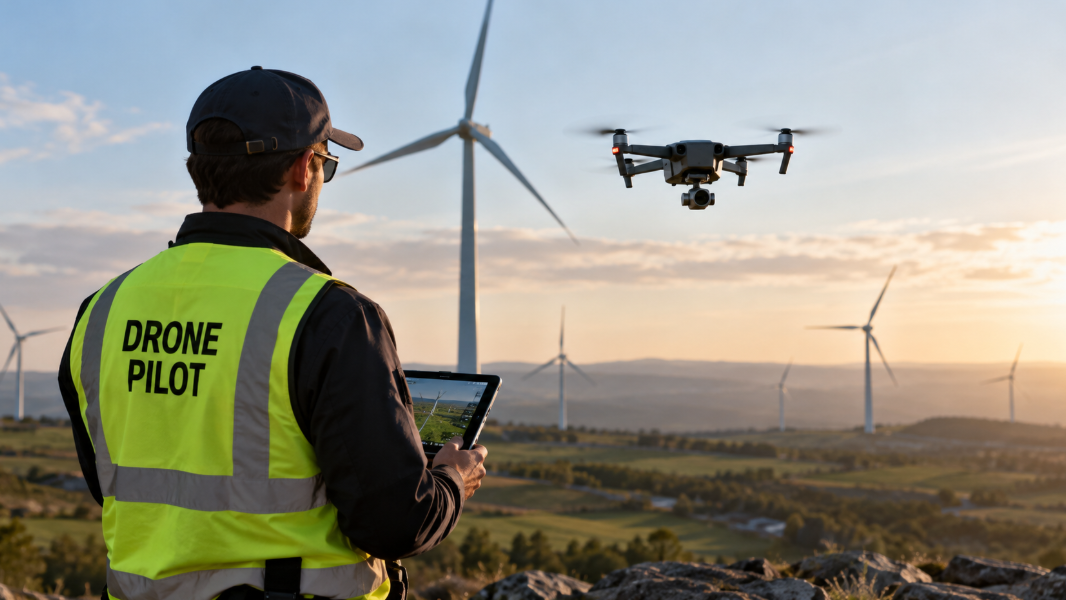
Becoming the person someone trusts to fly a drone around a wind turbine, solar farm, construction site, telecommunications tower or other working environment is a different matter.
Professional drone training should teach you more than how to take off, land and capture a good-looking aerial shot. You need to understand the airspace you are entering, the aircraft you are operating, the risks around you and what the client expects from the data you collect.
Depending on where you operate, there are also regulatory requirements to meet before you can carry out certain operations.
In the United States, for example, the Federal Aviation Administration requires a Remote Pilot Certificate for pilots operating under Part 107. First-time pilots must pass the Unmanned Aircraft General – Small (UAG) aeronautical knowledge test.
And the exam is not your typical ‘flying test’.
It covers regulations, airspace, weather, aircraft loading and performance, emergency procedures, radio communications, aeronautical decision-making, airport operations, maintenance, preflight inspections and other subjects.
That tells you quite a lot about professional drone operations.
Flying is only part of the job.
What Is A Drone Pilot Aviation Academy?
A drone pilot aviation academy provides structured training in the knowledge and practical skills required to operate unmanned aircraft safely and, depending on the program, professionally.
There is no single universal curriculum because drone regulations and certification systems differ between countries. The type of training you need also changes according to what you intend to do with the aircraft.
Someone preparing for the FAA Part 107 exam has different immediate training needs from a pilot who already holds a Remote Pilot Certificate and wants to conduct thermal inspections.
Likewise, someone flying a lightweight drone recreationally in Europe may face different competency requirements from a pilot preparing for a higher-risk operation in EASA’s Specific category.
That is why choosing an academy purely on the basis that it teaches “drone flying” misses the bigger question.
What will you be able to do with that training?
A useful training path normally starts with aviation knowledge and safe aircraft operation. From there, you can build specialist skills around the type of work you want to perform.
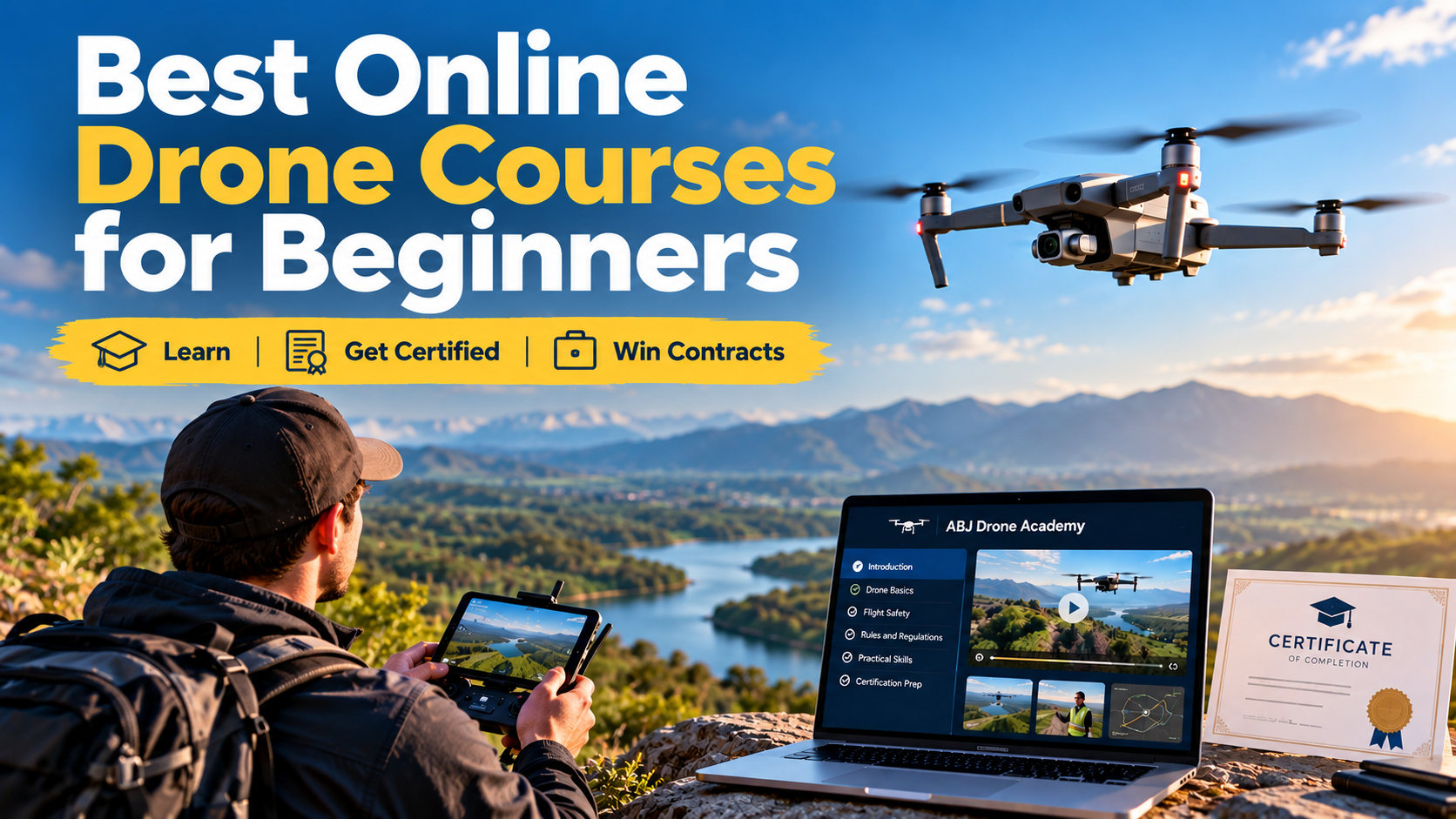
At ABJ Drone Academy, the training model includes online courses alongside in-person ground school and flight training, with additional programs for specialist commercial applications. The academy also provides training for individuals, educational institutions, commercial enterprises and government organisations.
The distinction between general drone pilot knowledge and specialist knowledge becomes important once you start looking at commercial work.
Learning To Fly Is The Beginning
Your first flights are understandably about the aircraft.
- How does it respond?
- How do you maintain orientation?
- What happens when GPS becomes unreliable?
- How do you land accurately?
Those skills are key. But commercial operations quickly introduce decisions that have more to do beyond moving the sticks.
Suppose you have been hired to inspect an asset.
Before launching, you may need to consider airspace, nearby people, obstacles, weather, electromagnetic interference, aircraft performance, emergency procedures and the purpose of the mission itself.
Then there is the data.
If your client needs a thermal inspection, ordinary RGB photographs will not answer the question they hired you to investigate. If the job requires a geometrically useful model of a site, casually flying around taking photographs is not enough.
Professional training therefore starts to move from “Can you fly a drone?” toward “Can you perform this operation correctly?”
That is a much higher bar.
Start With Aviation Knowledge
A drone may be considerably smaller than a conventional aircraft, but professional pilots still operate within an aviation system.
In the United States, the FAA’s Part 107 knowledge requirements make that clear. Topics include airspace classification, flight restrictions, aviation weather, loading and performance, emergency procedures, crew resource management and airport operations.
For first-time pilots, the FAA requires you to obtain an FAA Tracking Number, schedule the UAG knowledge test through an approved testing centre, pass the test and then apply for the Remote Pilot Certificate through IACRA. Certificate holders must also maintain their aeronautical knowledge recency through recurrent training every 24 calendar months.
If you are preparing for that route, a Part 107 preparatory drone training course can help you work through areas including regulations, airspace, weather, radio procedures, airport operations, maintenance, inspections and decision-making.
But passing an exam should not be confused with completing your development as a pilot.
The certificate establishes an important regulatory foundation. Your next question is what kind of operations you want to perform.
Build Practical Flight Skills
Knowing what controlled airspace is does not automatically make you comfortable handling an aircraft when something unexpected happens.
Practical training gives you a chance to turn theoretical knowledge into operating habits.
That includes ordinary procedures such as aircraft setup, flight planning, preflight checks, take-off, manoeuvring and landing. It should also include abnormal situations.
- What happens when another aircraft enters the area?
- What do you do when a member of the public walks into your operating area?
- How do you respond to a loss of connectivity?
- What happens if the aircraft loses GPS?
These are not particularly glamorous parts of drone training. They are, however, exactly the kind of situations where preparation matters.
A good pilot is not simply someone who can make a drone do what they want when everything works correctly.
You also need to know what to do when it doesn’t.
Choose A Commercial Specialisation
Once you have built the appropriate regulatory and flight foundation, you can start developing skills around a particular type of work.
That could mean surveying, thermography, telecommunications, photography, videography, multispectral imaging or infrastructure inspection.
Surveying And 3D Modeling
A mapping mission requires deliberate data collection.
You need sufficient overlap between images, appropriate flight planning and an understanding of how captured imagery becomes the final map or model.
ABJ’s Drone Surveying and 3D Modeling course covers maps, 3D models, geographical data, visual photogrammetry, capture methods and processing. The course is intended for pilots looking to move into surveying, mapping or modeling work.
Drone Thermography
Thermal cameras introduce another set of skills.
Pilots working with thermal payloads need to understand infrared science, thermal physics, camera operation and the factors that affect interpretation.
The Drone Thermography Level 1 Certification course covers thermal camera operation, interpretation of thermal images, thermal orthomosaics and applications including infrastructure, power lines, construction and solar arrays.
Consider a solar inspection. The value comes from collecting thermal data as you fly above the modules under suitable conditions and understanding what that data can tell the people responsible for the asset.
Multispectral Imaging
Agricultural drone operations can require another type of sensor altogether.
Multispectral cameras capture information across selected wavelength bands, including information outside the range visible to the human eye.
That can support analysis associated with crops, soil, fertilisation and irrigation.
A pilot entering this field therefore needs more than basic camera skills. ABJ’s Drone Multispectral Imaging course covers the scientific principles behind multispectral cameras as well as flight planning, data collection and analysis for agricultural applications.
Once again, the aircraft is the collection platform.
The professional skill lies in knowing what to collect, how to collect it and how that information relates to the client’s work.
Telecommunications
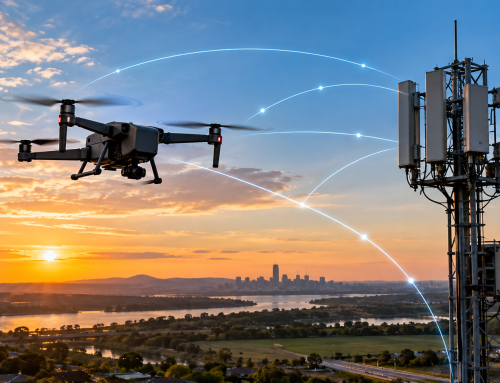
Flying close to telecommunications infrastructure introduces hazards that a pilot photographing a property may never encounter.
Radio-frequency environments are an obvious example.
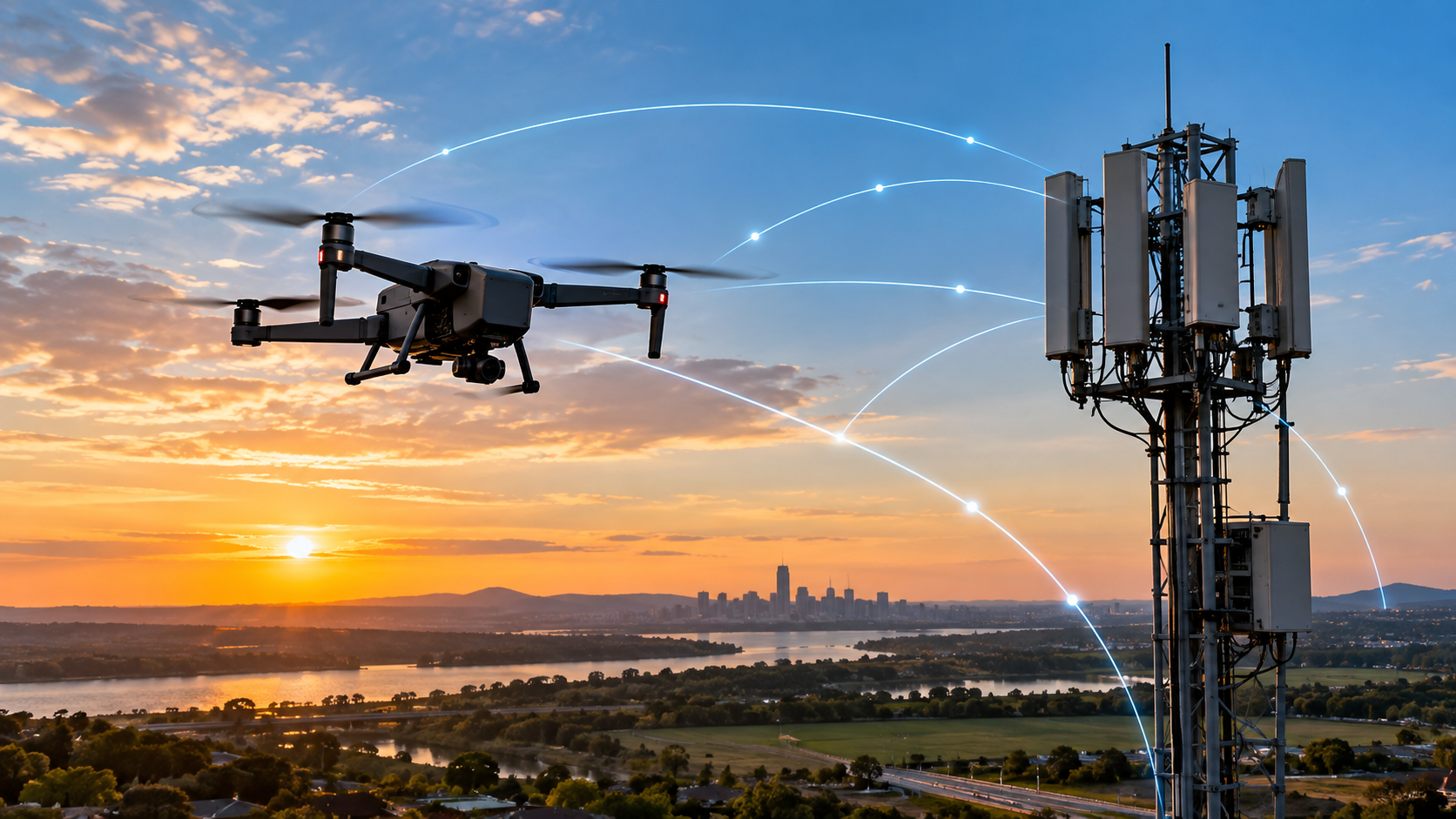
ABJ’s telecommunications drone training covers electromagnetic energy, radio frequencies, wireless infrastructure and the types of transmitting equipment that can affect both the pilot and the UAS.
A capable general drone pilot does not automatically understand every environment in which a drone can operate. That’s why you go for specialist training.
Rules of Where You Fly
Regulations are jurisdiction-specific.
The FAA Part 107 system applies in the United States. Europe operates under a different framework.
Under EASA rules, for example, Open-category operations are divided into A1, A2 and A3, with different operating restrictions and competency requirements depending on the aircraft and operation.
Higher-risk operations can move into the Specific category.
There, training requirements depend on the operation being conducted. For operations under a standard scenario, EASA states that remote pilots must hold the relevant theoretical knowledge certificate and accreditation for practical skill training. For other Specific-category operations, training may be determined through the risk assessment and operational authorisation process.
So one certificate doesn’t automatically qualifies you to perform every type of commercial drone operation everywhere.
Check the aviation authority responsible for the country in which you intend to fly and the rules applying to the operation you intend to conduct.
Learn How Real Drone Operations Work
Look beyond the course title and ask what happens after the aircraft leaves the ground.
What does the pilot need to collect?
- What can interfere with the mission?
- How should the data be captured?
- What does the customer eventually receive?
- This becomes particularly clear in infrastructure inspection.
ABJ Drones’ commercial inspection operations cover areas including wind turbines, solar farms, power lines and cell towers.
Take a wind turbine for instance. An inspection mission needs usable imagery or other sensor data that supports assessment of the asset.
The same principle applies elsewhere.
On a mapping project, the deliverable may be an orthomosaic or 3D model.
On a thermal mission, it may be infrared data showing areas that warrant further investigation.
On an agricultural mission, the customer may need multispectral information.
Professional drone pilots need to think about the required output before planning the flight.
Don’t Confuse Certification With Specialisation
These two things solve different problems.
A regulatory credential demonstrates that you have met the applicable requirements to operate within a particular framework.
Specialist training prepares you for a particular type of work.
You can hold an FAA Remote Pilot Certificate without knowing how to build a photogrammetric model.
You can understand thermal imaging without automatically having permission to conduct every drone operation you might want to perform.
You need both regulatory compliance and mission-specific competence where the job demands it.
This is also why your training path does not necessarily end with one large course.
So a more practical route looks like this:
Regulatory requirements → practical flight skills → specialist training → supervised or real-world experience → continuing development.
Your exact route will depend on where you live and the type of work you want.
What Should You Look For In A Drone Pilot Aviation Academy?
Start with the curriculum.
If most of the program is about the drone itself, look more closely. Professional operations involve considerably more than aircraft controls.
You should be able to see how the training addresses relevant regulations, airspace, flight planning, risk, emergency response and operational decision-making.
Then look at specialist options.
If your goal is infrastructure inspection, does the academy teach inspection-related subjects? If you want to work with thermal cameras, is thermography covered properly? If you want to create maps, will you learn data capture and photogrammetry rather than simply aerial photography?
Finally, consider where the training material comes from.
Industry experience matters because operating conditions are rarely as neat as classroom examples.
ABJ Drone Academy programs draw on pilots with field experience ranging from photography to energy infrastructure inspection and offers both foundational and specialist training. It also provides programs for professional individuals, colleges and universities, commercial organisations and government agencies.
Your Drone Career Is Bigger Than The Aircraft
It is easy to become preoccupied with equipment when entering the drone industry.
- Which drone should you buy?
- Which camera has the best resolution?
- Do you need RTK?
- Should you invest in thermal?
A skilled pilot can understand why a mission needs a particular aircraft, sensor, flight plan and operating procedure. Buying expensive equipment without that knowledge simply gives you expensive equipment.
Your aim should be to become useful on a job site.
That may mean becoming exceptionally good at mapping. Perhaps it is thermal inspection. Maybe your route takes you into renewable energy, telecommunications, agriculture or another specialist field.
The drone is the tool you use to get there.
A drone pilot aviation academy should help you understand both sides of that equation: how to operate an unmanned aircraft safely within the aviation system and how to use it competently for real work.
Frequently Asked Questions
What Is A Drone Pilot Aviation Academy?
A drone pilot aviation academy teaches the knowledge and skills needed to operate drones safely and, depending on the program, professionally. Training may cover aviation regulations, airspace, weather, aircraft operation, flight planning, emergency procedures and specialist commercial applications.
Do I Need Drone Training To Become A Commercial Pilot?
The requirements depend on the country and type of operation you intend to perform. In the United States, pilots operating under Part 107 need an FAA Remote Pilot Certificate, while other jurisdictions have their own certification and competency frameworks. Always check the current requirements of the relevant aviation authority.
Do I Need An FAA Part 107 Certificate To Fly Drones For Work In The United States?
You need a Remote Pilot Certificate to act as remote pilot in command under Part 107. The FAA requires first-time applicants to meet its eligibility requirements, pass the UAG aeronautical knowledge test and complete the certification process.
Is Passing Part 107 Enough To Become A Professional Drone Pilot?
Passing Part 107 gives you the regulatory credential required for Part 107 operations, but commercial competence can require additional skills. Surveying, thermography, multispectral imaging and infrastructure inspection each involve knowledge that goes beyond the subjects needed for the initial FAA certificate.
Can I Take Drone Pilot Training Online?
Yes, many areas of drone pilot training can be completed online. Theory, exam preparation and specialist subjects can work particularly well online, while practical flight training provides direct experience with aircraft operation and real-world procedures.
What Specialist Skills Can A Drone Pilot Learn?
Drone pilots can specialise in areas such as surveying, 3D modeling, thermography, multispectral imaging, photography, videography and infrastructure inspection. The right specialisation depends on the industry you want to enter and the type of data or service customers need.
How Long Does It Take To Become A Drone Pilot?
There is no single training period that applies to every drone pilot. Preparing for an initial regulatory certificate can take considerably less time than developing the technical knowledge and field experience required for specialist commercial work.
How Do I Choose The Right Drone Pilot Aviation Academy?
Choose an academy whose curriculum matches both the regulations in your operating region and the work you want to perform. Look beyond basic flight instruction and examine whether the program covers aviation knowledge, safe operations, practical skills and relevant specialist applications.
Should I Buy A Professional Drone Before Starting Training?
You do not necessarily need to buy an expensive professional drone before beginning your training. First determine the type of operations you want to perform and the equipment those jobs actually require. That can prevent you from spending thousands on an aircraft or sensor that does not fit your intended work.
What Comes After Drone Pilot Training?
The next step is to build experience in the type of operation you want to perform. Continue developing your flight skills, maintain any required regulatory credentials, learn the equipment and software used in your chosen field, and build experience producing the deliverables that customers actually need.