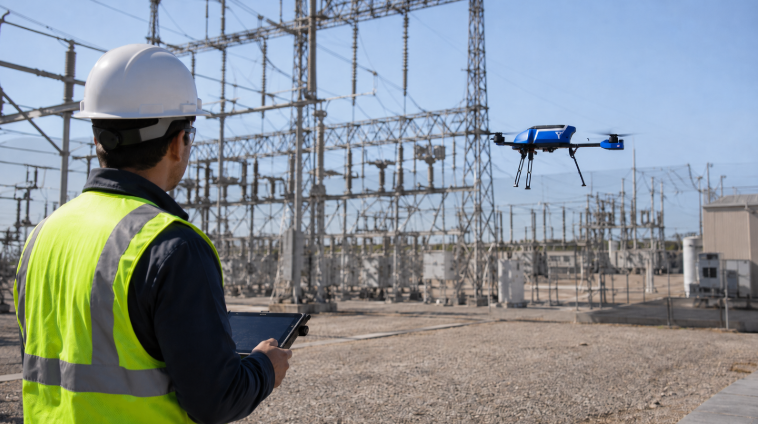
America’s industrial UAV market has entered a new phase.
For years, many drone conversations focussed on how long they could fly. That still counts. Flight time affects productivity, safety margins, mission planning and the number of batteries you carry into the field.
But if you work in infrastructure, energy, public safety, surveying, inspection or environmental monitoring, flight time is just part of it
You also want to know what the drone can carry. Can it support LiDAR, thermal, optical gas imaging, multispectral or other specialist payloads? How does it handle wind, rain, terrain changes, electromagnetic interference? Especially on those long days away from a clean office environment.
And for the United States in particular, there’s the policy issue that has made its way into purchasing decisions: where was the drone built, and can it survive the new scrutiny around foreign drones?
That is the environment Vision Aerial is stepping into with the Vulcan drone platform. One where the drone market is putting more emphasis on payload flexibility, domestic supply chains, field durability and platforms built around mission data instead of just aerial footage.
What Is the Vulcan Drone?
The Vulcan is Vision Aerial’s industrial drone platform built for professional field missions.
The smaller model, Vulcan SX, is a medium-lift compact UAS. The larger model, Vulcan YX, is a heavy-lift multimodal UAS designed for bigger payload demands and multi-sensor work.
The shared Vulcan drone platform features include active terrain following, forward collision avoidance, integrated RTK GNSS, dual-band L1/L5 GNSS, onboard edge computing, Flight Deck v4 mission planning, field-swappable payloads, a smart dovetail payload interface, IP54 rain rating, low EMI/RFI design and a redundant power architecture.
Put simply, Vulcan is meant for operators who fly along power corridors, over mine sites, around industrial assets, across rough terrain, near oil and gas infrastructure, through mapping projects and into locations where the data is valuable but the conditions are rarely perfect.
And it couldn’t have arrived at a more opportune time.
Workflow and Policy Factor
Industrial drone users are changing what they expect from aircraft. Just a while back, organizations were still proving that drones could reduce inspection costs or improve safety. Today, drones are being written into standard operating procedures. They are becoming part of how companies inspect assets, monitor risk, document progress and respond to emergencies.
At the same time, the United States has tightened its treatment of foreign drones. FCC’s ban on foreign-made drones created a major shift for operators, manufacturers and buyers who depend on imported systems or components.
The policy environment (federal rules, procurement policies and national security reviews) is pushing buyers to look harder at supply chains. A drone purchase has become a technology decision, a compliance decision and, for some buyers, a procurement-risk decision.
That creates a more favorable opening for American-built industrial platforms like Vulcan.
Vision Aerial: The Company Behind Vulcan
Vision Aerial is based in Bozeman, Montana, and positions itself as an American drone manufacturer for demanding field work.
The company designs, manufactures, assembles and tests its systems domestically. Its U.S.-made components include airframes, fuselage structures, printed circuit boards, electronic speed controllers, motors, props and rotors, wire harnesses, flight control systems, navigation systems and electronics.
That domestic manufacturing sits at the center of the Vulcan story.
For a hobby pilot, country of manufacture may feel like a distant policy issue. For a utility, government agency, public safety department, energy company or federally funded project, it can become central to whether a platform is even eligible for purchase.
Vision Aerial’s advantage is that it has been big on American manufacturing, NDAA compliance and field-specific aircraft for years. Vulcan gives the company a newer platform around which to build that positioning.
Vulcan SX: The Medium-Lift Workhorse
The Vulcan SX is the smaller of the two Vulcan aircraft, but “smaller” here still means serious professional capability.
The multirotor tricopter comes with a payload capacity of up to 3 kg, top or belly payload mounts, endurance of up to 65 minutes, and around 40 minutes of flight with a 3 kg payload. It has a listed top speed of 20 m/s, or about 45 mph, and a listed wind tolerance of 14 m/s, or about 32 mph.
Where Vulcan SX Fits
The SX looks best suited to operators who need enough payload capacity for professional sensors without moving into a larger heavy-lift aircraft.
That could include:
- Utility inspection teams carrying thermal and visual payloads
- Surveying teams using mapping cameras or compact LiDAR
- Environmental monitoring teams using multispectral sensors
- Public safety teams that need a rugged field aircraft
- Industrial inspection teams that want longer flight time and payload flexibility
The medium-lift category is especially useful because many field teams do not need maximum payload every day. They need a drone that can do repeatable work, travel well, deploy quickly and carry the sensors required for common missions.
The SX gives Vision Aerial a practical entry point into that daily-use industrial category.
Why the Tricopter Design Stands Out
The SX uses a tricopter design. Vision Aerial has long leaned into tricopter architecture with some of its previous platforms, and the same design philosophy appears in Vulcan SX.
A tricopter can offer efficiency advantages because fewer rotors can allow larger propellers, which can improve endurance and handling. For field operators, the value shows up in long flights, controlled hovering and portability.
The design choice also gives Vision Aerial a more recognizable platform identity. Many industrial drones look similar from a distance. A tricopter layout helps the SX stand apart visually and functionally.
Vulcan YX: The Heavy-Lift Multimodal Option
The Vulcan YX is the bigger aircraft in the family.
It is an offset Y-6 airframe with a payload capacity of up to 10 kg in multimodal use, endurance of up to 60 minutes, and a heavy-payload configuration of up to 15 kg for 10 minutes. It has a listed top speed of 20 m/s, or about 45 mph, and wind tolerance of 15 m/s, or about 33 mph.
What “Multimodal” Means in the Field
Multimodal capability is one of the more interesting parts of the YX.
This means the drone can support more complex payload setups. The Vulcan YX can complete missions with field-swappable payloads and fly multiple payloads simultaneously.
That matters for operators who want to reduce repeat flights. Like when you’re at a site where you need high-resolution optical imagery, thermal information and LiDAR data. A smaller or less flexible aircraft may force you to fly several missions, swap gear repeatedly or bring multiple drones.
A heavier platform gives you more room to build the mission around the data you need.
Where Vulcan YX Fits
The YX is the stronger candidate for heavier and more specialized industrial work.
Possible use cases include:
- LiDAR mapping over large or complex sites
- Energy infrastructure inspection
- Oil and gas monitoring
- Mine mapping and volumetric surveys
- Research payload deployment
- Multi-sensor public safety operations
- Heavy-payload testing and specialized field missions
The YX will appeal to organizations that already understand their payload requirements and need an aircraft that can grow with their program.
For a new drone team, it may be more aircraft than needed. For a mature program handling advanced sensors, it becomes far more interesting.
Payload Flexibility Is the Heart of the Vulcan Operations
A basic camera drone captures images. An industrial drone collects evidence, measurements, thermal signatures, vegetation data, gas-related indicators, 3D models, inspection records and operational intelligence.
An integral part of Vulcan is its payload support, including:
Optical Payloads
Optical cameras remain essential. They support inspection, documentation, mapping, asset records, site monitoring and visual reporting.
For blade inspections, powerline inspection, construction documentation or post-incident assessment, clean optical imagery gives teams a reference they can understand quickly.
Thermal and Visible Payloads
Thermal data is useful in solar farms, electrical systems, building inspections, search operations, industrial maintenance and energy audits.
Thermal payloads help teams identify heat patterns that may point to underperforming components, insulation problems, electrical stress or other issues needing closer review.
LiDAR Payloads
LiDAR is valuable when dealing with shape, distance and elevation metrics.
Surveyors, engineers, mine operators, construction teams and infrastructure managers use LiDAR to create accurate 3D models, map terrain, measure stockpiles, inspect corridors and document assets.
A drone with meaningful payload capacity becomes more useful when it can carry higher-quality LiDAR systems without crushing endurance.
Optical Gas Imaging Payloads
Optical gas imaging is relevant in oil and gas, industrial safety and emissions monitoring.
A drone carrying an OGI payload can help teams inspect assets from safer positions and reach areas that may be difficult or hazardous for people to access manually.
Multispectral and Hyperspectral Payloads
Multispectral and hyperspectral sensors are used in agriculture, forestry, environmental monitoring, research and land management.
These payloads can reveal patterns that standard RGB imagery may miss, especially where vegetation health, stress, moisture, species differences or surface conditions are part of the question.
Meteorological Payloads
Meteorological payloads add another layer for environmental, research and emergency-response applications.
Weather data collected close to the mission site can improve situational awareness, especially in wildfire, environmental monitoring and research contexts.
Built for Industrial Conditions
Industrial drones live hard lives.
They get packed into vehicles. They work in dust, light rain, wind, remote terrain and electromagnetic environments that make consumer-style flying more complicated. They land near roads, substations, industrial plants, agricultural fields and construction zones.
That is why Vulcan’s field features deserve attention.
IP54 Rain Rating
Vision Aerial lists Vulcan as IP54 rain rated.
An IP54 rating generally indicates protection against limited dust ingress and water spray from multiple directions. For field teams, this can expand the operating window when conditions are less than perfect.
You still need safe weather judgment. Rain rating does not mean careless flying. But it helps when inspection windows are tight and the weather refuses to behave politely.
Low EMI/RFI Design
Industrial sites can be noisy environments for electronics.
Power infrastructure, communications equipment, metal structures and industrial machinery can create electromagnetic and radio-frequency interference. Vulcan has a low EMI/RFI armored design.
That feature is especially relevant for operators flying around infrastructure where signal quality and aircraft stability are part of mission safety.
Redundant Power Architecture
The platform has a fault-tolerant, fully redundant power architecture.
For industrial drone buyers, redundancy is a confidence feature. When payloads are expensive and missions happen near valuable assets, teams want systems designed with failure resistance in mind.
Active Terrain Following
Active terrain following helps drones adjust to changes in elevation.
This is useful in mapping, mining, agriculture, utilities, forestry and corridor inspections. Instead of maintaining a simple fixed altitude above takeoff point, the drone can better follow the shape of the ground below.
That helps improve data consistency, especially for mapping and sensor-based work.
Forward Collision Avoidance
Forward collision avoidance helps reduce risk during low-altitude or infrastructure-adjacent flights.
No avoidance system replaces a trained pilot or a good risk assessment. Still, extra sensing can improve mission safety in environments where terrain, towers, trees, cables, vehicles or structures complicate the airspace.
Integrated RTK GNSS
RTK GNSS supports more accurate positioning.
For mapping, inspection repeatability, corridor work and survey-grade workflows, positioning accuracy can influence the quality and usefulness of the final data product.
Vulcan’s integrated RTK GNSS and dual-band L1/L5 support place it closer to professional mapping and inspection workflows than casual aerial photography.
Flight Deck v4: The Software Side of the Platform
Hardware gets the attention, but software shapes the workday.
Vulcan uses Flight Deck v4 for mission planning and that it does not require a subscription. For operators who manage budgets across aircraft, batteries, sensors, training, insurance, data processing and maintenance, subscription-free mission planning can be a practical selling point.
The software also connects to a larger trend in the drone industry.
Professional drone operations are becoming less about the aircraft alone and more about workflow. Planning, execution, geotagging, upload, processing, reporting and asset management all shape whether a drone program saves money or becomes another complicated tool nobody wants to use.
Vision Aerial has also announced a strategic partnership with Pix4D, linking its drone platforms with mapping workflows. For surveying and inspection users, that kind of ecosystem thinking helps turn flights into deliverables.
The U.S. Policy Shift Around Foreign Drones
What is the current U.S. policy climate around foreign drones?
The FCC released a public notice in December 2025 announcing the addition of UAS and UAS critical components produced abroad to the Covered List. The notice tied the move to a national security determination and the FY2025 National Defense Authorization Act.
This affects drone buyers. Foreign-produced UAS and critical components face tighter restrictions when it comes to new FCC equipment authorizations.
Existing aircraft may still be legally flyable, but the bigger concern is future availability, replacement parts, repairs, procurement eligibility and long-term business planning.
Procurement Is Becoming a Strategic Risk
The Federal Register’s interim rule implementing the American Security Drone Act prohibits executive agencies from procuring certain covered foreign UAS. From December 22, 2025, it also addresses operation and the use of federal funds for covered systems unless an exemption, exception or waiver applies.
That does not mean every private company must immediately replace every foreign drone in its fleet. The story is more layered.
A roof inspector flying private commercial jobs faces a different reality from a contractor serving federally funded infrastructure projects. A farmer has different pressures from a public safety department. A survey firm serving private construction clients may have more flexibility than a team bidding on government-funded work.
Still, the direction of travel is visible. Buyers increasingly want fewer future headaches. They want systems that are easier to defend in procurement discussions.
That is where American-built and NDAA-compliant platforms gain momentum.
NDAA Compliance and Blue/Green UAS: What Buyers Should Understand
Vision Aerial lists Vulcan as NDAA compliant, while the Blue/Green UAS Program certification remains pending.
NDAA Compliance
NDAA compliance generally refers to meeting restrictions linked to U.S. defense authorization laws and related procurement rules. In the drone world, buyers often use the term as shorthand for avoiding certain restricted foreign components, manufacturers or supply-chain risks.
For some buyers, NDAA compliance is a requirement. For others, it is a preference. For many, it is a way to reduce uncertainty when buying technology that could be used around sensitive assets.
Green UAS
Green UAS is a cybersecurity and supply-chain compliance certification for drones, components and software. The program is designed to help commercial and non-defense users acquire secure, NDAA-compliant technologies.
Green UAS certification looks at areas such as product and device security, supply-chain risk management, corporate cyber hygiene, remote operations and connectivity.
Blue UAS
Blue UAS is associated with U.S. government and defense procurement pathways. Green UAS now serves as a streamlined pathway into the Blue UAS ecosystem through alignment with the Defense Innovation Unit.
For buyers, read certification language carefully. “NDAA compliant” and “Blue/Green UAS Program cert pending” are not the same thing as full certification already granted.
Application Areas of the Vulcan Drones
Vulcan’s value depends on which payload you pair with it and how mature your drone program is.
Energy and Utilities
Energy and utility operators need regular inspections across distributed, high-value assets.
Vulcan SX could support visual and thermal inspections, while Vulcan YX could support heavier payloads or multi-sensor missions. The ability to carry LiDAR, thermal, visible and other payloads makes the platform relevant for power corridors, substations, pipelines, oil and gas sites, wind-farm supporting infrastructure and industrial energy assets.
Surveying, Mapping and AEC
Architecture, engineering and construction teams need accurate site records.
With LiDAR or photogrammetry payloads, Vulcan can support terrain mapping, progress documentation, stockpile measurement, corridor mapping and site planning.
The SX may suit everyday mapping jobs. The YX is more relevant where heavier sensors or multimodal data capture are required.
Public Safety and Emergency Response
Public safety teams often need rugged drones that can deploy quickly and carry mission-specific sensors.
Thermal imaging, optical zoom, mapping and meteorological payloads can support search operations, fire assessment, incident documentation and situational awareness.
For U.S. public agencies, procurement compliance can influence purchasing decisions as much as performance.
Agriculture and Environmental Monitoring
Agriculture and environmental teams need sensor flexibility.
Multispectral, hyperspectral, thermal and meteorological payloads can support crop analysis, vegetation monitoring, restoration tracking, water-related monitoring and research-grade field studies.
A longer-endurance medium-lift aircraft can be especially useful where field teams cover large areas and need repeatable data collection.
Mining and Industrial Sites
Mining operators and industrial asset owners often work in rugged environments.
Vulcan YX’s heavier payload capacity and wind tolerance make it relevant for LiDAR mapping, stockpile measurement, site monitoring, safety inspections and environmental documentation.
Mobix Labs and the Aerial Intelligence
Vulcan became even more interesting after Mobix Labs announced a proposed acquisition of Vision Aerial.
On June 4, 2026, Mobix Labs announced that it had signed a binding letter of intent to acquire the Montana-based manufacturer of American-built drones.
The proposed transaction was not complete at the announcement stage. Mobix Labs said completion remained subject to definitive agreements, due diligence, customary closing conditions and approvals.
A follow-up Mobix Labs release said the proposed acquisition would combine Vision Aerial’s U.S.-built drone platforms with Mobix Labs’ electronics, RF and sensing capabilities.
And that is an important point.
Drone companies are increasingly being valued for more than airframes. Sensors, connectivity, secure communications, edge computing, data workflows and mission intelligence are becoming part of the same conversation.
Vulcan fits into that broader “aerial intelligence” trend.
What Makes Vulcan Stand Out
Vulcan stands out because it connects several market shifts at once.
1. It Is Built Around Payloads
The platform supports multiple sensor categories, including optical, OGI, LiDAR, thermal, multispectral, hyperspectral and meteorological payloads.
That gives the aircraft relevance across inspection, mapping, monitoring and response work.
2. It Offers Two Aircraft in One Platform Family
The SX gives operators a medium-lift option. The YX gives them a heavy-lift option.
That helps organizations avoid buying completely separate ecosystems for different mission classes.
3. It Speaks Directly to U.S. Procurement Concerns
American-built, NDAA-compliant positioning is becoming more valuable.
As U.S. rules tighten around foreign drones, buyers in government, public safety, infrastructure and federally funded work are looking for platforms that create fewer compliance questions.
4. It Is Designed for Field Conditions
IP54 rain rating, wind tolerance, low EMI/RFI design, terrain following and forward collision avoidance all point toward real operating environments.
These features are especially relevant for users working outside clean, controlled demo settings.
5. It Has a Growth Story Behind It
The proposed Mobix Labs transaction gives Vision Aerial a larger strategic context.
If completed, the deal could bring additional electronics, sensing and connectivity capability around Vision Aerial’s drone platforms.
What Buyers Should Consider When Choosing Vulcan
A strong spec sheet should start the buying process, not end it.
Before investing in Vulcan, a serious operator should ask practical questions.
What Payloads Do You Need Integrated?
Payload support is broad, but buyers should confirm the exact sensor they need.
This also includes power requirements, mounting position, data workflow, gimbal support, calibration requirements and payload-specific endurance.
What Is the Real-World Flight Time With Your Payload?
Maximum endurance is useful, but your mission will depend on payload weight, wind, flight speed, altitude, temperature and reserve requirements.
Ask for endurance estimates with your actual sensor package.
What Training and Support Are Included?
Industrial drones need more than a quick start guide.
Ask about pilot training, maintenance support, spare parts, repair timelines, firmware support, warranty terms and field troubleshooting.
What Is the Certification Status Today?
Vulcan is NDAA compliant but the Blue/Green UAS Program certification is pending.
If you are buying for government, public safety or federally funded work, ask for the latest compliance documentation before purchase.
How Does Vulcan Fit Your Data Workflow?
The drone is only one part of the system.
How does Flight Deck v4, payload data, RTK positioning, image processing, LiDAR processing and reporting fit into your team’s existing workflow?
Vulcan’s Opportunity
The U.S. drone market is going through a reset. Operators who built their programs around low-cost foreign drones are now thinking about long-term access, replacements, repairs, compliance and procurement risk.
At the same time, industrial users want more capable aircraft. They want platforms that carry real sensors, work in imperfect conditions and produce data that supports decisions.
Vulcan sits at the intersection of those two shifts.
It gives Vision Aerial a platform family for medium-lift and heavy-lift work. It gives buyers an American-built option in a market increasingly shaped by supply-chain and security concerns. And it gives industrial teams a drone designed around payload flexibility rather than simple aerial imaging.
The platform still has to prove itself in the field, across many customers, payloads and operating environments. That is where industrial drones earn their reputation.
But it’s certainly one of the more interesting American-built industrial drone platforms to watch going forward.
FAQ
What is the Vision Aerial Vulcan drone?
The Vision Aerial Vulcan drone is an American-built industrial UAS platform designed for professional inspection, mapping, monitoring and sensor-based missions. It comes in two models: the medium-lift Vulcan SX and the heavy-lift Vulcan YX.
What is the difference between Vulcan SX and Vulcan YX?
The Vulcan SX is the medium-lift model, while the Vulcan YX is the heavy-lift multimodal model. The SX carries up to 3 kg and is suited to frequent field missions, while the YX carries up to 10 kg in multimodal use and can support heavier or multiple payloads.
How long can the Vulcan drone fly?
The Vulcan SX is listed with endurance of up to 65 minutes, while the Vulcan YX is listed with endurance of up to 60 minutes. Actual flight time depends on payload weight, weather, mission profile, battery setup and required safety reserves.
What payloads can Vulcan carry?
Vulcan can support optical, optical gas imaging, LiDAR, thermal and visible, multispectral, hyperspectral and meteorological payloads. Buyers should confirm exact payload compatibility with Vision Aerial before purchase.
Is Vulcan NDAA compliant?
Vision Aerial lists Vulcan as NDAA compliant. The company also notes that Blue/Green UAS Program certification is pending, so buyers needing formal procurement documentation should request the latest status directly.
Why is Vulcan relevant to the U.S. foreign-drone debate?
Vulcan is relevant because U.S. policy is moving toward tighter treatment of foreign drones and foreign-produced drone components. That shift makes American-built and procurement-friendly platforms more attractive to government, public safety, infrastructure and federally funded buyers.
Can existing foreign drones still be used in the U.S.?
Existing foreign drones may still be legally flyable depending on the operator, use case and applicable rules. The bigger challenge is future availability, equipment authorization, replacement parts, procurement eligibility and long-term fleet planning.
Who is Vulcan best suited for?
Vulcan is best suited for industrial, government, public safety, energy, infrastructure, mapping, environmental and research users. It is designed for teams that need payload flexibility, field durability and professional mission workflows.
Is the Mobix Labs acquisition of Vision Aerial complete?
The Mobix Labs acquisition was not complete at the announcement stage. Mobix Labs said the proposed transaction remained subject to definitive agreements, due diligence, closing conditions and approvals.
Should a beginner drone pilot buy Vulcan?
A beginner drone pilot should only consider Vulcan after understanding their commercial use case, payload needs, training requirements and budget. Vulcan is a professional industrial platform, so it makes more sense for serious operations than casual flying.