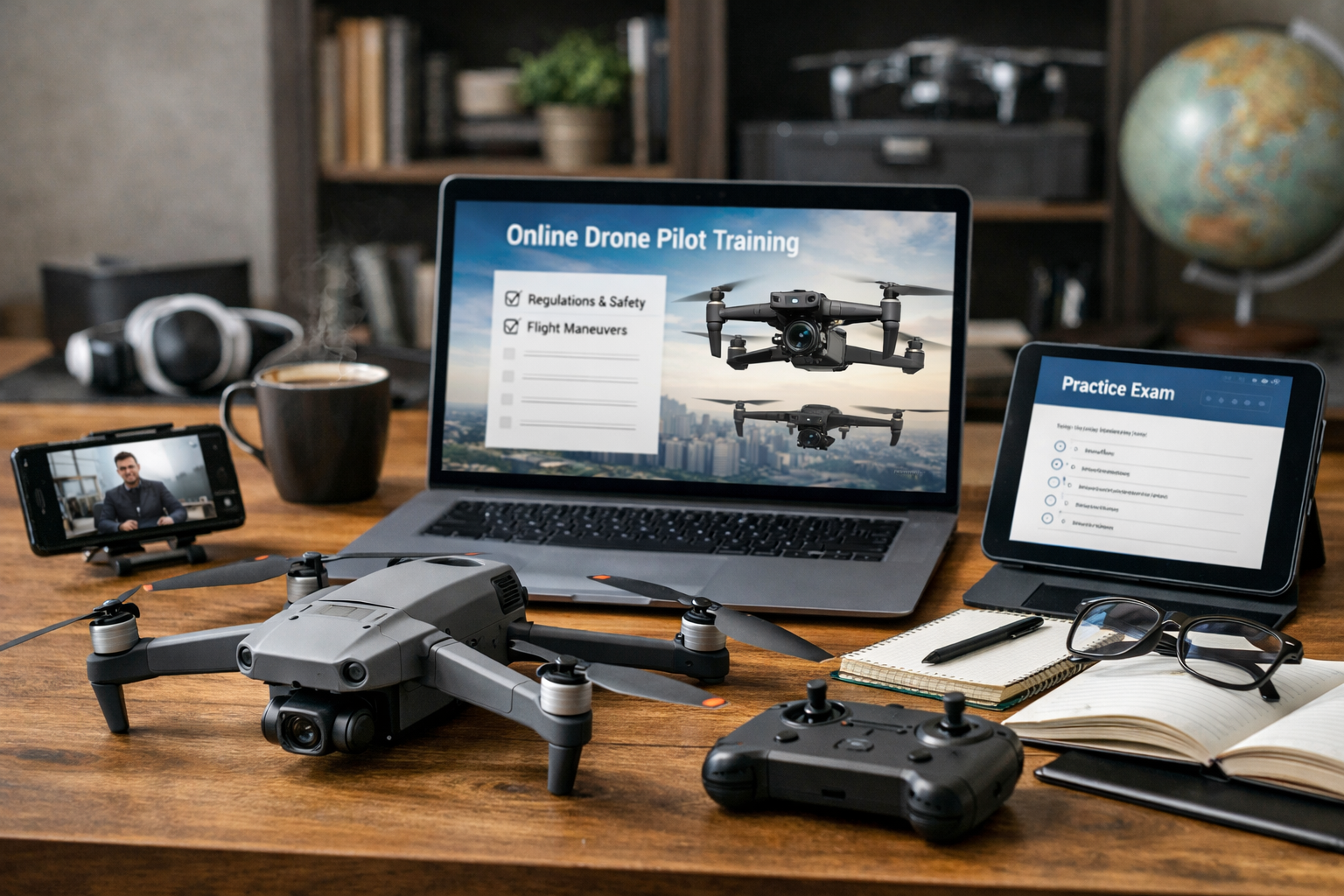
You want two things: the legal right to fly, and the skills to fly well.
Online courses can cover a huge chunk of the licensing journey, especially the knowledge side. Note that “drone pilot license” doesn’t mean the exact same thing everywhere, and the steps look different depending on whether you’re flying in the U.S. or under Europe’s EASA-style rules.
Either way, getting trained online is worth it. The U.S. aviation regulator’s public stats page lists 837,513 registered drones and 481,760 certificated remote pilots as of today. Across the pond, the drone ecosystem is also massive: a May 2025 EASA press release says there are more than two million registered drone operators in Europe. (Updated data is available at the IAM Hub drone economy dashboard).
Online drone courses are popular because they equip consumers and commercial operators with the skills they need to accomplish their projects. Still, licensing is a legal process, not just a “finish a course and you’re done” situation. You’ll usually need a government-issued certificate, an operator registration (in many cases), and ongoing compliance steps like keeping your knowledge current and meeting Remote ID rules.
Start With the Right License for Your Goals
Before you sign up for any course, it helps to get clear on what you’re actually trying to do. There are two common reasons people look for a “license”:
- You want to fly for work (paid gigs, business content, real estate shoots, inspections, mapping, construction progress, public safety support, and so on).
In the U.S., that points you toward the FAA’s Remote Pilot Certificate under 14 CFR Part 107 (often called “Part 107”).
In Europe, it starts with an Open category remote pilot certificate (A1/A3) and may expand into A2 or “Specific” category credentials depending on the risk and the scenario.
- Or you want to fly for fun. In the U.S., recreational flying can fall under the statutory exception in 49 U.S.C. § 44809 (and you’ll typically take the free online TRUST test).
In Europe, even hobby flights can still require operator registration and a remote pilot competency step depending on weight, sensors (like a camera), and whether the drone qualifies as a toy.
One more thing that trips people up: in Europe, “operator” and “remote pilot” are not the same role. Operator registration is tied to the person or company responsible for the flight, while the remote pilot is the person actually holding the controls.
Once you register, you get an operator registration number that you display on your drones and upload into the drone’s remote identification system. That distinction matters when you pick training, because some online courses focus on pilot competence while others focus on operator compliance.
What Can Be Done Online and What Cannot
In the U.S., you can do most learning online, but the initial Part 107 path still includes an in-person knowledge exam for most first-time remote pilots. First-time pilots must pass the “Unmanned Aircraft General – Small (UAG)” knowledge test at an FAA-approved testing center, and the page walks you through getting an FAA Tracking Number (FTN), scheduling, and completing the IACRA application.
There is one major exception: if you already hold a manned-aircraft pilot certificate under Part 61 and you’re current on flight review, You go through an online training path “in lieu of” the initial knowledge test.
In Europe, access is often more online-first at the entry level. For A1/A3, you get a “Proof of completion for online training” by completing online training and passing an online theoretical exam.
For A2, EASA describes extra steps like declaring practical self-training and passing an additional theoretical exam (which may be delivered by the national authority or proctored online depending on the country).
To summarize:
- U.S.: online courses prep you; the initial test is typically in-person.
- Europe: entry-level A1/A3 is often online training + online exam, then you build upward.
The U.S. Step-By-Step Path Through Online Courses
If your goal is to fly for work in the U.S., you start with the Remote Pilot Certificate under Part 107. And yes, you can prep for it online almost entirely.
Think of the process as four phases: choose your rule set, build knowledge online, pass the official steps, then keep your certificate current.
Phase One: Confirm You Actually Need Part 107
If you fly “for work or business,” the FAA points you toward Part 107 (commercial operations under 55 pounds in the NAS).
If you fly strictly for fun, you’re often in recreational territory—where the FAA requires TRUST and proof of completion when asked.
Phase Two: Set Up the Paperwork
For first-time Part 107 pilots, get your FAA Tracking Number (FTN) via the Integrated Airman Certification and Rating Application (IACRA), then schedule a test at an FAA-approved knowledge testing center.
This is where online courses help: you can study while you wait for your test date, and you’ll already have your admin accounts ready when you pass.
Phase Three: Prepare Online, Then Take the Official Knowledge Test
You don’t have to take an in-person class. In fact, no documented pre-test training is required under Part 107 to take the initial aeronautical knowledge test. FAA’s Remote Pilot Study Guide as a good resource to get you started.
That’s the opening for online courses and self-paced study.
Testing centers charge approximately $175 for the initial aeronautical knowledge test.
The common exam format people plan around is 60 questions, two hours, and a 70% passing score.
If you don’t pass on your first try, don’t panic—just plan your retake. However, you must wait 14 calendar days before retaking the initial aeronautical knowledge test. Proper preparation will help you avoid taking retakes.
Phase Four: Apply for the Certificate and Keep It Current
After you pass, you don’t just “have the license” instantly—you still apply through FAA systems. This includes submitting the IACRA application, a TSA security background check, and then printing a temporary certificate before your permanent card arrives by mail.
Finally, staying current is not optional. Certificate holders must complete online recurrent training every 24 calendar months to maintain knowledge recency.
Part 107 pilots take the required recurrent training online (free via FAASTeam), and there are specific online recurrent courses (including ALC-677).
Keep in mind that all drone pilots who are required to register (or have registered) must operate in accordance with the Remote ID rule (compliance through Standard Remote ID drones, broadcast modules, or FRIAs).
>>> Where Can You Legally Fly Without Remote ID?
Part 107 Study Plan You Can Follow
A good online course helps you think like a pilot: identify the airspace, understand who has priority, interpret weather, and recognize when a flight is a bad idea.
Here’s a simple online-first approach that matches the FAA’s topic expectations and how most people actually learn:
Start with the FAA’s official test topic areas. The UAG knowledge test covers regulations, airspace, weather, loading/performance, emergency procedures, crew resource management, communication procedures, maintenance, and night operations, among others.
Stack your study in layers:
Layer One: Learn the Rules and Airspace Basics
This is where most test fails come from, because airspace reading is a skill, not trivia. The FAA literally handles 44,360 average daily flights and counts 19,482 U.S. airports, so the system is busy—your training is basically learning how not to get in the way.
Layer Two: Practice “Exam Thinking” With Timed Questions
Because the exam is 60 questions in two hours with a 70% pass threshold, your practice should include timed runs—not just casual quizzes.
Layer Three: Do a Final “Mission-Style” Review
Before test day, rehearse realistic flight decisions: “Can I fly here?”, “Do I need authorization?”, “What’s my contingency plan?”, and “What paperwork would I need if an inspector asks?”
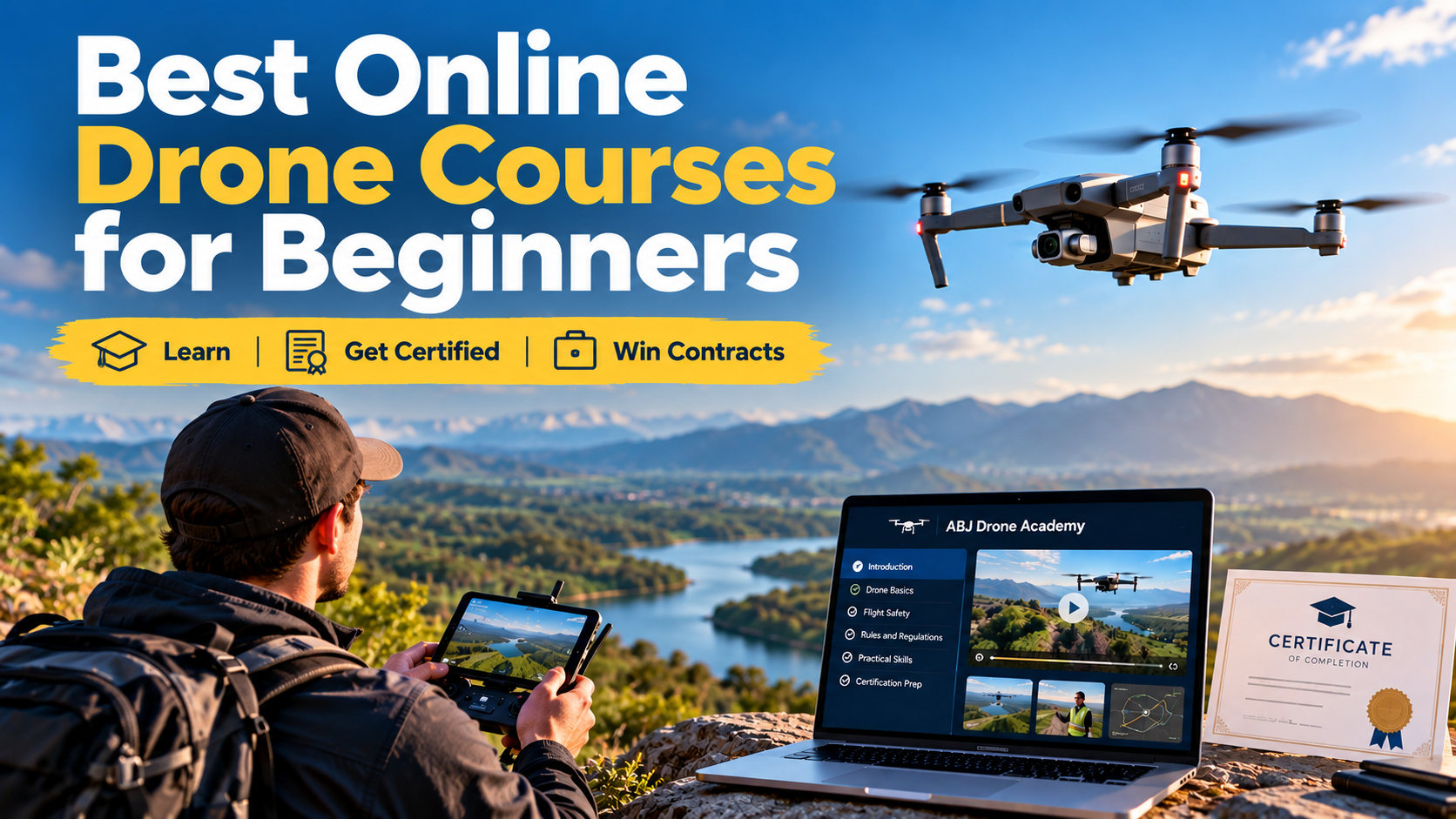
Do you want a structured online prep option that handles FAA knowledge areas? Get the Part 107 Preparatory course from ABJ Academy. It’s an in-depth online course designed to help you pass the FAA Part 107 exam and then take the test at a testing center. You get a guided sequence instead of assembling resources yourself.
One last detail people miss: having a Part 107 certificate is also tied to who can legally touch the controls. The regulation at 14 CFR § 107.12 says no person may manipulate the flight controls unless they have the remote pilot certificate (or they’re under the direct supervision of a remote pilot in command who can immediately take control).
>>> FAA COA vs Part 107 for Public and Commercial Use
The Europe Step-By-Step Path Through Online Courses
In Europe, “getting licensed” usually means following the EASA-style risk-based structure: Open, Specific, and (rarely for most people) Certified.
The backbone rules are Commission Implementing Regulation (EU) 2019/947 (operations and people/process rules) and Commission Delegated Regulation (EU) 2019/945 (product requirements and class markings).
EASA’s Easy Access Rules consolidate these and they’re updated to incorporate amendments.
Here’s how the path usually goeswhen you’re using online training as your main learning channel:
Step One: Figure Out Whether You’re Training as an “Open” Pilot or You Need “Specific”
Most new pilots start in Open category because it’s built for lower-risk flights that don’t require a custom operational authorization. Subcategories (A1, A2, A3) have concrete restrictions that show up in training:
- A1 includes limits like no flight over assemblies of people and a max height of 120 m above ground level.
- A2 adds distance rules like keeping 30 m from uninvolved people (reducible to 5 m if low-speed mode is active), also with the 120 m altitude cap.
- A3 is the “far from people” route, with 150 m horizontal distance from uninvolved people and urban areas, again under 120 m.
That’s why many European students start with A1/A3 online training: it’s the foundation layer that unlocks more options.
Step Two: Register as an Operator (Often Required Even for Hobby Flights)
Aafter registration you receive a drone operator registration number that must be displayed on all drones you own (even home-built) and uploaded into the drone’s remote identification system.
Your operator registration is recognized across EASA member states and you can’t register twice.
So, registration triggers your national portal experience. The details can vary a lot depending on the country, so online courses that are “Europe-wide” are best used for theory and principles, while your national authority’s portal is where the certificate comes from.
Step Three: Complete the A1/A3 Online Training and Exam
The A1/A3 competence is a “Proof of completion for online training,” which you get by completing online training and passing the online theoretical exam.
Then each national authority handles the mechanics. For example:
- Ireland’s aviation authority has a “Proof of online training” test with 40 questions and a 75% pass mark, and it says the test takes about 10 minutes on its online platform.
- Estonia’s transport authority states the A1/A3 exam is 40 multiple-choice questions with a 75% pass threshold, and it lists a 10 euro state fee in that country’s process.
- Transport Malta describes an exam with 40 multiple-choice questions, a 75% passmark, and a maximum duration of 1 hour, and it notes that A1/A3 is a prerequisite for the A2 examination in its system.
You’ll notice the pattern: online training + a multiple-choice exam with a 75% target is very common, even though the admin details vary.
Step Four: Add A2 and “Specific” Credentials If Your Jobs Need Them
A2 is where you start getting closer to people, so the competence bar goes up.
Note that A2 requires you already have A1/A3 proof, that you conduct and declare practical self-training, and that you pass an additional theoretical exam at the national authority or through a proctored online route depending on the state.
Country examples show how this looks:
- Ireland’s A2/competency path includes 30 questions with a 75% pass mark. A theoretical examination and a practical test are required for a “Remote Pilot Competency Certificate.”
- For Transport Malta, the A2 exam comprises 30 multiple-choice questions with a 75% passmark and a maximum duration of 45 minutes. There is no practical exam but the candidate must declare completion of practical training.
For advanced work (often in “Specific” category), you may also deal with standard scenarios and additional training requirements. Spain’s aviation safety agency, for example, has a standards-based pathway where training and exams are online for some steps and where certain exams require at least 75% correct answers, sometimes with limited attempts and certificate validity periods (the details depend on the specific certificate).
Safe drone operations are core to the bigger aviation picture. EASA’s Annual Safety Review highlights that European traffic reached more than 7.7 million flights, and it notes there were no fatal accidents involving drones (UAS) in the period summarized.That doesn’t mean drones are “risk-free,” but it does underline why structured online training and standardized rules exist in the first place.
How Online Training Works Across EASA Member States
Even though the core rules are harmonized, your certificate is usually issued through a national system.
Here’s what’s consistent, based on EASA’s own guidance:
- A1/A3 competence starts with online training and an online exam in the Open category.
- Operator registration matters, and the operator ID is valid for other EASA states once issued.
- Subcategory restrictions are standardized enough that online theory courses can teach you the “why” behind the rules (distance, height, overflight limits).
And here’s what commonly varies across countries (meaning the online course has to be paired with local instructions):
- Exam logistics: fully online vs. proctored vs. at an exam center (you saw this variation between Ireland, Malta, and Estonia).
- Fees and retake limits: one country may charge, another may not; some give limited attempts before you pay again.
- Minimum age: EASA has a standard minimum age of 16 for remote pilots in Open category, but a state may lower it to 12, and the lowered age applies only in that state.
Here is an example of those differences in one:
Switzerland’s aviation authority (an EASA-aligned state) puts the minimum age at 12 for the open category, an A1/A3 exam time allowance of 60 minutes, a fee of CHF 20, and certificate validity for five years across EASA member states—along with rules on retakes.
So keep in mind that national procedures set the exact workflow, even when the overarching rules are shared.
Choosing Online Drone Courses That Actually Move You Toward a License
Online “drone license courses” vary wildly. Some are basically entertainment. Others are tightly aligned to what regulators test—and those are the ones that save you time, money, and retakes.
Here’s how to pick well without getting overwhelmed.
Look for Direct Alignment With the Official Exam Blueprint
In the U.S., your course should map to the FAA’s published Part 107 knowledge areas (airspace, weather, regulations, operations, maintenance, night rules, etc.).
In Europe, your course should clearly reference Open category A1/A3 proof-of-training outcomes and should cover subcategory regulations.
Drone Training Budget
As mentioned, the U.S. knowledge testing centers charge about $175 for the initial Part 107 knowledge test. Since you pay per attempt and there’s a 14-day wait after a failed test, solid online prep can save you both time and money.
In Europe, the exam might be free in some places (like Spain’s free registration/training/exam for certain online procedures) or have modest state fees in others (like Estonia’s 10 euro figure for the A1/A3 path it describes).
So when you budget for online drone courses, keep the exam fee and any registration fees separate from the training cost.
Choose Skill Courses Only After You’ve Chosen Your Legal Track
If your main goal is licensing, start with the license-focused training first. Then, once you’re licensed, skills training becomes a smart second layer.
A good example of a post-license skills course is ABJ’s Drone Surveying and 3D Modeling program, which takes you through training on mapping and modeling workflows and ends with a 30-question quiz to check your understanding. Notice what the course itself assumes: basic drone flying ability and, ideally, the relevant license “within your region.” That’s the right order—legal first, then specialization.
Get More Value With Membership For Multiple Courses
Memberships can make sense if you already know you’re going to take different courses over a short period. ABJ’s membership, for instance, gives you access to 12 professional drone courses. That way you get more value when stacking multiple skills after you’re licensed.
Frequently Asked Questions About Online Drone Courses
Can You Get a Drone Pilot License Fully Online in the U.S.?
No, first-time Part 107 applicants still need to take the initial aeronautical knowledge test in person at an FAA-approved knowledge testing center. You can still do nearly all of your studying through online courses, and then just show up once for the official test.
Do You Need a License If You’re Only Flying for Fun in the U.S.?
No, if you fly strictly for recreational purposes and comply with the statutory conditions, you can fly under 49 U.S.C. § 44809 instead of Part 107.
You still need to take TRUST and keep proof of completion for recreational flights.
How Does the A1/A3 Certificate Work in Europe?
It’s typically earned by completing online training and passing an online theoretical exam, which gives you a “Proof of completion for online training” under EASA’s Open category framework. Then your national authority issues the credential and manages your operator registration and certificate records.
How Often Do You Have To Renew or Refresh Your Drone Pilot Knowledge?
In the U.S., you must complete recurrent training within 24 calendar months to keep your Part 107 knowledge current.
In much of Europe, EASA-based remote pilot certificates are generally valid for five years, but the exact renewal workflow is handled nationally. Spain, for example, allows revalidation before expiry through an online test and requires full retraining after expiry, while Ireland says pilot training must be renewed every five years. The UK uses a separate system, where a Flyer ID lasts five years and must be renewed by passing the theory test again.