If you are going to this year’s World Cup, you should assume your drone is not welcome anywhere near match activity unless you have formal approval. The tournament runs from June 11 to July 19, 2026, covers 104 matches, 48 teams, and 16 host cities across three countries, so the rules are not one simple ‘item’. They are a stack of national aviation laws, local property rules, venue policies, and match-day security restrictions.
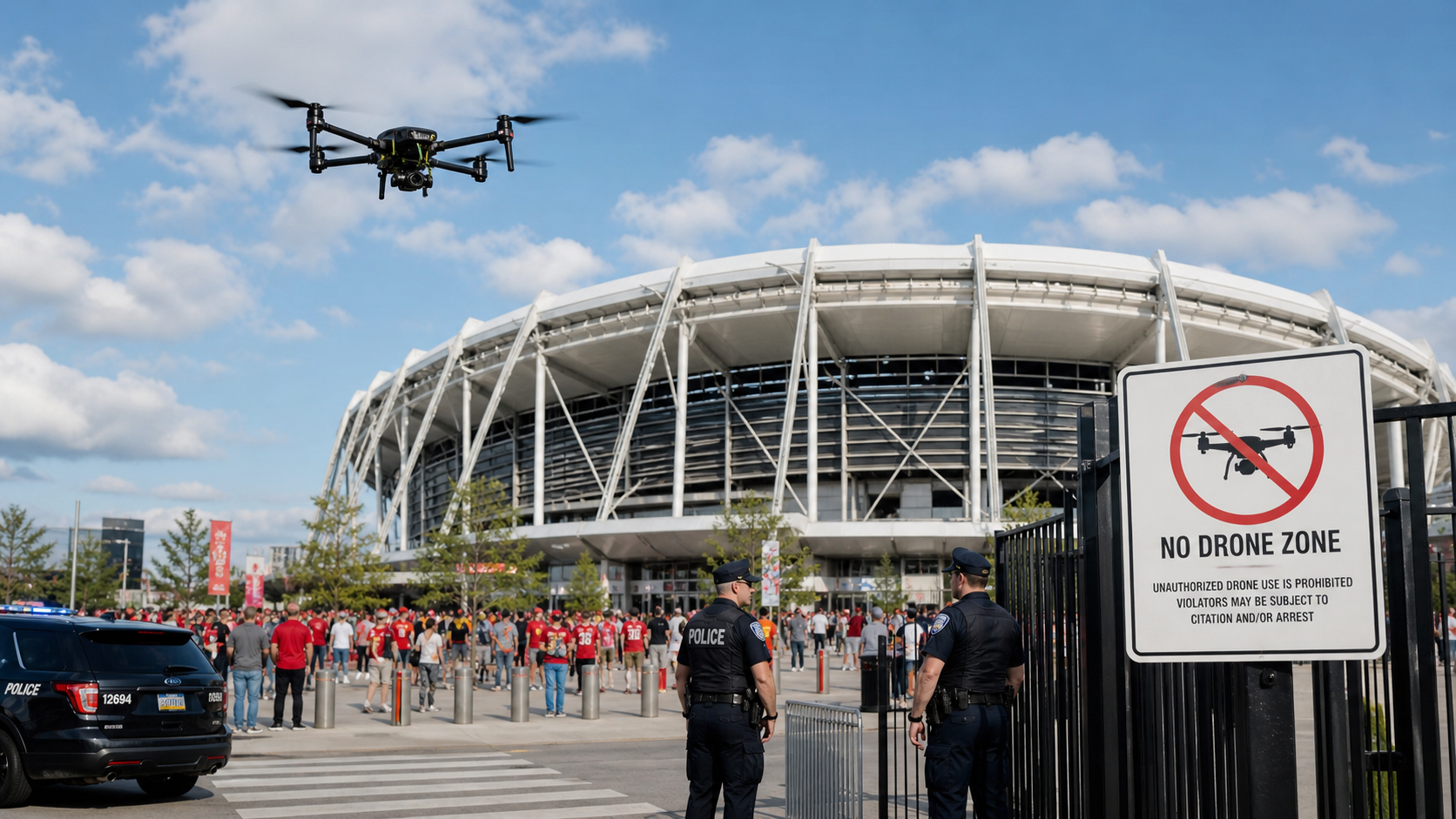
Like every other time, the tournament is being treated as a major security event, not just a set of soccer games. In the U.S., the Federal Aviation Administration[2] (FAA) has already created a World Cup safety page telling drone pilots to check no-drone zones and official Temporary Flight Restriction notices, and it says even experienced remote pilots with standard airspace authorization are not allowed to fly during active TFR windows around World Cup events. FIFA and national authorities are effectively sending the same message: if you are a fan, leave the drone at home on match day.
Heightened Security on Tournament Venues
The biggest mistake you can make is thinking that “legal airspace” automatically means “legal flight.” It does not. For World Cup 2026, you have to clear three separate hurdles:
- national aviation law,
- ground-level property and local rules, and;
- temporary event security controls.
If any one of those says no, your cancel the flight.
In the U.S., states and cities cannot generally regulate aviation safety or airspace efficiency, but they still can regulate takeoff and landing locations, immediate property interference, operator location, and ordinary ground-based conduct like trespass, nuisance, harassment, and privacy. That means the federal government controls the sky, but a city, park, stadium owner, or landowner can still block where you launch, where you stand, and what you do with the footage.
For World Cup 2026, that stack of rules gets tighter. Land-use approvals for takeoff and landing are strictly enforced, and drone pilots must respect no-drone zones around host cities during the tournament.
So near stadiums, fan festivals, practice sites, and security perimeters, the answer will usually be no.
Where Can You Fly Near A Host City?
Always check airspace restrictions through official Temporary Flight Restriction (TFR) notices or use the B4UFLY apps or before flying in or near host cities during the tournament.
- Check official airspace tools before leaving.
- Look for match-day TFRs and no-drone zones.
- Do not launch near stadiums, fan zones, or crowds.
Drone Rules In The United States
First, are you flying only for fun, or are you doing something beyond pure recreation? Recreational flying falls under 49 U.S.C. § 44809, while business, media, commercial, and most organized content work fall under 14 C.F.R. Part 107. If you are not sure, assume Part 107.
For recreational flying, you must:
- fly only for personal enjoyment,
- follow the safety guidelines of an FAA-recognized community-based organization,
- keep the drone within visual line of sight,
- give way to manned aircraft,
- stay at or below 400 feet in Class G airspace,
- get prior authorization in controlled airspace,
- take the TRUST safety test, and;
- carry proof of passage.
If your drone weighs 250 grams or more, you also need registration, and if registration is required, Remote ID is generally required too unless you fly inside a FRIA.
For non-recreational flying, Part 107 is the main set of rules. Part 107 pilots can fly for work or business with drones under 55 pounds, but they need a remote pilot certificate, and each aircraft must be registered. They can also fly at night, over people, and over moving vehicles without a waiver only if they meet the rule’s specific conditions, and controlled airspace still requires authorization.
That becomes much more restrictive during the World Cup. Drone pilots are not permitted to fly during active TFR windows surrounding World Cup events, even if they are experienced or already hold a standard authorization. On top of that, the FAA’s standing sports-stadium rule already prohibits drone flights one hour before through one hour after certain major U.S. sporting events within a 3 nautical mile radius and up to 3,000 feet AGL. World Cup matches are expected to bring their own event-specific restrictions through TFRs and Notices to Airmen (NOTAMs), so you should expect even tighter controls than a normal sports day.
Active TFRs are updated in real-time on the FAA’s TFR list.
If you are visiting from abroad, there are extra steps. Foreign operators using foreign-registered drones must follow U.S. Remote ID rules and submit a Notice of Identification before flying. If the purpose is commercial, the FAA also points foreign operators to 14 C.F.R. Part 375 economic authority requirements from the U.S. Department of Transportation. That means a tourist casually packing a drone for “just some match-day aerial shots” can run into paperwork trouble before the flight rules even start.
The FBI told Congress in April 2026 that UAS is one of the most significant safety concerns around the World Cup, that it has already conducted 73 detection-and-mitigation protection operations at major events, detected 1,210 unlawfully operating UAS, located operators 377 times, and attempted technical mitigation against 173 UAS. It also said 45 state and local officers had already been certified for counter-UAS work by April 2026, with 61 projected before the tournament, and that 12 field offices will host matches while 11 more cover team lodging and practice facilities.
That is why you should not treat World Cup drone rules in the U.S. like ordinary weekend hobby flying. At another major event, Super Bowl LX, the FAA and FBI warned that unauthorized drone operators could face fines up to $75,000, confiscation, and federal criminal charges. That specific warning was for the Super Bowl, not the World Cup, but it is a very clear sign of the enforcement tone the U.S. uses around major protected events
Drone Rules In Canada
Canada is, in one way, even clearer than the U.S. for sports events: if the event is an advertised public event, drone flying near it is generally off-limits unless you have a Special Flight Operations Certificate. That applies even to microdrones.
The national baseline comes from the Aeronautics Act and the Canadian Aviation Regulations, especially Part IX. Drones weighing at least 250 grams must be registered and marked with the registration number. Drones under 250 grams do not need registration, but pilots still must avoid reckless or negligent flying that could endanger aviation safety or people.
Transport Canada divides operations by aircraft size and operation class. Microdrones are under 250 grams, and small drones are 250 grams to 25 kilograms. If you are doing special operations, foreign operations, or advertised-event work, the basic hobby rules are not enough.
The advertised-event rule is the one that matters most for the 2026 World Cup.
An advertised event includes outdoor events advertised to the public, such as concerts and sporting events. If you are flying within 30 meters, or 100 feet, of the event boundary, you need an Special Flight Operations Certificate for a remotely piloted aircraft system (SFOC-RPAS). This applies to pilots of all drone sizes, including microdrones. Since April 1, 2025, the advertised-event requirement was extended to microdrones as well.
The penalty structure is not small. Individuals can face fines up to C$1,000 for flying a microdrone at an advertised event, up to C$3,000 for flying a 250-gram-plus drone at an advertised event, and up to C$1,000 for flying without the required safety assurance declaration. Corporations can face up to C$5,000, C$15,000, and C$5,000 respectively. On top of that, registration failures can trigger fines up to C$5,000 for recreational users and C$25,000 for commercial users.
City of Toronto launches Ontario-wide Legacy Campaign in celebration of the FIFA World Cup 2026™ in Toronto
— City of Toronto 🇨🇦 (@cityoftoronto) February 25, 2026
News Release: https://t.co/kaxzQ7FP91 pic.twitter.com/0yR6cDg8i7
If you are not Canadian, the rules tighten again. Foreign pilots or operators, and anyone flying a foreign-owned drone, need an SFOC-RPAS, subject to limited exceptions. So if you are visiting for a match in Toronto or Vancouver and thought your home-country certificate would carry you through, that is not how Canada handles it.
Drone Rules In Mexico
Mexico’s drone rules are more fragmented online than the U.S. and Canada, but the core picture is still clear enough for World Cup planning. Mexico is still operating under NOM-107-SCT3-2019.
The national aviation authority is the Agencia Federal de Aviacion Civil (AFAC).
Remotely piloted aircraft system (RPAS) are classified by weight, including RPAS Micro at 2 kilograms or less and RPAS Pequeño above 2 kilograms and up to 25 kilograms. Operators seeking registration should use the agency’s form-and-email process, and RPAS with maximum takeoff weight above 250 grams must be registered.
Two limits that matter a lot for fans and drone pilots:
- operators must stay at least 9.2 kilometers, or 5 nautical miles, away from any aerodrome, and;
- there is a 122-meter, or 400-foot, maximum altitude limit.
Then you hit the local layer. In Mexico City, the city film commission says drone filmings and recordings require processing with civil aviation authorities and directs applicants to the federal circular. In Guadalajara, municipal urban-forest regulations dictate that drones and other radio-control equipment are prohibited unless specially authorized by the park authority. That means casual fan use in host cities can run into municipal and public-space restrictions very quickly, even before you get close to a stadium.
So if you are planning to film in Mexico during the World Cup, do not treat it like spontaneous hobby flying. Use the federal rule set, work through local permissions where needed, and assume dense host-city areas, parks, and airport corridors are bad places to test your luck.
State, Provincial, And Local Drone Rules
This is where a lot of fans and even small creators get into trouble. Federal aviation law may control the airspace, but your actual shoot can still be ruined by privacy law, a city permit rule, a park bylaw, or a stadium property policy.
U.S. State Drone Laws
Florida is a good example of how state law can shape the rules around a host city. Florida Statute 330.41 says the authority to regulate drone operation is vested in the state, and political subdivisions generally may not create their own drone-operation rules about airspace, altitude, flight paths, tech requirements, pilot qualifications, or similar matters.
The same statute also bans knowingly flying over critical infrastructure facilities and schools in specified ways, and violating the critical infrastructure section is a third-degree felony. That matters in the Miami area because it keeps local patchwork smaller while leaving state criminal restrictions in place.
Florida also has a privacy rule that many recreational users underestimate. Statute 934.50 says a person, state agency, or political subdivision may not use a drone with an imaging device to record privately owned real property or the people on it with the intent to conduct surveillance in violation of a reasonable expectation of privacy without written consent.
Read more: Stricter Florida Drone Laws Mean Jail, Fines, and $5,000 Penalties
Texas is another host-state example worth knowing because it affects Dallas and Houston. Texas Government Code Chapter 423 creates an offense for using an unmanned aircraft to capture an image of an individual or privately owned real property with the intent to conduct surveillance, and it separately creates an offense for operating over critical infrastructure facilities in specified ways.
California gives you a different risk. California Civil Code section 1708.8 says a person can be liable for physical invasion of privacy when they knowingly enter onto land or into the airspace above land without permission to capture a visual image, sound recording, or similar impression of someone engaged in a private activity. If the invasion was for a commercial purpose, the law also allows civil fines from $5,000 to $50,000, along with damages and possible disgorgement. That matters a lot if you are tempted to grab “cool” hotel, backyard, or celebrity-adjacent footage around Los Angeles.
Read more: California Drone Laws – What You Need to Know
And if you are staying in New York City while attending matches in East Rutherford[40], do not assume New York is a casual launch point. A permit is required to take off or land any FAA-registered, FAA-compliant unmanned aircraft lawfully within the city. Start at the NYPD permit page.
Canadian City And Park Rules
Toronto has one of the clearest local park rules on this subject. City By-law 1482-2025 says that while in a park, no person shall operate a drone unless authorized by permit, and no person shall tether, launch, or land any aircraft described in the Canadian Aviation Regulations in a park unless authorized by permit. Basically, all city parks are “no drone zones” for recreational use.
Toronto also has World Cup-specific local restrictions that affect commercial filming and by extension any serious drone content plan. The city will host six matches, and filming will not be permitted in the “Last Mile” around the venue and fan festival from May 1 to July 31. Filming is also banned at Centennial Park during the tournament because it serves as a training facility. So even if you could satisfy Transport Canada, the city can still shut down the ground side of the operation.
Vancouver also adds local friction. Drone operations in parks require Park Board approval and a permit for certain event activity, and if you plan to use a drone on park property you must disclose that in the permit process and provide more information before approval. Film work on public property and parks generally needs a permit, and certain park uses prohibit drone activity unless specifically permitted.
World Cup 2026 Venue Drone Prohibitions
Official host venues are not neutral ground. At MetLife Stadium, drones, model aircraft, kites, and other remote-controlled flying objects are not permitted on the sports complex. At SoFi Stadium, drones and similar devices are prohibited, and the venue says possession or operation can lead to immediate ejection and confiscation. At BC Place, drones are listed as prohibited items.
So even if you somehow found legal airspace, you could still lose the moment you step onto venue-controlled property.
How To Stay Legal During The Tournament
Do not bring out your drone on match days unless you already know the airspace rules, property rules, and permit requirements for that location.
4-Step Checklist
Classify The Flight
Start by deciding what kind of operation you are doing. Media work, client work, branded content, sponsored posts, or monetized content usually means stricter rules than a purely recreational flight.
Check Official Flight Tools
Use the approved aviation tools for the host country before launch, e.g. TFR notices, before you assume a flight is allowed.
Get Ground Permission In Writing
Your takeoff and landing point matters. A rooftop, parking lot, sidewalk, or park near a stadium can still create legal trouble even if the airspace itself looks clear.
Expect Enforcement
Authorities are already preparing for illegal drone activity around tournament locations. If the trip is mainly for football, not licensed aerial work, leaving the drone behind is often the safest call.
By Host Country
United States
Treat non-recreational flights as Part 107. Check B4UFLY, NOTAMs, TFR notices, and LAANC where needed. Match-day restrictions and federal enforcement apply.
Canada
Flying near advertised sporting events is tightly controlled. Event-related work usually points to SFOC-RPAS requirements, and foreign pilots generally face added certification hurdles.
Mexico
Expect more paperwork, airport-separation checks, AFAC registration issues, and local filming rules. Spontaneous city flights are a risky assumption.
Stadium property, fan festivals, practice sites, hotel rooftops, parking lots, sidewalks near venues, and public parks used for event activity.
Watching matches? Keep the drone at home on match days unless you have a documented reason and the right approvals to produce licensed aerial footage.
FAQs on World Cup 2026 Drone Operations
Can I Fly A Sub-250g Drone Near A World Cup Stadium?
No, you should not plan on it. In Canada, even microdrones need an SFOC-RPAS near advertised sporting events, in the U.S. World Cup TFRs and land-use controls can still block you, and in Mexico local permit and airport-distance rules still make the flight illegal.
Do I Need A Commercial License If I Want To Post The Footage Online?
Usually yes, if the flight is for anything beyond pure fun. If you are not sure which rule applies in the U.S., assume Part 107, while Canada and Mexico both push event and filming work into formal approval pathways rather than hobby treatment.
Can Accredited Media Fly Inside A No-Drone Zone?
Yes, but only with formal approval. Public safety officials and media wanting to fly in a TFR need a Remote Pilot Certificate or Certificate of Authorization and must request access through the special waiver process, while Canada requires an advertised-event SFOC-RPAS and Mexico City routes operators through civil aviation processing for drone filming.
Can I Launch From A Hotel Roof Or Parking Lot Instead Of Stadium Property?
No, not automatically. You still need legal airspace, any required national authorization, and permission from the landowner or site controller, and local rules can still block takeoff and landing, as shown by NYC’s permit system, Toronto’s park bylaw, and stadium property bans at MetLife and SoFi.
What Is The Safest Rule To Follow As A Fan?
Leave your drone at home on match day. That lines up with the FAA’s World Cup warning, Canada’s advertised-event rule, Mexico’s permit-heavy approach, and the fact that major-event enforcement already includes large fines, confiscation, and criminal exposure in the U.S.