Buying a drone is the easy part. Learning to operate it safely, legally and well enough to produce useful work takes more structure. The best online drone courses for beginners give you that structure without forcing you into advanced material before you understand airspace, weather, aircraft limitations and basic flight planning.
There is also a large gap between watching a few flying tutorials and training toward professional work. The Federal Aviation Administration currently lists 837,513 registered drones and 481,760 certificated remote pilots in the United States. If you plan to earn money with a drone there, you enter a field where hundreds of thousands of pilots already hold a formal aviation credential. A useful course should therefore help you build knowledge you can apply, then point you toward the correct regulatory credential and a specialist skill.
What Should A Beginner Drone Course Actually Teach You
A beginner course should reduce the number of things you have to work out alone. Your first flights involve more than moving two control sticks. You need to understand where you can fly, how wind affects a small aircraft, what happens when GPS or the command link becomes unreliable, how to plan a safe return-to-home altitude and how to react when another aircraft or person enters your operating area.
For someone considering paid work, the syllabus should go further. Airspace classification, aviation weather, operational limits, maintenance, emergency procedures, crew coordination and decision-making all become part of the job. In the United States, those subjects also overlap heavily with the FAA Part 107 knowledge areas.
The FAA says a first-time Part 107 applicant must be at least 16, be able to read, speak, write and understand English, be physically and mentally able to fly safely, and pass the Unmanned Aircraft General knowledge exam. Certificate holders must also complete recurrent online training every 24 calendar months to keep their aeronautical knowledge current. You can review the current process on the FAA Remote Pilot certification page.
Certificate Of Completion And Pilot Certification Are Different
People looking for drone courses online with certificate often mix two different things. A training provider may issue a certificate showing that you completed its course. A civil aviation authority may separately issue the credential that permits or supports particular types of operations in its jurisdiction.
For example, completing an online Part 107 preparation course does not itself make you an FAA-certificated remote pilot. You still have to satisfy the FAA process and pass the required knowledge test.
The same principle applies outside the United States. Training can build your knowledge, prepare you for an exam or document completion of a specialist program. Your legal permission to fly depends on the rules where the operation takes place.
The Best Online Drone Courses For Beginners By Goal
There is no single beginner course that fits every pilot. A recreational flyer, an aspiring U.S. commercial pilot and an engineer interested in thermal inspections need different starting points. The options below are strongest when matched to the right goal.
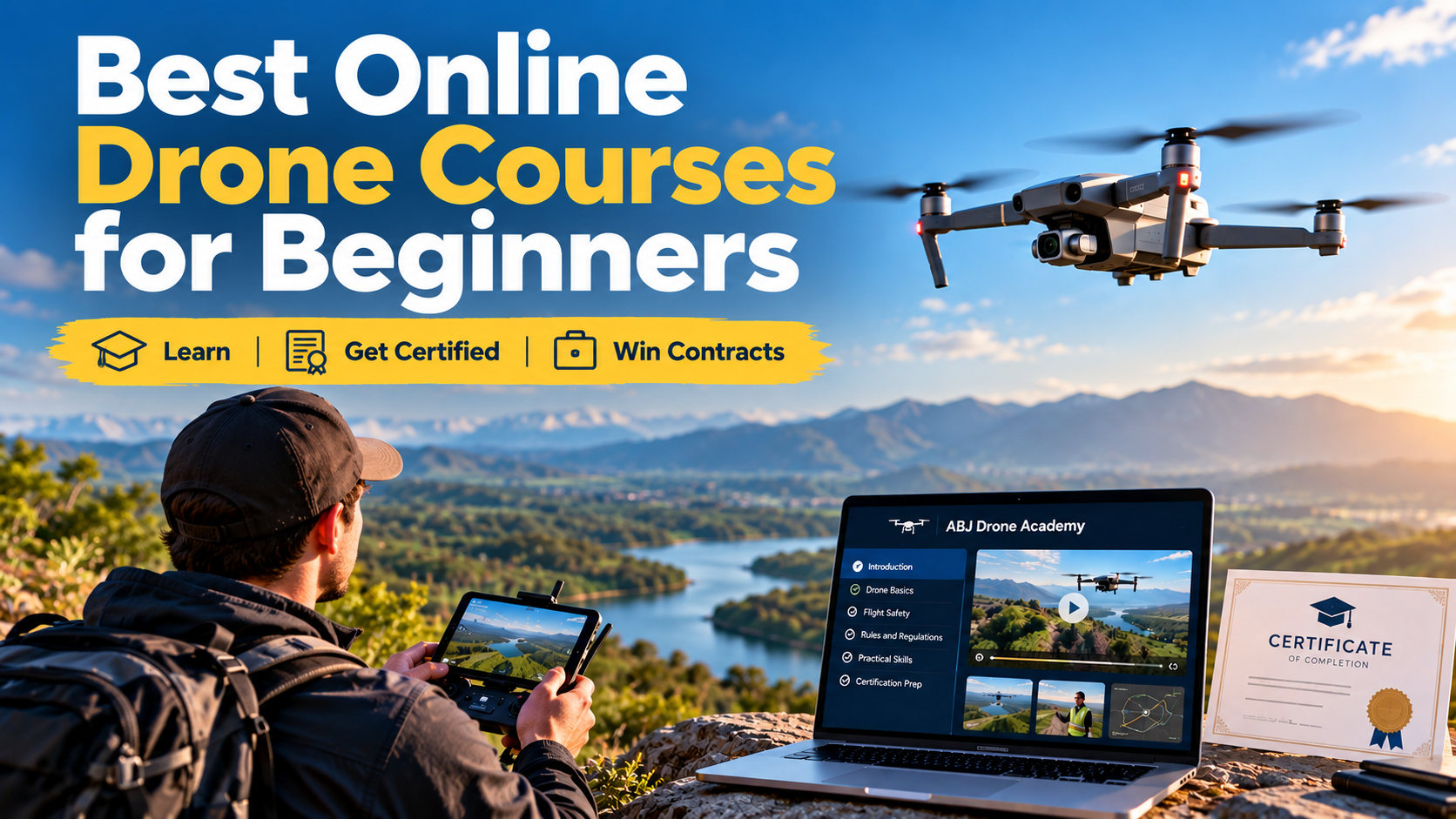
ABJ Drone Academy Part 107 Preparatory Course
Best suited to beginners who want a lower-cost route into U.S. commercial drone theory and a clear path toward specialist training.
ABJ Drone Academy’s Part 107 Preparatory course is built around the subjects a new commercial pilot needs before sitting the FAA exam. The current course handles regulations, airport operations, emergency procedures, radio procedures, airspace, weather, physiological factors, maintenance and inspections, aeronautical decision-making, UAS loading and performance, and crew resource management.
That mix is useful for a beginner because it moves beyond memorizing rules. Weather, loading and performance affect what your aircraft can actually do. Crew resource management becomes relevant as soon as you work with a visual observer, camera operator or client team. Airport and radio knowledge help you understand the aviation system around your drone rather than treating the aircraft as an isolated camera in the sky.
The course is self-paced and works on a computer, tablet or smartphone. Short tests appear at the end of sections, so you can identify weak areas before moving on.
Where ABJ Becomes More Useful After The Basics
ABJ’s main advantage for a career-minded beginner is the next step after basic pilot theory. The online course catalog extends into mapping and photogrammetry, thermography, photography, videography, multispectral imaging, cell-tower inspection and instructor development. You can therefore begin with aviation knowledge and later choose a technical or creative direction without rebuilding your learning plan from zero.
That sequence is especially sensible if your goal is paid work. A remote pilot certificate tells a client that you have met a regulatory requirement in the U.S. It does not show that you can produce an orthomosaic, interpret thermal imagery, plan a cell-tower inspection or deliver polished aerial media. Those are separate competencies.
FAA TRUST For Recreational Flyers
Best suited to U.S. recreational beginners who need the required safety test rather than a commercial course.
The FAA Recreational UAS Safety Test, usually called TRUST, is required for people flying recreationally under the Exception for Recreational Flyers. FAA-approved test administrators provide it online at no charge.
This is an important inclusion in any beginner comparison because paying for a commercial ground school makes little sense if your immediate aim is simply to fly recreationally in the United States. TRUST covers safety and regulatory information and produces a completion certificate after you pass. The FAA says all questions can be corrected to 100% before the certificate is issued.
TRUST is a legal starting requirement for the relevant recreational operations, not a full flight-skills curriculum. A new pilot can pair it with structured manoeuvre practice, manufacturer guidance and a broader beginner course if they want more confidence with the aircraft.
ABJ Basic Drone Photography And Videography Training
Best suited to beginners who can already fly safely and want to turn basic aircraft control into usable visual work.
ABJ’s Drone Photography Training and Drone Videography Training are among its specialist courses. These courses make more sense after you have basic flight control because camera work adds another workload layer: exposure, composition, aircraft position, movement, subject safety and client expectations all compete for your attention.
For a beginner interested in real estate, tourism, construction progress or marketing content, photography and video can be an accessible first specialisation. You can practise repeatedly without needing an expensive thermal payload or a full surveying software stack. A portfolio also gives prospective clients something concrete to judge.
ABJ Drone Surveying And 3D Modeling
Best suited to beginners who have completed their basic pilot foundation and want to move toward mapping, construction, engineering or data work.
ABJ currently lists its specialist drone courses with Drone Surveying at $345. Surveying is a logical progression for pilots who are more interested in data than cinematic flying. The work can involve repeatable flight plans, image overlap, ground sampling distance, photogrammetry, coordinate systems, quality checks and deliverables such as orthomosaics or 3D models.
This is not the first course most people should buy before they have flown a drone. It becomes valuable once aircraft control and regulatory knowledge stop consuming all your attention. At that point, you can focus on whether the data collection plan will produce the required output.
ABJ Drone Thermography Level 1
Best suited to technically minded beginners who already have basic drone flying ability and want to work toward inspection applications.
The ABJ Drone Thermography Level 1 course covers infrared science, thermal physics, thermal camera design and operation, image interpretation, thermal orthomosaics and applications including infrastructure, power lines, construction and solar arrays. No previous thermography knowledge is required, although basic drone flying ability is assumed. The listed September 2026 price was $895.
Thermography is a good example of why course selection should follow a sequence. Thermal cameras do not simply show ‘hot’ and ‘cold.’ Emissivity, reflections, environmental conditions, viewing angle and the properties of the target can affect what appears in an image. A pilot who understands the aircraft yet lacks thermal science can collect misleading data. A thermographer who cannot plan a safe drone operation has the opposite problem.
Find The Right ABJ Drone Course For Your Next Step
Start with pilot knowledge or choose a specialist skill based on the type of drone work you want to pursue.
Part 107 Preparatory Course
Build your knowledge of airspace, regulations, weather, operations, emergency procedures and other subjects covered in the FAA Part 107 knowledge test.
Beginners preparing to pursue commercial drone operations under FAA Part 107.
Drone Photography And Videography
Develop practical aerial imaging skills for photography and video work, from camera technique and composition to creating more polished visual content.
Pilots interested in real estate, tourism, marketing, content production and other visual drone services.
Drone Surveying And 3D Modeling
Develop skills for drone mapping and 3D modeling workflows, including the principles behind collecting useful aerial data for professional projects.
Pilots interested in surveying, construction, mapping, engineering and geospatial applications.
Drone LiDAR Made Easy
Learn the fundamentals behind drone LiDAR and how the technology is applied to collect detailed spatial data for professional projects.
Pilots moving into advanced mapping, surveying, infrastructure and geospatial data collection.
ABJ Drone Thermography Level 1
Learn infrared science, thermal imaging principles, camera operation and interpretation for applications such as solar, construction and infrastructure inspection.
Drone pilots developing technical inspection and thermal imaging skills.
Not Sure Where To Start?
New commercial pilots can begin with regulatory knowledge, build consistent flight skills and then choose a specialist course that matches the work they want to pursue.
Part 107 preparation → flight practice → specialist training → portfolio and commercial experience.
How To Choose Between Drone Courses Online With Certificate
Match The Course To The Credential You Actually Need
Which operation do you want to perform, and in which country will you perform it? Then check the aviation authority before you compare course marketing. In the U.S., commercial operations under Part 107 require the FAA remote pilot route. Recreational flyers have the TRUST requirement. Other countries use different categories, certificates and operating permissions.
The UK illustrates how quickly requirements can differ. Under rules effective from January 2026, the UK Civil Aviation Authority requires a Flyer ID for drones of 100 g or more, with Operator ID requirements depending on weight and whether the aircraft has a camera. The basic Flyer ID theory test is free, and the ID is valid for five years. A course aimed only at FAA Part 107 would therefore be the wrong regulatory preparation for a beginner flying solely in the UK.
Check Whether The Course Teaches A Deliverable
A useful professional course should lead to something you can produce or perform. For photography, that may be a consistent set of correctly exposed aerial images. For mapping, it may be a planned data-capture mission and a processed orthomosaic. For thermography, it may be a correctly collected and interpreted thermal dataset. For inspection, it may be a repeatable acquisition workflow and documented findings.
Course descriptions that stay vague about outcomes deserve closer scrutiny. Look for a syllabus, exercises, assessments, practical components, sample outputs and clear prerequisites.
Check How Current The Regulatory Material Is
Drone rules change. A course can have excellent production quality and still teach old operating requirements. Look for visible update dates and compare key claims with the regulator. For U.S. pilots, the FAA certification page was updated in June 2026. In the UK, several drone rules changed on 1 January 2026. Current training should reflect changes of that scale.
Check Whether Practical Flight Is Included Or Separate
Online learning is well suited to theory, planning, weather, regulations, image interpretation and software concepts. Flight competence still needs actual control time or a simulator that supports deliberate practice.
Read the wording carefully. ‘Online drone course’ may mean theory only. ABJ, for example, describes optional practical sessions for its Part 107 pathway rather than presenting the online preparation course as hands-on flight training. That clarity helps you budget for the full learning process.
Check Instructor Access And Assessment
Recorded video is useful until you hit a question that the video does not answer. Beginners often need help interpreting sectional charts, weather reports, operating scenarios or technical imagery. Instructor support, live sessions, graded quizzes and explanations can reduce the amount of time you spend reinforcing a misunderstanding.
A Sensible Beginner Learning Path
You can avoid buying courses in the wrong order by treating drone education as a progression.
Stage One: Learn The Rules And Aircraft Basics
Begin with the legal framework for your country and the fundamentals of your aircraft. Learn airspace, pre-flight checks, batteries, weather limits, return-to-home behaviour, emergency procedures and basic flight planning. U.S. recreational pilots should complete TRUST. Aspiring U.S. commercial pilots can move directly into structured Part 107 preparation.
Stage Two: Build Deliberate Flight Practice
Practise take-offs, landings, orientation changes, straight lines, squares, circles and figure-eight patterns. Add controlled emergency scenarios only in safe conditions. A simulator can help you repeat control exercises without risking an aircraft, although real-world wind, glare, obstacles, battery behaviour and situational awareness still require field experience.
Stage Three: Add One Commercial Skill
Choose one application rather than collecting unrelated certificates. Photography and videography suit visually oriented pilots. Mapping suits people interested in measurement, construction and geospatial outputs. Thermography fits inspection and engineering applications. Multispectral imaging is more relevant to vegetation and agricultural analysis. Telecom training becomes useful if infrastructure inspection is your target.
ABJ’s training pathways follow this general progression by separating primary training, specialist skills, simulator practice and instructor development. For a beginner, that makes the catalog easier to use: primary knowledge first, a specialist capability later.
Stage Four: Build Evidence Of Competence
A certificate is stronger when it sits beside work samples. Create a small portfolio that matches the service you want to offer. A photography student can produce a short property set. A mapping student can document a practice mission and resulting model. An inspection student can show how findings are captured, located and reported using non-sensitive training data.
Keep flight logs as well. Hours alone do not prove quality, though they show that you have spent time operating rather than only studying.
How Much Should A Beginner Spend On Online Drone Training
There is no need to buy every course at the beginning. Your first budget should cover the regulatory foundation relevant to your location, enough flight practice to become consistent and one application that matches your intended work.
The current examples in this guide show how wide the price range is. FAA TRUST is free. ABJ’s Part 107 preparation was listed at $45. Creative specialist courses are listed at $225 each, Drone Surveying at $345 and Thermography Level 1 at $895.
Higher cost can be justified when the subject itself is more technical, the training includes specialist standards, assessment or instructor input, or the skill supports higher-value work.
Which Course Should You Start With
For a complete beginner in the United States who wants to fly only for recreation, start with FAA TRUST and structured flight practice. You can add photography or manoeuvre training once the basic controls feel familiar.
For a beginner who wants to earn money with a drone in the United States, Part 107 preparation is the logical first formal course. ABJ Drone Academy is particularly attractive if you want a low-cost entry point and already expect to progress into mapping, photography, videography, thermography or inspection.
For someone who already flies confidently and wants a career skill, skip generic beginner material that repeats what you know. Move into one application and learn the complete workflow around it. ABJ’s specialist catalog is useful here because the options are organised around actual drone work rather than only flight theory.
For learners outside the U.S., begin with your own aviation authority. You can still take international specialist courses, since subjects such as photography, photogrammetry and thermal science cross borders, yet the legal framework for the flight remains local.
Frequently Asked Questions
What Is The Best Online Drone Course For A Complete Beginner
The best course is one that matches your country and your immediate goal. U.S. recreational beginners should begin with FAA TRUST, while aspiring U.S. commercial pilots should study for Part 107 and practise flight skills alongside the theory. ABJ’s Part 107 Preparatory course offers a lower-cost starting point with a route into later specialist training.
Can I Learn To Fly A Drone Entirely Online
No, online training can teach the theory and demonstrate flight techniques, but safe competence requires practical control time. Simulators are useful for repetition, and field practice adds wind, obstacles, visibility, battery management and real operating decisions.
Do Online Drone Courses Give You A Certificate
Many online drone courses give you a certificate of completion, but that certificate may not be a government pilot credential. Check who issues the certificate, what competence it represents and whether your aviation authority requires a separate test, registration, licence, certificate or operational authorisation.
Do I Need Part 107 Before Taking An ABJ Specialist Course
Not every ABJ specialist course lists Part 107 as a prerequisite, although you still need the legal authority required for the operations you perform. The Thermography Level 1 course, for example, says no prior thermography knowledge is required but assumes basic drone flying ability. Check the prerequisites on the individual course page before enrolling.
Is A Drone Photography Course Good For Beginners
Yes, drone photography can be a practical first specialisation once you can fly safely and consistently. It lets you build a portfolio with relatively accessible equipment and teaches you to combine aircraft position, camera settings, composition and repeatable flight planning.
Is Drone Mapping Too Advanced For A Beginner
Drone mapping is suitable after you have a basic pilot foundation. You will learn more efficiently once routine aircraft control, flight planning and legal checks no longer take all your attention, because mapping adds mission geometry, image overlap, processing and data-quality decisions.
Are Free Drone Courses Worth Taking
Yes, free official courses are valuable when they serve a defined purpose. FAA TRUST is the clearest example for U.S. recreational flyers. Free videos and practice tests can also help you test your interest or identify weak topics, although a structured paid course may be more efficient when you are preparing for a formal exam or a technical application.
How Long Does It Take To Become A Commercial Drone Pilot
The timeline depends on your jurisdiction, study pace, test availability and flight practice. In the U.S., the knowledge preparation can be completed online at your own pace, but first-time pilots still have to pass the FAA exam and complete the certification process. Building reliable commercial flight and application skills takes additional practice beyond passing the test.
What Should I Learn After Part 107
Choose a skill tied to the work you want to sell. Photography and videography suit media work, surveying and 3D modeling suit geospatial and construction workflows, thermography supports thermal inspection, and multispectral imaging can support vegetation and agricultural analysis. One well-developed specialty is usually more useful than several shallow course completions.