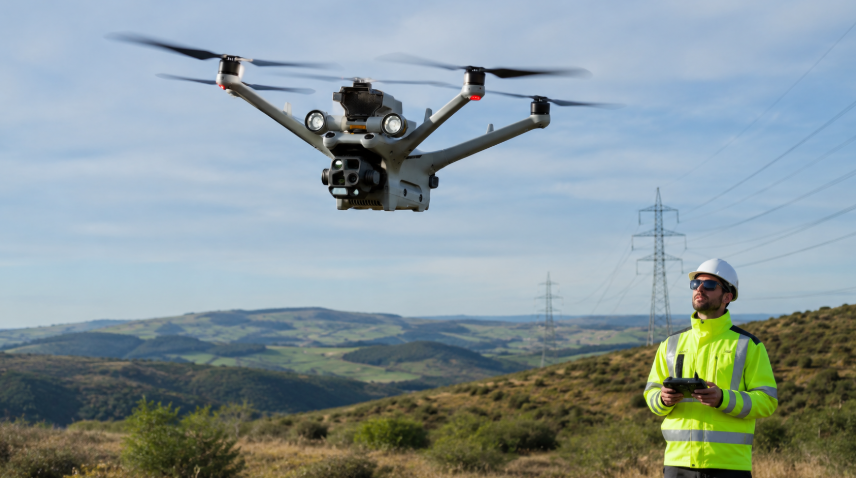
There are drone updates that sound technical at first, then turn out to matter a lot once you understand the paperwork behind them.
DJI’s Matrice 4D Series update is one of those.
On June 12, 2026, DJI Enterprise announced that the Matrice 4D Series C6 marking now covers standalone operations when the aircraft is flown with the DJI RC Plus 2 Enterprise controller, provided the drone is running firmware version 17.1.5 or later. Until this update, the C6-compliant configuration was tied to the DJI Dock 3 setup. DJI says the aircraft hardware was already built to meet the C6 requirements; what changed is that the certified compliance scope now recognises the controller-based setup too.
That may sound like a small paperwork change. It is not.
For European drone operators working toward legal beyond-visual-line-of-sight missions, this changes the economics and logistics of deployment. A Dock 3 is a powerful fixed or vehicle-mounted drone-in-a-box system. But it is still a dock. It needs planning, deployment infrastructure, power, connectivity, maintenance and capital investment. A controller-based setup is more mobile. You can pack it, drive it to site, fly the mission, and leave.
That is why this update matters most to the people doing field work: utility inspection crews, search-and-rescue teams, emergency responders, public safety units, mapping firms, railway inspectors, pipeline teams, wind asset managers and surveyors.
But before you read this as “DJI just opened the sky for BVLOS,” slow down.
The drone may now fit the C6 side of the European framework in standalone mode, but a compliant aircraft is not the same thing as a compliant operation. You still need the right operating scenario, paperwork, pilot competency, operational manual, ground-risk controls and national authority process.
The update removes one major equipment bottleneck for operators who already know they have to work inside it.
What DJI actually changed
DJI has expanded the C6 compliance coverage of the Matrice 4D Series so it now includes standalone flights using the DJI RC Plus 2 Enterprise controller.
The aircraft already carried the C6 label, but its certified use had been associated with DJI Dock 3. Now, with the required firmware and documentation, the same aircraft can be used in a controller-flown configuration while still sitting within the relevant C6 compliance framework. DJI specifically names firmware 17.1.5 or later as the requirement for this standalone configuration.
No new aircraft body. No new propulsion system. No new payload bay. No new external add-on that suddenly makes the aircraft safe.
The change is in the recognised configuration.
That matters because aviation regulation is often as much about the approved setup as it is about the machine itself. A drone is not judged only by its model name. It is judged by how it is configured, documented, operated and maintained. Change the controller, the firmware, the launch method or the operational concept, and you may no longer be talking about the same compliance case.
In other words, for the Matrice 4D Series, the standalone controller setup is now inside that C6 compliance envelope.
So for you as an operator, the Matrice 4D and 4TD are no longer locked to Dock 3 if your goal is to prepare for C6-based European STS-02 operations.
Good news for drone operators based in Europe 🚁 pic.twitter.com/4vYFHh0vS1
— DJI Enterprise (@DJIEnterprise) July 1, 2026
The Dock Era
When DJI launched Dock 3 in February 2025, it positioned the system as a drone-in-a-box solution for 24/7 remote operations. The Dock 3 package came with the Matrice 4D or Matrice 4TD, targeting sectors such as public safety, emergency response and infrastructure inspection. Matrice 4D was the model for high-precision mapping and detailed surface inspections, while the Matrice 4TD added thermal capability for more specialised missions.
That made sense. BVLOS missions naturally pair well with docking stations. You can automate routes, return the aircraft to a protected base, recharge, redeploy and manage operations remotely. For a utility company inspecting the same corridor again and again, a dock can be a strong investment. For a port, mine, industrial site or public safety agency, it can become part of the operational infrastructure.
But not every mission is repetitive. Not every site deserves a permanent dock. Not every operator has the capital or business case to install one.
Think about a storm-damaged power line in a rural area. A missing person search. A flood assessment. A road corridor survey. A one-off inspection of a remote asset. A mapping job in a sparsely populated area. For those missions, a dock can be overkill.
You do not always need a permanent robot garage. Sometimes, you need a compliant aircraft, a trained crew, a controller, a field vehicle and a carefully planned mission.
That is where the standalone C6 update becomes important.
What C6 means in Europe
C6 comes down to European UAS class marking.
Under the EU drone framework, different class markings indicate that a drone meets defined technical standards for certain kinds of operation. For STS-02, the relevant class marking is C6. EASA’s standard scenario guidance says STS-01 uses C5, while STS-02 uses C6.
The C6 requirements are designed around a very specific kind of risk-controlled BVLOS operation. Core aircraft-side requirements include maximum take-off mass below 25 kg, a maximum characteristic dimension no greater than 3 metres, maximum horizontal speed not exceeding 50 m/s, command-and-control link monitoring, flight volume enforcement, geocaging and an independent flight termination system.
Features such as geocaging and flight volume enforcement are key.They are part of the safety logic. Before the mission, the operator defines where the aircraft is allowed to fly. During flight, the aircraft has systems that help keep it inside those limits.
For BVLOS, that is critical. Once the aircraft goes beyond the pilot’s direct visual line of sight, the regulator needs confidence that the drone is not simply free-ranging across the landscape. It must be constrained by design, procedure and oversight.
Why STS-02 is the real prize
C6 matters because of STS-02.
In the European system, STS stands for standard scenario. This is a predefined operation under Regulation 2019/947. If your operation fits the scenario and you meet the requirements, you do not need to go through a full bespoke operational authorisation process. Instead, you submit a declaration to the national aviation authority in the state where you are registered as an operator. Once the authority confirms receipt and completeness, you may operate within the limits of that standard scenario.
That is powerful because it gives operators a more predictable route.
STS-02 is the standard scenario that matters here. It covers BVLOS with airspace observers over a controlled ground area in a sparsely populated environment.
STS-02 requires a C6-marked aircraft, operating over a controlled ground area in a sparsely populated environment, with a 120 m height limit and distance limits of 1 km without an airspace observer or 2 km with an airspace observer.
What standalone C6 unlocks for operators
The update gives operators more flexibility. That is the big shift.
Before this, if you wanted to lean on the Matrice 4D Series’ C6 compliance for a European BVLOS workflow, the certified route was associated with Dock 3. That pushed you toward a dock-based deployment model, even when the mission itself did not necessarily need one.
Now, a field team can look at a job differently.
A utility crew can inspect a rural power corridor without first turning the site into a semi-permanent drone base. A mapping company can plan a BVLOS route over a sparsely populated area without making Dock 3 the centre of the project. A search-and-rescue team can respond with a portable setup instead of waiting for infrastructure that was never designed for that terrain.
This does not remove the need for compliance. It removes one equipment constraint.
Note that difference.
A dock is excellent when your mission is repeatable, automated and tied to a known location. A controller is better when your mission moves. Europe has plenty of drone use cases that are not neatly tied to one launch point. Linear infrastructure is the obvious example: power lines, roads, railways, pipelines, canals, borders, dykes and coastal stretches.
These are exactly the environments where BVLOS makes operational sense, provided the ground risk is controlled and the airspace risk is managed.
DJI itself makes this distinction clear: the aircraft-side compliance does not replace the operator-side requirements.
The aircraft can be eligible. The mission still has to be legal.
The aircraft is only one part of compliance
This is where many drone conversations go wrong.
People see a class label and assume the drone has “permission.” It does not. Aircraft compliance and operational compliance are connected, but they are not the same thing.
The aircraft must meet the C6 technical requirements. The operator must meet the STS-02 operational requirements. The pilot must hold the right competency. The site must fit the scenario. The ground area must be controlled. The mission must stay within the distance and height limits. The paperwork must be accepted by the competent authority. The crew must follow the declared procedures.
If any of those pieces are missing, the C6 label alone does not save the operation.
To fall under a standard scenario, the operation must comply with all the requirements of that scenario, including the appropriate CE class identification label. It also says operators must submit the STS declaration to the national aviation authority before starting the operation.
Operation Areas
Inspection work
For inspection companies, the appeal is obvious.
Many valuable assets are long, remote and difficult to inspect from one standing position. A pilot maintaining visual line of sight can only cover so much ground before repositioning. That creates delays, handovers, extra crews and more chances for inconsistent data.
BVLOS changes that. It allows a drone to follow a planned route across a larger area, collecting imagery, thermal data or mapping outputs in a more continuous way. Under STS-02, this still has limits, but those limits are wider than ordinary VLOS workflows.
Now add the standalone C6 update.
Instead of building every BVLOS case around a dock, an operator can deploy a Matrice 4D Series aircraft from a field location with a controller-based setup. For a utility inspection, that can mean fewer site preparations. For a survey firm, it can mean more flexible job planning. For emergency response, it can mean faster mobilisation.
The advantage is not that the drone suddenly flies farther. The advantage is that the compliance path can now match more real-world field missions.
Search and rescue
Search-and-rescue work is rarely neat.
The location changes. The weather changes. The urgency changes. The first launch point may not be the best launch point after 20 minutes. A dock can be useful in some public safety settings, but a portable kit is often more realistic when teams are moving across forests, hills, farmland, coastline or flood-affected areas.
The Matrice 4TD is especially relevant here because thermal capability can help teams search in low light or identify heat signatures, depending on conditions. DJI positioned the Dock 3 package, including the Matrice 4TD, for public safety and emergency response use cases from launch.
The standalone C6 update does not replace search planning or rescue procedures. It does not allow reckless flying. But it does make the aircraft more useful for European teams that need a portable compliance-ready platform for eligible STS-02-style missions.
That is a meaningful development.
Search operations often need range, speed of deployment and flexible positioning. A handheld controller setup fits that reality better than a fixed dock in many cases.
Mapping and surveying
Surveying is another area where this update could quietly change workflows.
A lot of mapping work happens in areas that are not densely populated: farms, estates, mines, quarries, construction corridors, rural roads, forestry blocks and coastal assets. These environments may be better suited to STS-02 than urban jobs, assuming the operator can control the ground risk and meet the airspace requirements.
The Matrice 4D is already positioned toward mapping and detailed surface inspection. That makes the standalone C6 coverage commercially useful. Instead of limiting C6-aligned workflows to dock-based deployments, operators can take the aircraft into the field and use it for missions where a dock would make little economic sense.
This is where the update is most practical. It makes the aircraft more deployable, not just more compliant on paper.
And in drone work, deployability is often the difference between a service you can sell and a service that stays trapped in a brochure.
European Law
This update is primarily a European regulatory issue.
C6 and STS-02 belong to the European framework. If you are operating in the United States, Kenya, Australia, Canada or elsewhere, you cannot simply copy and paste this into your local rules. The aircraft may have the same hardware, but the approval pathway is different.
That does not make the news irrelevant outside Europe. Regulators around the world are watching BVLOS closely, and manufacturers increasingly design aircraft around safety cases that can travel across jurisdictions. But the specific benefit here is tied to Europe’s standard scenario structure.
For European operators, the value is immediate and concrete. You have a clearer equipment path for certain BVLOS missions under STS-02.
For operators elsewhere, the takeaway is broader. Drone manufacturers are moving toward aircraft that come with more built-in containment, geocaging, link monitoring and documented compliance features. That is where serious enterprise drone work is heading.
What operators should check
Before you build a sales pitch around this update, check the basics.
- First, confirm that your aircraft is actually the Matrice 4D or Matrice 4TD configuration covered by the update. Do not assume every Matrice 4 Series model has the same status.
- Second, confirm the firmware. DJI specifically refers to firmware version 17.1.5 or later for the standalone C6 configuration.
- Third, check the documentation. In aviation, documentation is part of the compliance chain. Your aircraft, controller, firmware, manuals, declarations and operating procedures must tell the same story.
- Fourth, check your national aviation authority process. EASA gives the Europe-wide framework, but your declaration still goes through the relevant national authority. If you operate across borders, EASA says the declaration is submitted to the authority in your state of registration, and then the operator sends the declaration and confirmation to the authority in the state of operation.
- Fifth, check whether your mission truly fits STS-02. If it does not, you may need another route, such as an operational authorisation.
This is not bureaucracy for its own sake. It is how you avoid turning a promising aircraft capability into a non-compliant operation.
What DJI gets right with this update
DJI deserves credit for focusing on the boring part.
In enterprise drones, the boring part is often the part that makes the business case work. Operators do not only need better cameras, longer endurance and clever AI features. They need aircraft that fit regulatory pathways.
That is what this update addresses.
By extending the C6 compliance scope to standalone controller operations, DJI has made the Matrice 4D Series more useful to operators who do not want every eligible BVLOS mission to depend on Dock 3. It gives them a choice.
Use the dock where the dock makes sense.
Use the controller where mobility makes sense.
That is how enterprise drone programmes mature. Not by pretending one deployment model fits every mission, but by giving operators compliant options.
Frequently Asked Questions
Does the C6 update mean the Matrice 4D can now fly BVLOS anywhere in Europe?
No. This is the most important point. The aircraft may meet the C6 side of the framework in standalone mode, but the operation still has to meet STS-02 requirements. That includes the right scenario, controlled ground area, sparsely populated environment, pilot competency, declaration process and operating limits.
What is C6?
C6 is a European UAS class marking for drones intended to support certain Specific category operations, including STS-02. It confirms that the aircraft meets defined technical requirements, including weight, size, speed and safety systems such as geocaging, flight volume enforcement, link monitoring and flight termination capability.
What is STS-02
STS-02 is a European standard scenario for BVLOS operations with airspace observers over a controlled ground area in a sparsely populated environment. It is one of the predefined routes operators can use in the Specific category if the entire operation fits the scenario.
Does C6 certification automatically authorise BVLOS flight?
No. C6 relates to the aircraft. BVLOS permission depends on the operation. You still need to comply with STS-02 or another relevant authorisation pathway. EASA says operators must submit a declaration to the national aviation authority before operating under an STS.
Why does standalone mode matter?
Standalone mode removes the need to rely on DJI Dock 3 for every C6-aligned Matrice 4D Series operation. A dock is useful for fixed or repeated automated missions, but many inspections, surveys and emergency response missions are mobile. A controller-based setup is easier to deploy in the field.
Is DJI Dock 3 now unnecessary?
No. Dock 3 still has a strong role in automated, repeatable and remote operations. It is especially useful where the aircraft needs to fly from the same place again and again. The standalone update simply gives operators another compliant configuration for missions where a dock is not practical.
What firmware is required?
The aircraft must be running firmware version 17.1.5 or later for the standalone C6 configuration. Operators should confirm firmware status and official documentation before planning any compliant operation.
What controller is required?
DJI RC Plus 2 Enterprise controller is used for the standalone C6 setup. Operators should verify the exact controller version and documentation for their region and aircraft package.
Does this apply outside Europe
The C6 and STS-02 framework is European. Other countries have different BVLOS rules. The aircraft may still be technically capable elsewhere, but operators must follow the local aviation authority’s requirements.
Can a hobby pilot use this to fly BVLOS?
No. This is an enterprise compliance development, not a casual flying loophole. BVLOS operations are regulated and require the right aircraft, training, procedures, operating environment and authority process.
Is STS-02 easier than a full operational authorisation?
It can be, but only if your mission fits the standard scenario. An operator does not need to obtain an operational authorisation for an operation covered by an STS, but must submit a declaration to the national aviation authority and operate within the standard scenario’s limits.
What happens if the mission does not fit STS-02?
If the mission does not fit STS-02, the operator may need another pathway, such as an operational authorisation. The C6 aircraft marking may still help the safety case, but it does not automatically make a non-STS-02 mission legal.
What should operators do before using this update commercially?
They should confirm the aircraft model, firmware version, controller configuration, official DJI documentation, national aviation authority requirements, pilot competency, STS-02 declaration status, operational manual, site suitability and insurance position.