Published in the Federal Register on May 6, 2026, FAA’s proposed critical infrastructure drone rule will create a formal process for certain fixed-site facility owners to ask the FAA for drone flight restrictions over or near their sites. The public comment deadline is July 6, 2026, so the rule is still proposed, not final.
For you as a drone operator, asset owner, inspection company, energy stakeholder, or public safety team, this matters because it could change how low-altitude drone work is planned around energy sites, chemical facilities, rail assets, prisons, large commercial sites, and other sensitive locations. The FAA says the goal is to balance site security with economic growth and public interest, but the details will decide how easy or difficult compliant drone work becomes.
What The FAA Is Proposing
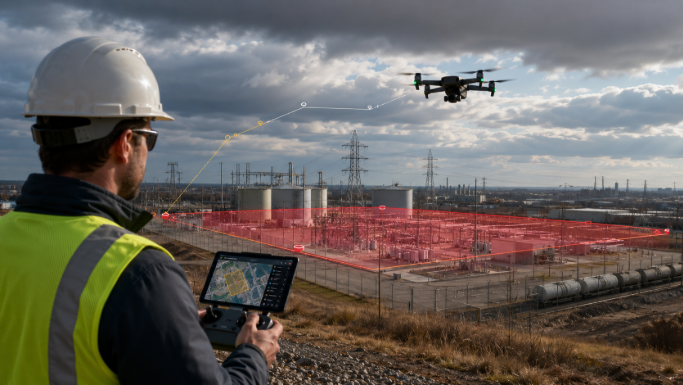
The proposed rule would create a new regulatory framework called Unmanned Aircraft Flight Restrictions, or UAFRs. A UAFR would be a defined airspace area where drone operations are restricted unless they fall into specific allowed categories. The FAA proposes to place this framework in a new 14 CFR Part 74, with related amendments to 14 CFR Parts 1, 91 and 107.
This is not the same as giving every critical infrastructure owner automatic control over the sky above their property. Instead, the owner or operator of an eligible fixed-site facility would need to apply to the FAA, show that the site qualifies, and prove that the restriction is needed for aviation safety, protection of people and property, national security, or homeland security.
That distinction matters. The proposal does not create a blanket drone ban over all infrastructure. It creates a petition-based process. In other words, a facility would need to go through the FAA before a UAFR could be created.
The FAA is also clear that a UAFR would not create a physical barrier. It would not give a facility owner automatic permission to jam, capture, disable, or interfere with a drone. It would create a legal airspace restriction, not a technical force field.
The Legal Background Behind The Rule
This rule traces back to Section 2209 of the FAA Extension, Safety, and Security Act of 2016. That law told the FAA to set up a process that would allow operators or proprietors of certain fixed sites to request drone flight restrictions. Those sites included critical infrastructure, oil refineries, chemical facilities, amusement parks, and other locations the FAA could identify.
Congress later amended the framework. The FAA Reauthorization Act of 2018 added railroad facilities. Then the FAA Reauthorization Act of 2024 added state prisons, removed the FAA Administrator’s broad discretion to include “other locations,” and set a new deadline for the FAA to act.
That is part of the reason this proposal is getting so much attention. Section 2209 has existed for nearly a decade, but the formal FAA process had not been completed.
The current proposed rule would apply to Docket No. FAA-2026-4558, Notice No. 26-03, with the Federal Register citation 91 FR 24650. (You’ll need this if you plan to track the rule, cite it in a compliance memo, or submit comments before the July 6, 2026 deadline).
The Scale Of The Proposal
The numbers are large. The FAA says National Security Memorandum 22 identified 16 critical infrastructure sectors. Sector Risk Management Agencies then identified about 125,000 fixed-site facilities in those sectors that may be high priority for a UAFR based on proposed minimum thresholds.
However, not all 125,000 sites are expected to receive restrictions. The FAA estimates that more than 9,000 eligible fixed-site facilities could obtain UAFRs over five years. Based on that scenario, the FAA estimates annualized costs between $21 million and $31 million, including applicant compliance costs and government review costs.
What about the cost breakdown? Under a 3% discount rate, the FAA estimates annualized costs of $19.7 million to $28.8 million for fixed-site facilities and $1.9 million for government review. Over five years, that equals a present value range of $90.1 million to $132 million for facilities, with $8.6 million for government.
For the drone industry, the scale creates two competing realities.
- On one hand, sensitive sites may finally get a more consistent federal process.
- On the other hand, if thousands of UAFRs are approved, operators could face a much more complex low-altitude operating environment, especially in industrial corridors, energy regions, port areas, rail zones, and dense metropolitan regions.
The 16 Critical Infrastructure Sectors
The proposed rule is tied to the 16 critical infrastructure sectors identified under federal policy. The Federal Register table of contents lists the sectors covered in the proposed Part 74 framework: Chemical, Commercial Facilities, Communications, Critical Manufacturing, Dams, Defense Industrial Base, Emergency Services, Energy, Financial Services, Food and Agriculture, Government Services and Facilities, Healthcare and Public Health, Information Technology, Nuclear Reactors, Materials and Waste, Transportation Systems, and Water and Wastewater Systems.
So the rule is broader than power plants and refineries. It could touch sites linked to hospitals, communications networks, dams, water systems, manufacturing, ports, rail, bridges, finance, prisons, amusement parks, and government facilities.
However, the FAA is not treating every site in every sector the same way. Some sectors have more developed proposed criteria than others. Criteria for Food and Agriculture and Water and Wastewater Systems are reserved pending public comment, which means the eventual pool of eligible facilities could still shift.
For inspection operators, this means you should not think only in terms of “restricted sites.” You should think in terms of sectors, site types, property boundaries, Remote ID requirements, allowed-operation categories, notification duties, and whether the facility has received a Standard or Special UAFR.
Standard UAFRs And Special UAFRs
The FAA proposes two main categories: Standard UAFRs and Special UAFRs.
- A Standard UAFR would restrict unauthorized drone operations inside a defined airspace volume with horizontal and vertical limits. It could be continuous or part-time. This is the category most relevant to many private-sector fixed-site facilities that meet the rule’s eligibility criteria.
- A Special UAFR would be more restrictive. It would apply where a credible safety or security threat has been identified, including federal security, intelligence, military, or selected high-risk fixed-site facilities. Special UAFRs could also be linked to national security or homeland security concerns, and unauthorized operations could trigger civil or criminal enforcement.
Special UAFRs would be available only in limited cases, with support from federal security or intelligence agencies, the Department of Defense, the Department of Energy, or the FAA Administrator. The proposal also says existing restrictions under 14 CFR 99.7 could be integrated into the Special UAFR framework where appropriate.
This two-tier structure is one reason some commercial drone stakeholders see the proposal as workable.
How High Would The Restrictions Go?
For most UAFRs, the FAA proposes a ceiling of 400 feet above ground level. That is consistent with the general ceiling for many small drone operations under Part 107 and recreational drone operations in Class G airspace.
Most small drones already operate at or below 400 feet AGL. If a UAFR is meant to restrict the airspace where drones are most likely to fly, that ceiling captures the main low-altitude operating band without unnecessarily affecting many crewed aircraft operations.
The FAA does allow for limited exceptions. If the tallest component of the fixed-site facility is more than 300 feet AGL, the UAFR could extend to the height of that component plus 100 feet, rounded up to the nearest 50-foot increment. Take a 310-foot smokestack for example: add 100 feet to reach 410 feet, then round up to 450 feet.
That is key for wind, energy, communications, and industrial inspection teams. Tall assets may lead to higher UAFR ceilings, and that could affect route planning, transit corridors, emergency response flights, and nearby commercial work.
Property Boundaries Matter
The FAA proposes that UAFR lateral boundaries should not exceed the applicant’s property boundary. The agency says it intends to draw the smallest practicable polygon consistent with the facility’s protection needs and, where possible, preserve low-risk flight corridors between adjacent facilities.
This is one of the most important protections for commercial drone operators. A facility should not be able to request a broad airspace bubble far beyond the property it controls unless the final rule changes materially from the proposal.
Still, even property-boundary limits could create operational challenges. Many critical infrastructure sites sit near roads, rail lines, rivers, other facilities, neighborhoods, ports, and utility corridors. Multiple narrow UAFRs in one area could still create a complicated operating map.
Public safety operators have already raised that concern. Commercial UAV News reported a public comment from a New York fire department official warning that multiple UAFRs close together could create confusion during emergency response, training, launch, recovery, and readiness operations.
Who Could Still Fly Inside A Standard UAFR?
The proposed rule does not block every compliant operator from entering a Standard UAFR. The FAA proposes allowed access for certain operations, including Part 91 operations with the right credentials, Part 107 operations with an airman certificate, proposed Part 108 operations with a permit or certificate, Part 135 operations with the required air carrier certificate, and Part 137 agricultural operations with required certification.
This is a major point for inspection teams. Part 107 operations are often used by governments, public safety teams, inspection companies, aerial survey teams, and mapping businesses. Those operations can be essential for fixed-site facilities themselves.
However, allowed access is not automatic in a casual sense. The operator would need to satisfy the applicable FAA requirements, broadcast Remote ID unless otherwise authorized, move through the UAFR in the shortest practicable time, and provide notification details under the proposed access process.
The proposed notification information includes the airman certificate number or Part 108 permit or certificate number, Remote ID serial number, drone registration number, the UAFR site being accessed, date, approximate time, number of drones, and the area of operations inside the UAFR.
Remote ID Becomes Even More Important
Remote ID is central to the proposal. The FAA proposes that drones operating inside a UAFR must broadcast Remote ID under 14 CFR Part 89, unless otherwise authorized. The goal is to help fixed-site facilities identify allowed operators and distinguish them from suspicious or non-compliant activity.
The proposal also discusses Remote ID sensing capability at fixed-site facilities. The FAA notes that facilities with UAFRs would need ways to receive Remote ID information, and it asks for public input on whether record retention should be required, what duration would be appropriate, and whether more stringent Remote ID requirements may be needed inside UAFRs.
For commercial drone companies, this means Remote ID is no longer just a box to tick. It could become part of access control, customer assurance, site coordination, and proof that your operation is permitted. If your drone, controller, documentation, and operations team are not Remote ID-ready, UAFRs could make that weakness more visible.
This is especially important for energy inspections, telecom inspections, rail inspections, solar farm thermography, wind turbine assessments, and emergency infrastructure surveys. Those missions often happen near assets that could qualify for UAFR requests.
>>> Where Can You Legally Fly Without Remote ID?
The Rule Does Not Create Counter-Drone Powers
One of the clearest points in the proposal is that UAFRs do not authorize a facility to interfere with drones. The FAA says a UAFR does not create a physical or electromagnetic boundary and does not allow facility owners to use detection or mitigation technologies to interfere with unmanned aircraft unless they already have separate legal authority.
That matters because some readers may hear “restriction” and assume facility owners could take technical action against drones. The proposed rule does not do that. It creates a legal restriction and an enforcement framework.
The proposal would not prevent a bad actor from entering a UAFR. The rule would mainly help compliant operators know where restrictions apply and help authorities treat non-compliant activity more clearly.
That is both useful and limited. It may reduce confusion, support enforcement, and improve coordination, but it will not physically stop a reckless or unlawful drone flight.
>>> Can Private Security Shoot Down Drones?
The Drone Industry’s Main Concern
The commercial drone industry is not rejecting the need to protect critical infrastructure. The concern is that a broad UAFR framework could burden legitimate drone operations that already follow the rules.
AUVSI welcomed the move toward one national standard but said the final rule should preserve workable access for legitimate missions such as infrastructure inspection, agriculture, and commercial services.
There are several questions that operators are already asking:
- Is the scope too broad?
- Could thousands of UAFRs create an overregulated airspace pattern?
- Are the proposed exceptions wide enough for commercial and public service operations?
- How will the proposal work alongside the FAA’s proposed BVLOS framework?
If the final rule creates too much uncertainty, commercial operators may face delays, extra coordination, higher compliance costs, and more complex route planning. If it is too loose, critical infrastructure owners may argue that it does not offer enough protection.
The final rule will need to strike a balance: protect truly sensitive sites without making lawful inspection, mapping, emergency response, delivery, and agricultural work harder than necessary.
How This Connects To BVLOS
The timing of this proposal matters because the FAA is also working through its broader BVLOS rulemaking. In January 2026, the FAA reopened comments on its proposed Part 108 BVLOS framework, which is meant to support low-altitude BVLOS operations and third-party services such as UAS Traffic Management.
The BVLOS rulemaking received huge public interest. The Federal Register page for the reopened comment period listed 900,842 comments received at Regulations.gov. That number shows just how much attention the industry, communities, pilots, companies, and public agencies are paying to low-altitude drone integration.
The UAFR proposal directly mentions Part 108. Proposed Part 108 operations with an FAA-issued operating permit or certificate would be allowed to enter a Standard UAFR if they meet the access requirements. It also points to use cases such as infrastructure inspection, agriculture, package delivery, and public safety missions.
BVLOS is meant to allow routine, scalable drone work. UAFRs are meant to protect sensitive fixed sites. If the two rules do not fit cleanly together, future long-range drone routes could run into repeated access friction near the very infrastructure they are meant to inspect.
>>> The FAA Wants BVLOS at Scale but Your Drone May Not Qualify
What This Means For Energy And Utility Inspections
Energy assets are right at the center of the proposed rule. Congress specifically identified critical infrastructure such as energy production, transmission, distribution facilities, and equipment as eligible categories.
That means drone inspections around power plants, substations, transmission corridors, refineries, wind assets, solar farms, oil and gas facilities, and related infrastructure may need tighter planning if nearby facilities receive UAFRs. Some work will still be allowed, especially if it is conducted by or for the facility, but the coordination burden could grow.
For wind and solar operators, this has two sides. A UAFR may help keep unknown drones away from sensitive assets. At the same time, it could add new steps for scheduled inspections, emergency inspections, post-storm assessments, thermal surveys, and asset documentation.
The best operators will treat compliance as part of service quality. That means clear pilot credentials, Remote ID readiness, pre-flight airspace checks, written client coordination, documented flight purposes, and clean records of site access.
What This Means For Public Safety
Public safety operations are also heavily affected. Drones are now used for fires, search operations, disaster assessment, traffic incidents, storm response, and infrastructure emergencies. Many of these missions happen near roads, rail, utilities, bridges, ports, prisons, hospitals, and dense neighborhoods.
The proposed rule includes public aircraft operations and other eligible operations as allowed categories, but public safety groups still want clarity. In emergency conditions, every minute matters, and responders need to know whether a UAFR will slow them down or create uncertainty during launch and response.
The FAA is asking for comments on whether additional categories of allowed operations should be included and whether there are circumstances where allowed operations should not be allowed entry or transit through a UAFR. That open question gives public safety agencies, inspection companies, news organizations, and industrial operators a direct chance to shape the final rule.
What This Means For Media And Visual Production
The proposed rule may also affect drone journalism, documentary work, and media production near sensitive facilities. The “shortest practicable time” transit standard could limit non-transitory operations such as newsgathering, documentary filming, and other First Amendment-protected work.
That issue is likely to stay active during the comment period. A drone that simply passes through a UAFR is different from a drone that needs to remain in position to document a news event, environmental incident, public protest, storm impact, or infrastructure failure.
The final rule may need clearer language for media, public-interest documentation, and emergency reporting. Without that clarity, legitimate operators may avoid work near sensitive sites even when they have a lawful reason to operate.
State And Local Rules Still Matter
The FAA proposal would create a federal UAFR process, but state and local rules can still affect drone work. Some states restrict drone flights over correctional facilities and critical infrastructure such as electrical systems, petroleum refineries, chemical storage facilities, water treatment facilities, utility transmission infrastructure, and railroads.
Texas is a useful example. Texas Government Code Section 423.0045 addresses drone operation over critical infrastructure facilities. The statute also lists lawful uses in Section 423.002 and related exceptions.
>>> What House Bill 41 Means for You and Texas Drones
Recent state-level activity is also relevant. For instance, in 2025 Connecticut lawmakers backed restrictions on certain foreign drones for state and local government use and also barred drone operation less than 250 feet above a critical infrastructure facility, with exceptions for workers using drones as part of their jobs.
So, you cannot look only at the FAA proposal. For real operations, you need to check federal airspace rules, UAFR status, Part 107 or other FAA authority, state restrictions, local takeoff and landing rules, property permissions, client requirements, and any temporary flight restrictions.
What Operators Should Do Before The Rule Is Final
- The first step is to treat this as a live rulemaking
The rule is proposed, and comments are due by July 6, 2026. If your business depends on inspection, mapping, public safety, media, agriculture, delivery, or BVLOS operations near sensitive sites, this is the time to study the proposal and submit practical comments.
- Second, audit your Remote ID readiness
The proposed rule leans heavily on Remote ID broadcasting, Remote ID sensing, and notification details that include Remote ID serial numbers. If your fleet records are messy, fix that before UAFRs become part of routine planning.
- Third, tighten your client coordination process
For inspection work, you should know who owns the site, who controls the property, who can authorize flights, whether the site may request or already have restrictions, and what advance notice will be needed.
- Fourth, improve pre-flight documentation
A good operating file should include FAA authority, pilot credentials, aircraft registration, Remote ID serial number, insurance, site contact, mission purpose, airspace review, emergency contacts, and any UAFR-related notice.
- Finally, monitor how the final rule treats access categories
Part 107, Part 108, Part 135, and Part 137 operators may all have different access pathways. The way the final rule defines notice, transit, permission, and exceptions will directly affect business planning.
What Facility Owners Should Know
If you own or operate a potentially eligible fixed-site facility, the proposed rule does not mean you can immediately declare your site a drone no-fly zone. You would need to apply through the FAA and show eligibility, site boundaries, security need, and other required information.
The proposed term is also limited. The FAA proposes that UAFRs granted under Part 74 would last for a maximum of five years, unless renewed. The FAA could also cancel or amend a UAFR if the basis for approval no longer meets the requirements.
That means facility owners need to think carefully before applying. A strong request should be narrow, evidence-based, and tied to a real risk. A weak request that simply says “we do not want drones nearby” may face pushback from operators, public agencies, media groups, and the FAA itself.
Facility owners should also prepare for Remote ID sensing and coordination duties. If approved, a UAFR may require the site to manage notifications from allowed operators, understand which flights are authorized, and maintain clear internal procedures.
For compliant drone companies, the message is: paperwork, Remote ID, flight planning, client coordination, and regulatory tracking are now part of the product. Good inspection data still matters, but the ability to operate legally and smoothly near sensitive infrastructure may become just as important.
For infrastructure owners, the proposal offers a potential federal process to protect high-risk sites. Yet it also creates responsibility. Restrictions should be precise, justified, and workable for lawful operations that support maintenance, safety, emergency response, and public interest.
For regulators, the challenge is balance. The FAA must protect sensitive facilities without choking the commercial drone work that helps inspect, maintain, repair, document, and secure those same assets.
If the final rule lands well, it could create clearer rules for everyone. If it lands badly, it could create confusion in the exact low-altitude airspace where drone operations are becoming more useful.
FAQs on New Infrastructure Drone Rules
Is The FAA Banning Drones Over All Critical Infrastructure?
No, the FAA is proposing a petition-based process, not a blanket ban. Eligible fixed-site facility owners or operators would need to apply for a UAFR and show that the restriction is needed for safety, property protection, national security, or homeland security.
When Is The Comment Deadline?
The comment deadline is July 6, 2026. The proposal was published in the Federal Register on May 6, 2026, under Docket No. FAA-2026-4558 and Notice No. 26-03.
What Is A UAFR?
A UAFR is a defined unmanned aircraft flight restriction area. It would restrict drone operations inside specific horizontal and vertical limits unless the operator qualifies under an allowed category and meets the proposed access requirements.
How High Would Most UAFRs Go?
Most UAFRs would normally extend up to 400 feet above ground level. The FAA proposes limited exceptions for taller fixed-site structures, where the ceiling could be based on the tallest component plus 100 feet, rounded up to the nearest 50-foot increment.
Can A Part 107 Pilot Fly Inside A Standard UAFR?
Yes, a Part 107 pilot could fly inside a Standard UAFR if they meet the proposed access requirements. Those requirements include Remote ID broadcasting, proper certification, and required notification details.
Does A UAFR Let A Facility Disable A Drone?
No, a UAFR would not give a facility owner authority to jam, capture, disable, or interfere with a drone. The FAA says the restriction would create a legal airspace designation, not a physical or electromagnetic barrier.
Which Industries Could Be Affected Most?
Energy, chemical, transportation, communications, emergency services, water, dams, healthcare, nuclear, manufacturing, and government facilities could be heavily affected. The proposed framework covers 16 critical infrastructure sectors.
What Should Drone Operators Do Now?
Drone operators should review the proposal, check Remote ID readiness, clean up fleet records, strengthen pre-flight planning, and consider submitting comments before July 6, 2026. The final rule could affect inspection, mapping, public safety, delivery, agriculture, media, and BVLOS operations near sensitive sites.