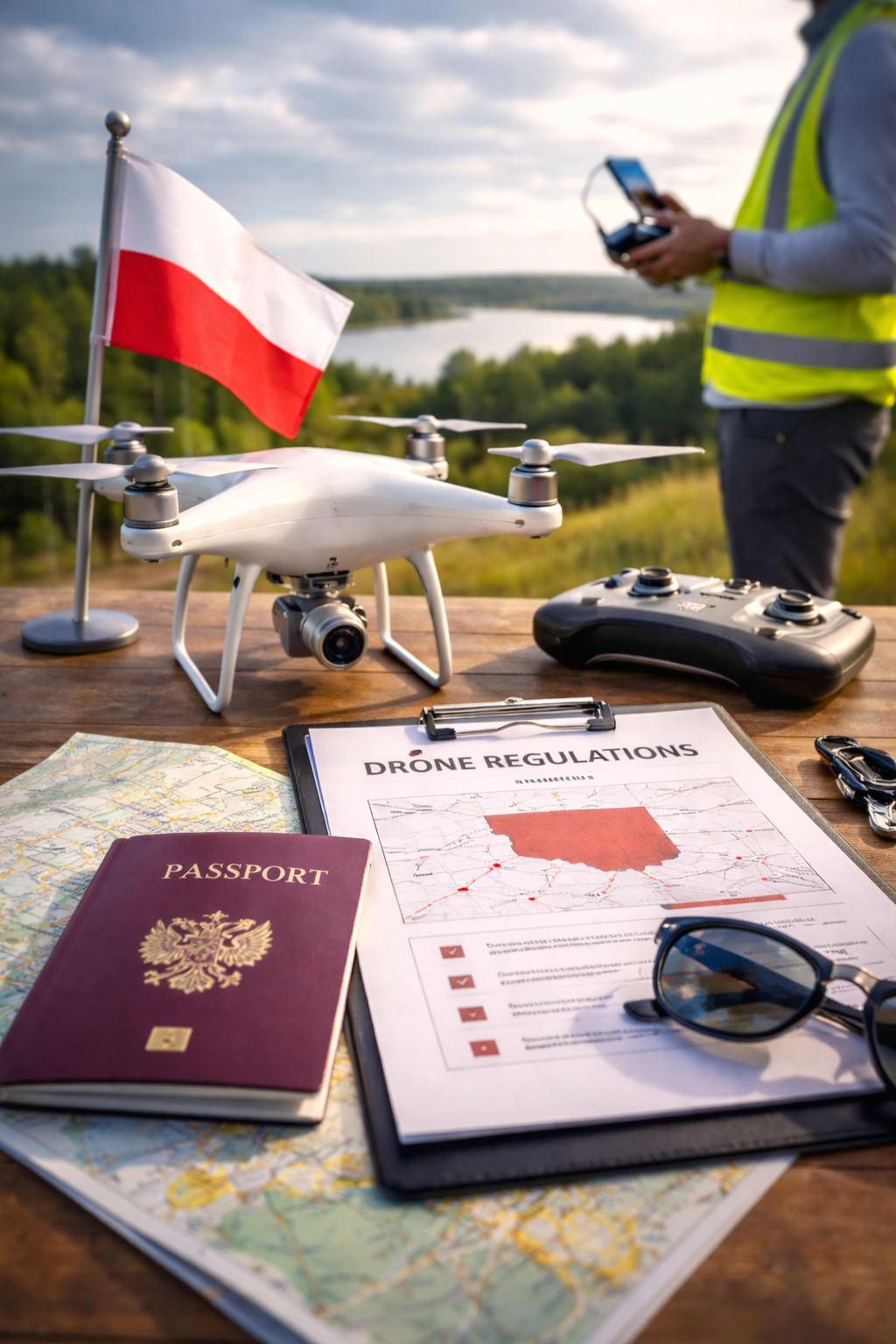
Poland’s drone rules are pretty manageable: pick the right flight category, register when the law mandates you, stay inside the open-category limits unless you have a specific-category route, check PANSA’s geo-zones before every launch, report the flight through the system PANSA designates, and carry liability insurance if your drone’s take-off mass falls between 250 g and 20 kg.
Let’s break all that down.
How The Polish Drone System Works
Poland follows the shared aviation framework of the European Union, so the core approach is the same one used across EASA states. That means your flight in Poland is judged first by EU risk categories, then by Polish geo-zones, local restrictions, and Polish operational tools.
The Civil Aviation Authority (ULC) handles registration, training, certificates, and authorisations. The Polish Polish Air Navigation Services Agency (PANSA) publishes and manages the geographic zones and the systems you use before flight. EASA sits above both with the common European rule set that Poland follows.
One point that catches many people out is that the rules are not split into “recreational” and “commercial” in the old-fashioned way. Under the EU system, a paid aerial photo job can still sit in the open category if it fits the safety limits, while a hobby flight can jump into the specific category if it goes beyond them. In other words, the risk profile of the operation matters more than whether you are being paid.
ULC divides operations into three main categories:
- The open category covers low-risk flights, typically within visual line of sight, below 120 metres from the nearest point on the ground, and with drones under 25 kg.
- The specific category covers medium-risk operations that step outside those limits and therefore need a declaration or an authorisation path.
- The certified category is the high-risk end of the scale and is reserved for operations such as flights over assemblies of people, flights carrying passengers, or flights carrying dangerous goods that could create a high third-party risk in an accident.
If you are flying a small drone within sight, staying low, keeping away from crowds, and working inside the allowed geo-zone conditions, you are usually in the open category. If you want BVLOS work, more demanding urban operations, linear inspections, or other flights that do not fit the open box, you should start looking at the specific category instead.
What You Need Before You Fly
Registration Rules for Poland Drone Pilots
You must register as an operator in Poland if you fly in the open category with a drone that has an MTOM of 250 g or more, or if your drone has a sensor capable of collecting personal data, such as a camera, unless it is a toy. You must also register for any specific-category operation, no matter how light the drone is. Registration is free and handled through drony.gov.pl
A tiny camera drone can still trigger paperwork. So, if you own a sub-250 g drone with a camera, the weight alone does not save you from registration. At the same time, a very light toy drone can sit outside that requirement. This is one of the most common mistakes new pilots make, especially when they rely on advice from other countries.
Your registration is not locked to Poland alone. The operator number you receive is valid across the rest of the EASA area, and you cannot register twice in different member states. If you already hold an operator registration from another EASA country, Poland recognises it. If you are a non-EU visitor, you must register in the first EASA state where you intend to fly, and that registration then works across the rest of the system.
Training, Age, And Certificate Validity
For everyday open-category flying, the minimum age is 14. There are exceptions for some toy-class C0 drones, some privately built drones under 250 g, and supervised operations. That fits the broader EU model, because EASA sets the default minimum age at 16 but allows states to lower it. Poland has used that flexibility.
If your drone weighs 250 g or more, you must complete online training and pass an online test before flying. The online test has 40 multiple-choice questions, and you need 75% to pass. For A2, you need more: the A1/A3 online work, practical self-training, and an additional theory exam run by an authorised body.
Pilot competencies in A1/A3, A2, and STS stay valid for 5 years.
Renewal is not one-size-fits-all either: A1/A3 usually means redoing the online training and exam, A2 needs a further theory step or a refresher route during validity, and STS has its own revalidation path.
The scale of the system shows how mainstream drone flying has become. In one ULC briefing, the authority reported 448,755 registered operators, 318,620 A1/A3 pilots, and 46,640 A2 pilots as of 11 February, with average daily registrations in December at 457 people. Those show a very large regulated user base.
>>> Drone Pilot License Costs in the EU
How The Open Category Works for Poland Drone Flights
A1, A2, And A3
The easiest way to think about the open category is by asking: How close do you want to be to other people?
A1 is the lightest-touch subcategory. A2 lets you fly closer to uninvolved people, but only with the right drone class and competence. A3 is the “well away from people and built-up areas” lane.
- A1: you may fly over people only in the narrow cases allowed by the rules, but never over an assembly of people.
- A2: the minimum horizontal distance from uninvolved people is 30 metres, or 5 metres if the drone has a low-speed mode.
- A3: you must stay at least 150 metres horizontally from residential, commercial, industrial, or recreational areas.
Across the open category, the general ceiling remains 120 metres above ground and the flight must stay in VLOS unless you are using permitted observer support.
So a city-centre real-estate shoot is not automatically banned, and it is not automatically a specific-category job either. If your drone class, pilot competence, local geo-zone, and people separation all line up, it may fit open-category A1 or A2.
On the other hand, a line inspection outside visual line of sight is likely to leave the open category very quickly, even if nobody is paying you for it.
Class Labels, Legacy Drones, And Remote ID
The class label on your drone now matters a lot.
The open category from 1 January 2024 is built around drones with C0 to C4 class labels, privately built drones, or drones placed on the market before 31 December 2023 without a class label.
The key mapping is:
- C0 and C1 live in A1;
- C2 lives in A2 and can also be flown under A3 conditions;
- C3 and C4 live in A3.
For drones without a class label that were sold before the cut-off date, the post-2024 rules are tighter: if the drone is under 250 g you can use A1, and if it is under 25 kg you can use A3.
This is exactly why older buying guides can mislead you. A no-class drone that once sat in a friendlier transition rule does not automatically stay there forever. If you are buying now, it is usually smarter to think in class labels first rather than brand names first, because the class decides where you can fly and how much paperwork follows you.
Remote identification is another major point. The active and updated direct remote identification requirement applies to drones marked C1, C2, C3, C5, or C6. From 1 January 2024, every drone operated in the specific category below 120 metres must carry remote identification as well, unless it falls into a listed exception. All drones in the specific category and all class-marked drones in the open category need an active and up-to-date remote identification system.
One small but important detail: A class C0 drone can still be operated in A1 even if its mass slightly exceeds 250 g because the conformity standard for C0 and C1 allows a ±3% tolerance. However, the Polish insurance duty looks at actual take-off mass, not the class label. So a drone can be legally treated as C0 for A1 flying and still fall into the 250 g to 20 kg insurance bracket. That is a great example of why you cannot rely on the class label alone.
FPV pilots should take care too. FPV can be used in the open category across A1, A2, and A3, but goggles do not satisfy the VLOS requirement on their own. That means you need an observer who keeps visual contact with the drone and warns you about hazards. So yes, FPV is possible, but no, you cannot treat goggles as a replacement for an observer in ordinary open-category flight.
>>> How to Be an Effective Visual Observer for Drone Missions
Where You Can And Cannot Fly Drones in Poland
Geo Zones, Check In, And Local Permissions
Poland adds one step that visitors often find stricter in day-to-day use than they expected: Every drone flight in Polish airspace should take place after informing PANSA about the intention to fly through the telematics system designated by PANSA.
The operator is fully responsible for the operation and must check airspace availability before flight using DroneMap. In other words, a legal flight in Poland is not only about class label, registration, and pilot certificate; it is also about the current condition of the airspace around you.
PANSA’s own drone ecosystem now includes tools such as DroneMap, PansaUTM, and DroneTower, and those services support mission planning, flight submission, notification, and execution. This workflow has become central to day-to-day operations, because Poland has built a very digital system around drone traffic management rather than leaving pilots to work from static maps alone.
That is also why you should never assume that a place where you flew last month is still available today under the same conditions. Geographic zones can be controlled, restricted, or conditioned on permission. In some cases, the zone manager’s consent is needed. In others, you will need a mission plan in PansaUTM rather than a quick check-in. The safe habit is simple: check the live map every single time, then follow the workflow the zone requires.
Nature Areas, Rescue Flights, And Sensitive Sites
Open-category permission does not mean “fly anywhere scenic.” Do not fly near or inside an area where rescue operations are underway unless the responsible rescue services have given permission. The drone should not carry dangerous goods and may not drop material in the open category. So even if the airspace is technically open, the exact operation still has to fit the rule set.
Nature protection rules add another layer. Flights by powered aircraft over national parks and nature reserves below the relevant protected heights are prohibited under Polish aviation law and the long-term flight-restriction regulation. Breaking that ban can lead to a PLN 10,000 financial penalty. Outside national parks, drone flights over other protected areas may still raise legal problems if they disturb wildlife, especially birds during the breeding season (1 March to 15 October).
Sensitive infrastructure is another separate issue. The Homeland Defence Act and the 2025 regulation on signs ban photography. That means a flight that is allowed from an airspace point of view can still create problems if you are filming or photographing a protected object that is separately restricted by national law. So if your job involves industrial, military, or critical-infrastructure sites, check both the flight rules and the filming rules before you take off.
When You Need The Specific Category
The Three Paths Into The Specific Category
The specific category is where Poland’s system becomes more technical. You have three main routes:
- a declaration that your operation matches a standard scenario,
- an operational authorisation for flights outside those scenarios, or;
- a Light UAS Operator Certificate, better known as an LUC, if your organisation has the maturity to manage operations under that framework.
SORA and PDRA are the main risk-assessment tools when a simple declaration is not enough.
>>> SORA Guide For Drone Operators
For standard scenarios, the EU STS paths have applied since 1 January 2024. If you are an experienced Polish operator and your paperwork still talks about NSTS, treat that as a warning sign to check the newest guidance. NSTS competencies were valid only until 31 December 2025, that EU law did not extend them, and that they were not automatically converted into STS. Pilots with older NSTS backgrounds can still move forward, but they need the required supplementary steps rather than assuming their old documents still do the job.
The STS pathway is specific down to the exam format. Candidates for STS must already hold A1/A3 competence and then pass an extra theoretical exam through an approved body. For candidates who already hold A2, that STS theory test has 30 questions. For candidates holding only A1/A3, it has 40 questions. In both cases, the pass mark is 75%. Practical training then has to use the correct class of drone: C5 for STS-01 and C6 for STS-02.
If your operation is more unusual, ULC’s authorisation track is for you. The authority offers an optional information stage before submission, including an initial discussion of route, airspace, local risk, and mitigation measures, and that consultation can run up to 60 minutes. That is useful because many specific-category projects fail at the planning stage, not because they are impossible, but because the operator picked the wrong pathway or did not prepare the risk assessment in the right format.
Cross-border work needs extra care. If you are an operator from another EU member state and you want to perform a specific-category operation in Poland on the basis of an existing Article 12 authorisation, you must send ULC a copy of that authorisation and a cross-border application. Only after ULC reviews the documents and issues a confirmation of acceptability can you start the operation. So, if you are an EU operator coming in for a commercial inspection or surveying job, do not assume your home-state authorisation alone is enough.
Insurance and Penalties For Poland Drone Flights
The biggest recent change for many ordinary pilots is insurance. Since 13 November 2025, operators of drones with a take-off mass from 250 g to 20 kg have had to hold mandatory third-party liability insurance. No policy can mean a fine of up to PLN 4,000, and that the minimum guaranteed sum is 50,000 SDR, which translates to about PLN 270,000. Drones under 250 g stay outside that mandatory bracket, while drones above 20 kg remain subject to the older aviation-insurance regime under Regulation 785/2004.
This is not cosmetic paperwork either. Mandatory policy covers damage to third parties, not damage to your own drone. The policy does not cover, among other things, flights conducted in breach of the law. That means flying illegally can hurt you twice: first because you may face a regulatory penalty, and second because your insurer may refuse the claim that you expected to save you.
FAQs about Poland Drone Laws
Do You Need To Register A Drone Under 250 G?
Yes, if the drone carries a camera or another sensor able to collect personal data and it is not a toy, you still need operator registration even below 250 g. If it is a toy and falls inside the toy exception, the rule can be different.
Can You Fly In A City Centre?
Sometimes, but only if your drone, your competency level, and the local geo-zone conditions all fit the rules. A1 and A2 can work in built-up areas under the right conditions, while A3 cannot because it requires at least 150 metres from residential, commercial, industrial, or recreational areas. You also still need to avoid assemblies of people and follow PANSA’s live airspace workflow. [16]
Do You Need To Report Every Flight?
Yes, every drone flight in Polish airspace should take place after informing PANSA through the telematics system designated by PANSA. On top of that, you must check the current airspace situation in DroneMap before the flight.
Can You Fly FPV With Goggles Alone?
No, not in ordinary open-category operation. FPV flights are allowed in the open category, but goggles do not satisfy the VLOS requirement by themselves, so you need an observer who keeps visual contact with the drone and warns you about hazards.
Can Tourists Use A Registration From Another Country?
Yes, if your operator registration comes from another EASA state, Poland recognises it and you must not register twice. If you are coming from outside the EASA system, EASA says you should register in the first EASA country where you intend to operate. If you want to conduct a specific-category operation in Poland using a home-state authorisation, you still need Polish confirmation of acceptability before starting the mission.
Do You Need Insurance To Fly A Drone In Poland?
Yes, if your drone’s take-off mass is between 250 g and 20 kg, you now need mandatory third-party liability insurance. Below 250 g, that mandatory rule does not apply, although voluntary cover can still be sensible. Above 20 kg, the aviation-insurance regime under Regulation 785/2004 applies instead.
Can You Fly Over A Concert Or A Crowd?
No, not in the open category. A mass event usually counts as an assembly of people, so that kind of operation generally belongs in the specific or certified category, with the matching risk analysis and approvals.