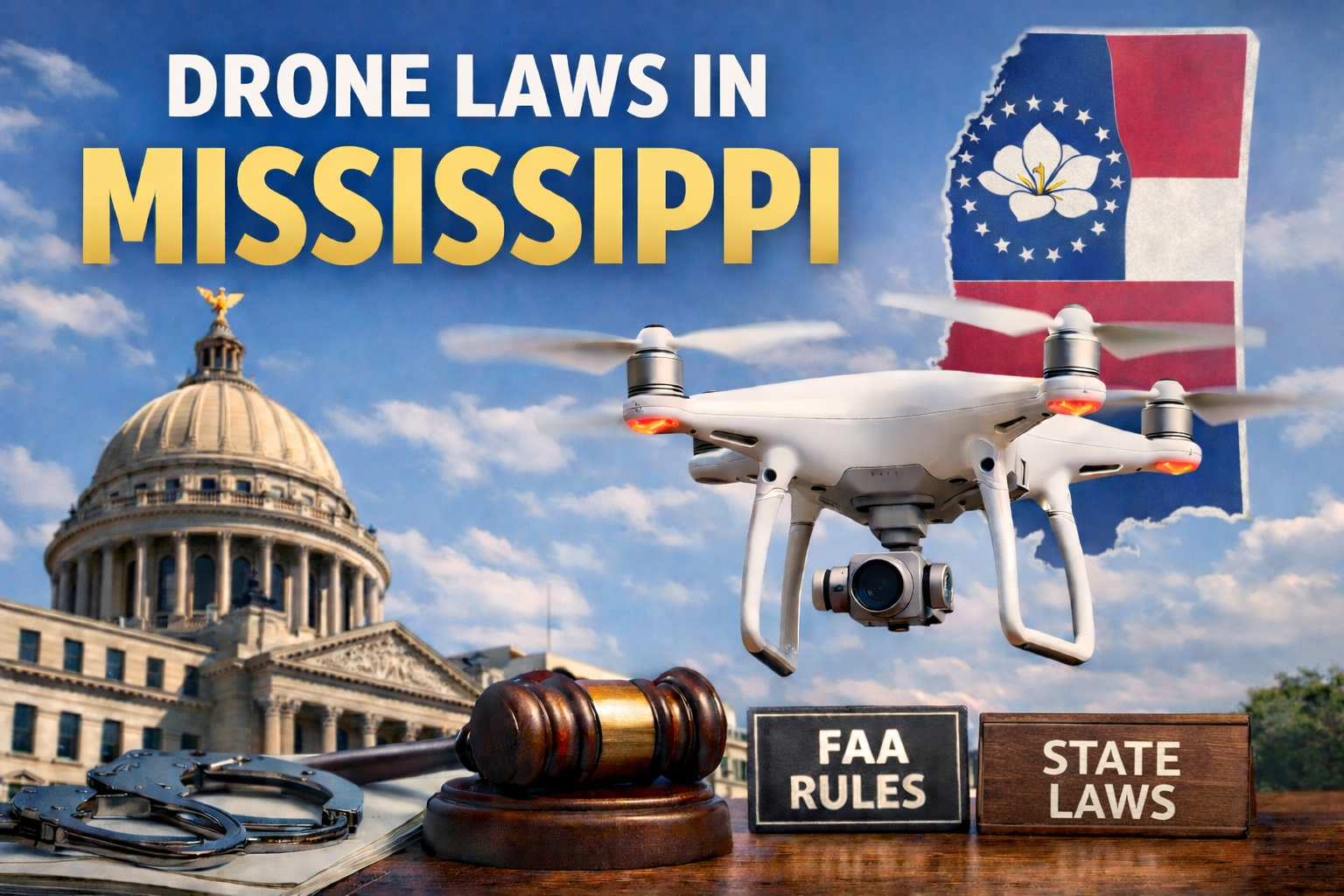
If you’re in Mississippi and flying a drone (or thinking of getting one), it’s important you know the rules. Drone regulations come from both federal authorities and Mississippi state law – and yes, there’s always new legislation to consider.
In this guide, we’ll break down what you need to know about U.S. drone laws, Mississippi-specific regulations (including recent updates)
Federal Drone Laws You Must Follow
No matter what state you’re in, you have to follow the Federal Aviation Administration (FAA) rules for drones. These national drone laws apply in Mississippi just like everywhere else in the U.S.
- Registration: If your drone weighs more than 0.55 pounds (250 grams), you must register it with the FAA before flying. Registration is easy (it costs $5 and can be done online), but it’s legally required. You’ll get a registration number that needs to be marked on your drone. See total costs to get licensed and business-ready.
- Recreational Flyers (Hobbyists): For casual, fun flying, the FAA requires you to pass The Recreational UAS Safety Test (TRUST) and carry proof of passing it. This is a simple online test on drone safety. As a hobbyist, you also need to follow safety guidelines, often set by community-based organizations. In general, you must fly below 400 feet, keep your drone within your visual line of sight, and stay away from manned aircraft (like planes and helicopters). You should avoid flying near emergency response efforts, and don’t fly over people or moving vehicles for safety unless you have specific FAA authorization. Also, don’t fly near airports (within 5 miles) without notifying the airport/control tower – in many cases you can use the FAA’s LAANC system to get approval in controlled airspace. Basically, fly responsibly and yield to any manned aircraft.
- Commercial Flyers: If you’re flying a drone for business or any profit (even something like monetized YouTube videos or real estate photography), you fall under FAA’s Part 107 rules. That means you need to obtain an FAA Remote Pilot Certificate (by passing a written exam) and follow the Part 107 regulations. Part 107 has many of the same basic limits (max 400 ft altitude, line-of-sight, etc.) but also allows certain operations with a waiver or meeting conditions (for example, you can fly at night with anti-collision lights as long as you’re Part 107 certified, and recent rule changes allow flying over people in limited cases if your drone meets specific safety criteria). If you’re a government or law enforcement operator, you can either operate under Part 107 or obtain a special FAA Certificate of Authorization (COA) for public aircraft operations. In any case, all drone pilots must adhere to FAA airspace restrictions – for instance, flying near military bases or in other restricted zones is prohibited without permission.
- Remote ID Requirement: A new federal rule requires most drones to broadcast identification signals, that way authorities can track it. Think of it like a “digital license plate” for your drone. As of September 2023, drones that must be registered are required to comply with Remote ID (there was a grace period, but full enforcement began on March 16, 2024). If your drone isn’t broadcasting its ID as required, you could face FAA fines or even have your pilot license suspended.
- No Weapons on Drones: It may seem obvious, but you cannot arm your drone with weapons. The FAA and other agencies strictly prohibit attaching a firearm or any dangerous weapon to a drone. Doing so isn’t just against policy – it could violate serious federal laws. So don’t turn your fun gadget into a mini fighter jet!
- Temporary Flight Restrictions: Be aware that there are times/places where you cannot fly at all. For example, the FAA issues Temporary Flight Restrictions (TFRs) over stadiums during NCAA or NFL football games and other major sporting events – drones are forbidden within 3 miles of stadiums from one hour before to one hour after the event. There are also TFRs over wildfires or disaster areas (to protect firefighting aircraft). And as a rule, drones cannot take off or land in National Parks by National Park Service policy. If you were hoping to get aerial shots in, say, the Natchez Trace Parkway or Gulf Islands National Seashore, sorry – those are off-limits for drone takeoffs/landings. Always check resources like the FAA’s B4UFLY service for any airspace restrictions before you fly.
- Penalties for Unsafe Flying: The FAA can and does enforce these rules. If you fly recklessly or where you’re not allowed, you could be fined, and your drone could even be confiscated. For example, flying a drone in a way that endangers people or other aircraft is illegal. In extreme cases, people have faced heavy fines and criminal charges – one drone pilot was charged with federal felonies after flying over an NFL stadium and violating defense airspace. Others have been fined thousands of dollars for buzzing over crowds. So while flying is a blast, you want to do it safely and legally to avoid getting into serious trouble.
- Don’t Shoot Down Drones: Finally, a note for those on the ground: If someone else’s drone is over your property and you find it annoying, do NOT try to shoot it down or damage it. Under federal law, drones are considered aircraft, and it’s a felony to destroy an aircraft in flight. Yes, that applies even to a small hobby drone – shooting at a drone could land you in federal court. (Plus, it’s dangerous; bullets have to land somewhere!) If a drone is truly harassing you or posing a danger, the proper response is to call the authorities, not take matters into your own hands.
>>> Can Private Security Shoot Down Drones?
So the FAA’s rules are the foundation: register if required, always yield to manned aircraft, keep your drone in sight, respect airspace and privacy, and use common sense. Now that we’ve covered the national basics, let’s see what Mississippi has to say about drones.
Mississippi State Drone Laws and Regulations
Mississippi has added its own flavor to drone regulation, especially in the areas of privacy, critical infrastructure, and law enforcement use. State laws can address concerns that the federal rules don’t explicitly cover.
Privacy and Peeping Tom Law (Voyeurism)
One thing Mississippi absolutely does not tolerate is using a drone to spy on people. Back in 2015, Mississippi updated its “Peeping Tom” law (the state’s voyeurism statute) to include drones. Specifically, Senate Bill 2022 (2015) amended Mississippi Code §97-29-61 to make it crystal clear that using a drone (or any similar device) to peep on someone is a felony. In other words, if you fly a drone to snoop into someone’s window or private space for lewd or invasive purposes, you’re committing a serious crime in Mississippi.
To quote the law, it penalizes “any person who… otherwise views by means of any instrumentality, including, but not limited to… drones… the interior of any… area in which the occupant has a reasonable expectation of privacy, with the intent to invade the privacy… shall be guilty of a felony”.
What are the consequences? If convicted under this law, an adult offender can face up to 5 years in state prison for a first offense (and up to 10 years if the victim is a child under 16). That’s on par with other serious felonies. Mississippi really wants to deter would-be snoops from using drones to violate privacy. So, never use your drone to spy on neighbors – not only will you rightfully anger people, you could end up in jail. (This also means if you’re an ordinary resident and someone flies a drone to gawk into your house, you should call law enforcement – the drone pilot could be charged under this law.)
Critical Infrastructure and Prisons (UAS Protection Act of 2021)
Mississippi enacted a comprehensive drone law in 2021 called the Mississippi Unmanned Aircraft Systems Protection Act of 2021. This is codified in Mississippi Code Title 97, Chapter 47 (Sections 97-47-1 through 97-47-9). This law addresses drones flying over sensitive sites – namely critical infrastructure facilities and correctional facilities (prisons).
Under this Act, it is a crime to use a drone to surveil or record critical infrastructure or a prison without permission. “Critical infrastructure” is defined to include things like petroleum refineries, power plants on the Mississippi power grid, natural gas terminals, military installations, and defense contractor facilities. Essentially, these are high-security or vital facilities. The law says you must have the written consent of the facility’s owner (or designee) before flying a drone to collect data, photos, or video of such a site.
So, for example, you cannot just send your drone to get cool footage of a power station or a pipeline station unless the company in charge gave you permission. The same goes for flying over a prison – you need the prison authorities’ okay.
The second part of this law is aimed at a very specific bad behavior: delivering contraband to prisons via drone. Believe it or not, this has become a thing in recent years (nationwide, people have tried dropping drugs, phones, and other contraband into prison yards with drones). Mississippi’s law makes it a felony to use a drone to deliver or attempt to deliver contraband to a correctional facility (or even to fly contraband on adjacent property with intent to drop it into the prison). If you get caught doing that, the penalties are harsh – a felony conviction punishable by 3 to 15 years in state prison and up to $25,000 fine. In contrast, the penalty for the surveillance part (flying over critical infrastructure without consent) is a misdemeanor – up to 1 year in jail or $1,000 fine for a first offense. Mississippi clearly decided that spying on a refinery is bad (misdemeanor), but dropping contraband into a prison is much worse (felony).
In 2020, two men in Mississippi were caught trying to smuggle drugs and a phone into the Central Mississippi Correctional Facility using a drone. Their drone crashed into the prison’s netting, and officers recovered it with marijuana, a cell phone, chargers, and more attached. The suspects were arrested and faced charges for attempting to smuggle contraband into a prison. This was exactly the kind of incident the 2021 law targets.
The Department of Corrections noted it was the third drone they’d intercepted in recent years. In that case, the individuals were charged with conspiracy and existing contraband laws (the incident happened just before the new drone-specific law took effect), but moving forward, anyone attempting the same stunt can be prosecuted under the UAS Protection Act felony provision as well.
Law Enforcement and Government Drone Use
What about police or other government agencies? Mississippi’s UAS Protection Act has a section on that too.
Law enforcement agencies in Mississippi are explicitly allowed to operate drones “for any lawful purpose” – the state law basically says nothing in the act prohibits police from using drones in their work. So, police can use drones for things like search and rescue, crime scene documentation, monitoring public events, etc., as long as it’s within the bounds of the law (and of course they must follow FAA rules too). Mississippi did not impose any state-level warrant requirement for drones, unlike some states. (So, for surveillance that would normally require a warrant, Mississippi relies on federal constitutional law – generally, if police use a drone to look into a place where you have a reasonable expectation of privacy, they’d need a warrant just as they would if they used a manned helicopter or walked up to your window. But the state law itself doesn’t add extra restrictions on police drone use.)
For other public agencies or contractors (like say a city engineering department, or a company contracting with the state for a project), the law is a bit more restrictive: they may operate a drone only if they have the written consent of the owner of any critical infrastructure or prison they fly over, and they must follow FAA rules. This is basically saying: if you’re not law enforcement but you’re a government entity flying a drone for some public purpose, you still can’t snoop on someone’s refinery or a prison without permission. It’s an interesting nuance – it gives law enforcement more leeway than other government operators.
Mississippi also took action regarding government purchase of drones. Very recently, Mississippi lawmakers showed concern about security risks of foreign-made drones (particularly Chinese-manufactured drones, like DJI, which dominate the market). In 2023, the state passed a requirement (effective January 1, 2025) that any drone purchased by Mississippi state agencies must be made by a domestic manufacturer and must have collision avoidance systems onboard. In fact, the law outright forbids state agencies from buying drones made in certain countries (the intent here is mainly to ban Chinese drones due to data security worries). For example, a Mississippi police department or fire department can no longer go buy the cheapest DJI drone off Amazon or local resellers– they’ll have to choose an American-made model with approved tech. This might align with similar moves in other states and federal guidelines about removing Chinese drones from government fleets. So, if you work in public safety in Mississippi, be aware of this procurement rule. And as a citizen, you can know that Mississippi is trying to ensure law enforcement drones meet security standards and aren’t sending data to foreign servers.
>>> DJI Ban in US 2026 Update, Timeline and Effects
It’s worth noting that Mississippi did not enact any broad preemption law stopping local governments from making drone rules – but as of now, no Mississippi city or county has its own drone ordinance on the books. The state has basically handled it at the state-law level and left the FAA to cover the rest. Cities like Jackson, Gulfport, etc., have not passed local drone laws specifically. (They can enforce general laws – e.g., a drone that is a nuisance or noise issue might violate a noise ordinance, and of course privacy and safety laws apply everywhere.) But you won’t find a patchwork of local drone regulations in Mississippi as you might in some other states.
This is actually nice for pilots – it means the rules are uniform statewide. Still, always use common sense on local property: for example, a city park may have rules about model aircraft or a university might require permission to fly on campus. Always check for any posted signs or policies when flying on public property, even if no formal ordinance exists.
Penalties and Examples of Enforcement
To recap Mississippi’s specific penalties: using a drone for voyeurism (peeping) is a felony (you could get up to 5 years prison), flying over critical infrastructure without consent is a misdemeanor (up to 1 year jail and $1,000 fine), and dropping contraband to prisons is a felony (3–15 years prison and up to $25,000 fine). Those are state charges. These can be in addition to any federal charges if your actions also violate FAA rules. For instance, if someone flew a drone in a reckless way over a crowd and it was near a power plant without permission, they could theoretically face an FAA enforcement (civil fine) and a Mississippi misdemeanor charge at the same time.
Enforcement cases
We mentioned the prison contraband case – two men charged after their drone full of drugs crashed at a prison.
In another incident, there was public concern in Hernando, MS, about a “mysterious drone” hovering over neighborhoods. Residents were frustrated, but were reminded they shouldn’t try to shoot it down. Law enforcement indicated that if a drone “hovers where it’s not welcome, becomes a nuisance, or tries to look into a dwelling,” it could be breaking the law(likely the voyeurism or harassment laws).
Neighbors were advised to report it. Police take these reports seriously, and there are legal tools to charge a drone operator if they are endangering or harassing people.
Another common question: Can I fly a drone over someone’s house or backyard? By FAA rules, simply flying over private property at a certain height isn’t per se illegal (airspace is a public highway in most cases). However, if you hover low over someone’s yard, especially peering at them, you cross into privacy/harassment territory. Mississippi law doesn’t define a specific altitude for “trespass” with a drone, but the reasonable expectation of privacy standard is key.
If you hover in someone’s backyard looking into their windows, that’s clearly illegal spying (felony). If you’re just passing high over their property on the way to somewhere else, that’s likely allowed (assuming you’re following FAA altitude and line-of-sight rules). It’s a bit of a gray area that courts are still figuring out across the country. Our advice: be respectful. Don’t hover over private homes or backyards – not only could it upset people, but you could be accused of voyeurism. It’s best to stick to flying over public spaces or your own property unless you have permission to overfly someone else’s.
If you’re a Mississippi resident concerned about a drone repeatedly flying over your house, you have options:
- You can call your local police (especially if you suspect it’s trying to film or harm someone) – they might investigate and, if appropriate, invoke the voyeurism law or others.
- You can also contact the FAA Flight Standards District Office (FSDO) in Jackson for persistent unsafe flying issues. The FAA has authority over the airspace, so if someone is flying recklessly (too low, over people, at night with no lights, etc.), the FAA can pursue civil penalties.
In any case, do not take drastic action yourself. Again, don’t shoot at the drone – call authorities and let them handle it through legal channels.
Flying Safe and Legal: Tips for Drone Users in Mississippi
By now you might be feeling a little overwhelmed – there are a lot of rules! But it boils down to common-sense principles: fly safely, respect others’ privacy, and stay informed. Mississippi is a beautiful place to fly a drone – from the Delta flatlands to the Gulf Coast – and by following the law, you can enjoy stunning aerial photography or FPV racing without issues. Here are some final tips and takeaways:
- Always follow FAA rules first. They are the baseline. Register your drone if needed, carry your FAA certificate if you’re Part 107, and check airspace maps before you fly. Keep your flights under 400 feet and within sight. Most importantly, don’t do anything that could put people or aircraft in danger. If you stick to the basic safety rules, you’re already halfway to staying out of trouble.
- Be mindful of privacy. In a residential area, assume people value their privacy (wouldn’t you?). Avoid flying low over homes, and never use your drone’s camera in a sneaky or intrusive way. What might seem like a harmless curiosity (hovering to peek at a neighbor’s pool party, for example) could actually be a felony voyeurism offense in Mississippi if done with prying intent. It’s just not worth it. If you want to shoot video and there are homes in the area, do it from a high altitude where individuals aren’t identifiable, or get permission if possible. Basically, treat a drone like a vehicle – you wouldn’t drive your car into someone’s yard to stare in their windows; don’t do the equivalent with your drone.
- Stay away from critical sites. Mississippi law says no unauthorized drone snooping around refineries, power plants, pipelines, correctional facilities, etc. So don’t plan any flights near those. Even if you have zero malicious intent, you might attract unwanted attention (and yes, security folks will call police if they see a drone over a power plant). If you have a legitimate reason to fly near such a facility (say you’re a contractor inspecting cell towers near a refinery), get written permission from the site first. Also, be aware that flying near military bases is heavily restricted by federal law – for example, Camp Shelby or Columbus AFB will have restricted airspace. Check sectional charts or apps for no-fly zones.
- Never drop stuff from your drone. Attaching a payload to deliver something is risky legal territory. Certainly, absolutely do not attempt to drop any package at a prison – that’s asking for years behind bars. Even dropping harmless items elsewhere could violate FAA rules unless you have Part 107 and a waiver (dropping objects is illegal if it creates any hazard). So it’s best to just not use your drone as a delivery device unless you’re part of a sanctioned test program (like those Walmart drone deliveries – those operators have FAA approval).
- Government drone users: If you’re reading this as a public employee or first responder, know that Mississippi supports your use of drones – the law explicitly allows law enforcement to use drones for any lawful purpose. Drones have become great tools for police and fire departments (for example, helping in search-and-rescue missions, assessing disasters, or giving situational awareness during emergencies). Just keep in mind the new state procurement rule: agencies should be purchasing U.S.-made drones with collision avoidance tech. And even though state law doesn’t force warrants for drones, good practice (and constitutional law) means if you’re going to surveil a private backyard or something in an investigation, it’s wise to get a warrant. Transparency with the community is key – some cities like Hattiesburg have even held town halls about plans to use drones for public safety, emphasizing finding the balance between safety and privacy. For community trust, it’s great when agencies let the public know how and when they use drones.
- Local rules and ordinances: As mentioned, Mississippi doesn’t have specific city-level drone laws at this time. That means if you travel from Tupelo to Biloxi with your drone, the state law and FAA rules remain the same. However, always use courtesy on public lands. State parks in Mississippi, for instance, do not have an official statewide drone ban, but park directors could ask you not to disturb wildlife or visitors. Always heed on-site instructions. And if a local official or law enforcement officer approaches you about your drone flight, be polite and explain what you’re doing. Often, any issues can be resolved by communicating – sometimes they just want to ensure you’re not doing anything dangerous. Having your FAA registration and, if applicable, your Part 107 license on hand can demonstrate you’re a responsible pilot.
- When in doubt, ask. If you’re unsure about a planned flight – maybe you want to film a cool abandoned factory (check if it’s “critical infrastructure” or not), or you worry a neighbor might misinterpret your drone hovering near their yard – it doesn’t hurt to talk to people. For instance, if you want to fly around your neighborhood, you might let neighbors know and assure them you won’t film their homes. A little goodwill can prevent angry calls or confrontations. And if you have legal questions, the FAA and Mississippi Department of Transportation’s Aeronautics division can be resources, as can local drone enthusiast groups. Mississippi has a growing community of drone hobbyists and professionals – sharing knowledge helps everyone fly better.
Mississippi Needs Skilled Drone Pilots. Start Training Today
Explore Online Drone Courses