When searching for a UAV coach, chances are you’re not looking for basic “how to fly” tips.
You want to fly commercially, operate safely, and deliver inspection data that clients can trust. You also want fewer mistakes, fewer re-flights, and a smoother path from “I can fly” to “I can run a professional mission.”
And the demand is high. In the U.S. alone, the FAA reports 837,513 total drones registered and 481,760 certificated remote pilots as of March 2026. That is a big pool of operators, and it is still growing. Across Europe, EASA notes more than two million registered drone operators under the EU rules framework. You can view data for the different countries on the IAM Hub drone economy dashboard.
So if you’re trying to stand out, coaching becomes necessary.
What a UAV Coach Actually Does (It’s Not Just Flight Practice)
A good UAV coach helps you build repeatable performance.
That usually means working with you on three layers at the same time:
-
Pilot skill under real conditions
Flying in calm conditions is one thing. Flying near structures, dealing with gusts, maintaining framing, and keeping your drone stable around assets is another.
A coach helps you:
- tighten your stick control and camera control
- plan safer approaches
- build muscle memory for consistent angles and distance
- reduce “panic inputs” when the drone drifts or warnings pop up
If your work depends on consistently clean imagery, ABJ Academy’s Drone Photography Training Course focuses on still-image fundamentals for drone work. If you deliver video for clients (or you’re building a portfolio), the Drone Videography Training Course is also available for $225.
-
Mission discipline (the part that wins commercial clients)
Commercial flying is mostly planning and process.
A coach helps you build:
- pre-flight briefs that stop surprises
- checklists that catch the boring mistakes
- site risk scans
- clear “go / no-go” rules
- clean handovers and logs
If you’re working toward U.S. commercial operations, ABJ Academy has a Part 107 Preparatory Online Course built to help you prep for the FAA Part 107 exam.
Also, if your commercial work includes mapping, volumes, ortho capture, or 3D deliverables, ABJ Academy’s Drone Surveying course covers surveying basics, flight planning, and data capture.
-
Inspection output that holds up
Inspection clients care about what you deliver, not how fun the flight was.
A coach helps you deliver:
- sharp, repeatable imagery
- correct overlap and coverage
- the right defect angles
- consistent naming, tagging, and reporting
If you’re moving into inspection deliverables that include infrared, ABJ Academy’s Drone Thermography Level 1 handles training that supports live inspections of photovoltaic solar panels. Then, Drone Thermography Level 2 is the next step after Level 1 with deeper ISO-aligned coverage and image presentation/reading skills.
Why UAV Coaching Matters More in Inspection Work
Inspection work is where “almost good” becomes expensive.
If your imagery is inconsistent, you get:
- missing coverage
- misaligned sets
- blurry defect shots
- rework
- arguments about what was or wasn’t captured
That is also why inspection drone adoption is rising. One industry forecast pegs the global inspection drone market at $3.98B in 2025, projecting it to $12.34B by 2032 (with a stated 17.6% CAGR).
Coaching helps you move from “I captured something” to “I captured what the client needs, every time.”
You can even get a broad “inspection mindset” foundation (beyond one sensor type), with Non-Destructive Testing Techniques Level 1 Certification at ABJ, that includes ISO standards and multiple NDT methods used across industries like solar farms and wind turbines.
If you’re training a team (not just yourself), ABJ Academy’s Membership – Premium gives you access to primary, specialist, and instructor courses (any 2 drone courses per month), plus instructor/field-operator access and network opportunities. There’s also a Premium Pro annual option.
Safety Factor
If you work around infrastructure, you’re often dealing with height, moving machinery, weather, and risk. A UAV coach should help you reduce risk in practical ways:
- standoff distance rules for different assets
- crew roles (pilot, visual observer, payload operator)
- safe launch/landing procedures
- emergency planning (lost link, low battery, flyaway)
- weather decisions that keep you out of trouble
Compliance Basics Your Coach Should Lock In With You
Rules vary by country, but the pattern is similar: your operation has to match the risk.
A coach should help you translate “regulations” into what you do on a real job:
- how to pick the right operational category and limits
- how to document your process so a client (or regulator) can follow it
- how to avoid common compliance slips that happen on busy sites
If you operate in Europe there are operational categories (Open, Specific, Certified) alongside the general structure of compliance. If you operate in the UK, the CAA’s safety review shows why discipline matters. It reports 55 accidents and serious incidents involving RPAS during 2024, and notes loss of control in flight contributed to 56% (31) of those cases.
Want permissions for higher-risk operations? See our guidance on CONOPs for Part 107 waiver applications that breaks down what the FAA expects and how to structure your CONOPs.
>>> Check out our Drone Pilot License Costs (US, UK, EU, Canada, Australia) analysis that breaks things down by region (useful when you’re budgeting for training, exams, and renewals).
UAV Coach for Wind Turbine Inspections
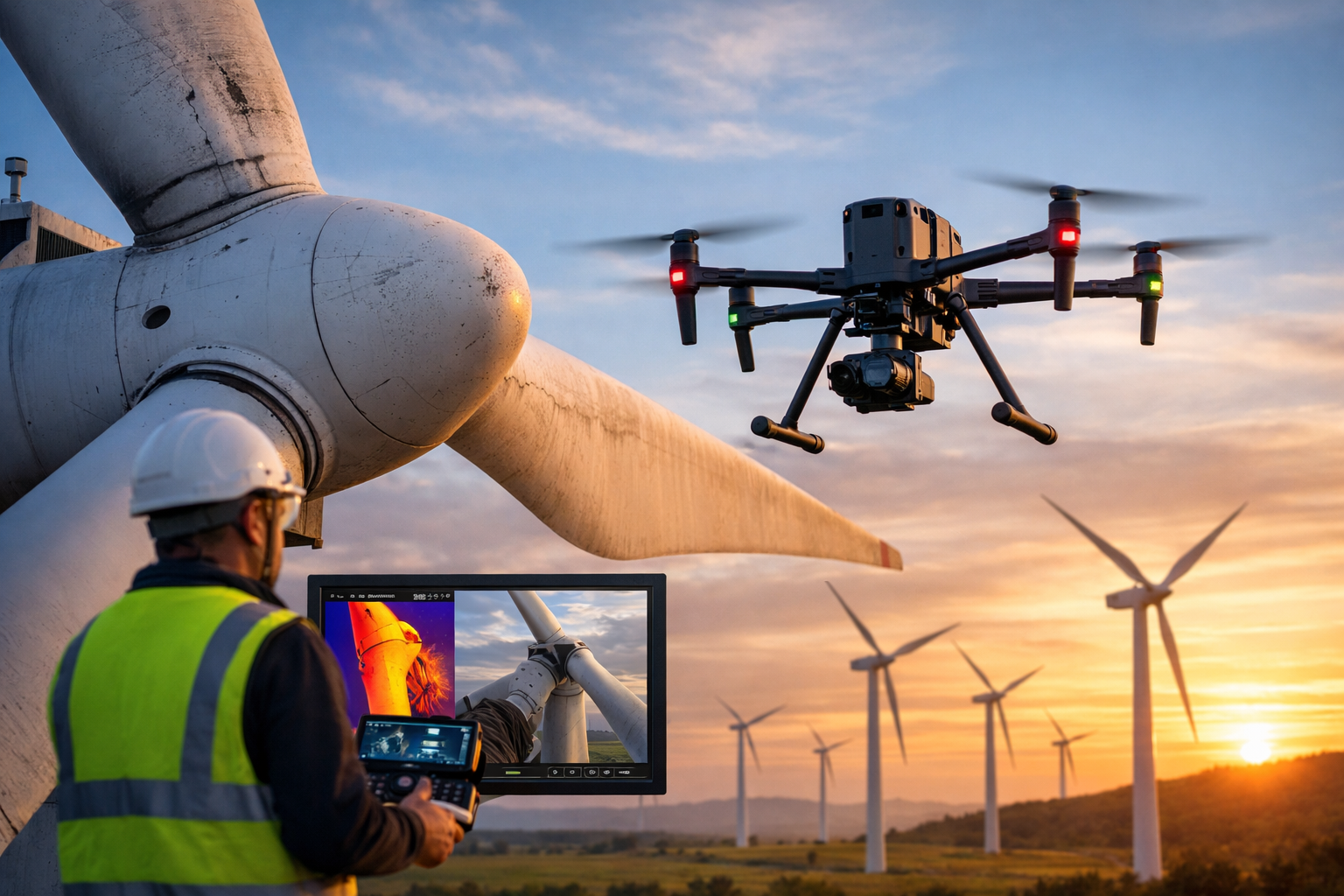
Wind turbine blade inspection is one of the clearest examples of why coaching matters.
Traditional approaches can be slow, costly, and risky. Conventional methods like rope access and ground-based inspections are labor-intensive, expensive, and carry safety risk. Drone inspection as a safer and more efficient alternative.
Now for the numbers.
Drone inspection can be dramatically faster: An ORE Catapult presentation (Cyberhawk) reports UAV inspection can be up to six times quicker than traditional rope-access inspection.
Drone-based models can cut cost and downtime impact: A study on ScienceDirect estimates that replacing rope-access inspection with drones can reduce costs by up to 70% and decrease revenue lost due to downtime by up to 90% (model-based estimates in the paper).
What coaching focuses on for wind:
- blade coverage plans (root to tip, LE/TE coverage, repeatable passes)
- stable distance control in wind and turbulence
- defect-focused framing (cracks, erosion, bonding issues, lightning receptors)
- consistency across turbines so analysts can compare like-for-like
UAV Coach for Solar Inspections for Throughput and Consistency
Solar is a volume game. The faster you cover ground while keeping data clean, the more competitive you become. A single drone team can inspect 50–100 MW per day depending on layout and conditions.
In higher-throughput workflows, an autonomous drone electroluminescence approach that can inspect up to 15,000 modules per 8-hour night shift, and notes over one million modules have been analyzed worldwide
Your coach should help you make your output reliable at scale:
- flight line spacing and overlap that matches your analysis method
- thermal best practices (timing, irradiance context, avoiding false positives)
- clean file handling so huge datasets don’t become a mess
- repeatable reporting so clients can act quickly
What You Should Expect From a Coaching Program
A solid UAV coaching program should be practical and structured.
Skills you should build with your coach
Flight control and camera control
- stable hover and controlled side-slip
- consistent speed on inspection passes
- smooth yaw control without ruining framing
- intentional distance control so your imagery is comparable
Mission planning
- site walkdown habits
- airspace checks and permissions workflow
- weather thresholds and decision rules
- crew assignments and callouts
Data quality
- coverage maps (what must be captured, from where)
- defect shot standards (distance, angle, lighting expectations)
- file naming, metadata, and logging
- reporting structure that matches client decisions
Reliability under pressure
You should practice:
- simulated GPS issues
- battery and return-to-home decisions
- sudden wind changes
- maintaining safe separation when you’re rushed
How to Pick the Right UAV Coach (Quick Checklist)
When you’re choosing a coach, look for proof of process.
Ask these questions
- Can you show me a sample checklist or SOP you teach?
- How do you measure improvement week to week?
- Do you coach inspection deliverables, not just flying?
- What does “good data” look like in your world?
- Have you coached teams, not only individuals?
FAQs About UAV Coaching
What does “UAV coach” mean?
A UAV coach is a trainer or mentor who helps you improve as a drone pilot, usually with a mix of flight skills, safety habits, workflow advice, and commercial know-how.
Is a UAV coach the same as a drone instructor?
No, a UAV coach is not always the same as a drone instructor. An instructor usually teaches a defined course or certification syllabus, while a coach often works more directly on your real-world goals, such as passing Part 107, improving inspection flights, building a client workflow, or fixing weak areas in your flying. This is an industry-use distinction rather than a legal title, so different companies may use the terms differently.
Do you need a UAV coach to become a commercial drone pilot?
No, you do not legally need a UAV coach to become a commercial drone pilot in the U.S. Under FAA rules, if you want to fly a small drone for work or business, you generally need to operate under Part 107 and obtain a Remote Pilot Certificate. A coach is optional, but it can make the process faster and less messy.
Is ABJ Academy’s Part 107 course meant for beginners?
Yes, ABJ Academy’s Part 107 course is meant for people preparing for the FAA knowledge exam. You get the information you need to pass the Part 107 exam and can be accessed on a computer, tablet, or smartphone connected to the internet.
How often do Part 107 pilots need recurrent training?
Part 107 pilots need to keep their aeronautical knowledge current every 24 months. The FAA’s recurrent training course is available online through FAASTeam, and the FAA states that this recurrent training is free.
Can a UAV coach help if you already have Part 107?
Yes, a UAV coach can still help after you get Part 107. Part 107 proves you understand the rules, but it does not automatically make you good at inspections, client deliverables, flight planning, data capture, or commercial workflow. That gap is exactly where coaching is useful.
Can a UAV coach help with inspection work, not just basic flying?
Yes, many UAV coaches help with inspection-specific work such as shot planning, repeatable coverage, defect documentation, thermal workflows, and reporting. That is especially useful in sectors like wind, solar, utilities, and cell tower inspection, where “good flying” is only part of the job.
What is the difference between EASA Open, Specific, and Certified categories?
The difference is the level of operational risk. EASA says the Open category covers low-risk operations, the Specific category covers operations that go beyond Open-category limits, and the Certified category is for the highest-risk operations, such as future passenger-carrying uses.
Can a UAV coach help you get clients?
Yes, a UAV coach can help you become more client-ready, but no coach can honestly promise you contracts. What a good coach can do is help you build stronger deliverables, safer workflows, clearer pricing logic, and a portfolio that makes sense to commercial clients.
Is ABJ Academy membership better than buying single courses?
ABJ Academy membership is better if you plan to take multiple courses in a short period. Since the membership includes any 2 courses per month, it can make more financial sense than buying several specialist courses one by one, especially if you want to stack Part 107 prep, imagery training, surveying, and thermography.
Does ABJ Academy offer instructor training?
Yes, ABJ Academy does offer instructor training. Its includes a Drone Instructor course, which is also part of the broader academy catalog and membership access.