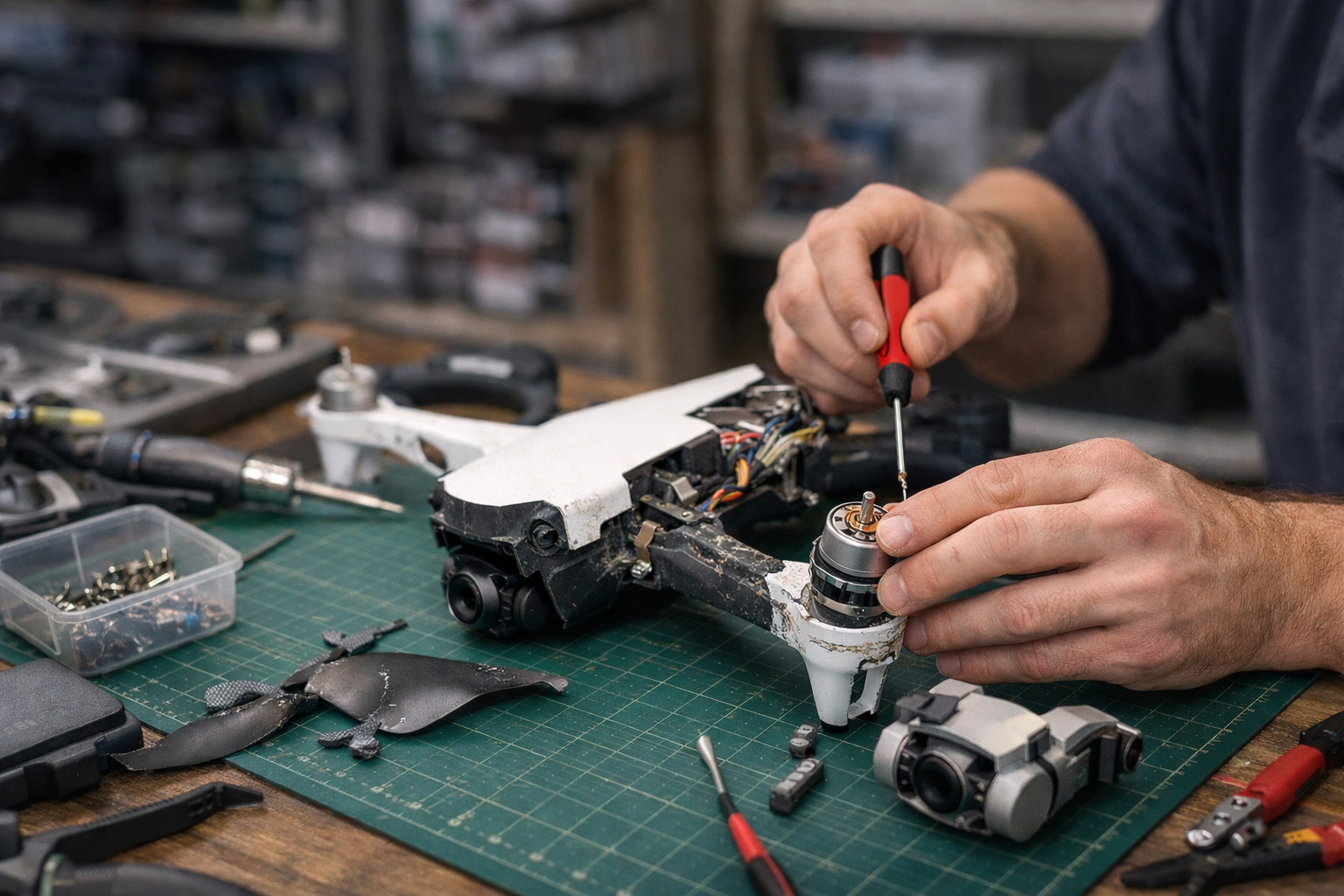
After a crash or weird behavior, the smartest way to decide “repair vs replace” is to sort issues into three buckets:
- Safe and cheap to fix,
- Repairable but only worth it if the quote is reasonable
- Not worth repairing because it is safety-critical or unreliable afterward.
Most hobby and small-operator drones can be repaired cost-effectively when the damage is limited to props, landing gear, a shell cover, or a gimbal mount, but it is often better to replace if you have battery damage, water intrusion, frame cracks near motors, or repeated sensor and flight controller faults.
Whatever you choose, you still need to treat “fit to fly” checks seriously before the next flight.
Summary:
- Fix first when it’s props, minor vibration, loose parts, or small cosmetic breaks.
- Replace first when it’s battery swelling, water damage, structural cracks, or flight-critical electronics faults.
- Compare quotes using deliverables and parts scope, not just labor hours.
- Use manufacturer repair channels or authorized dealers when you want predictable parts and diagnostics.
- Always do a post-repair calibration and test flight before returning to normal flying.
The decision rule
The real question is not “Can it be fixed?” It is:
- Will it be reliable afterward?
- Will it still be safe around people and property?
- Will the repair cost and downtime beat replacement?
Your drone must be safe and functional enough to fly for the operation you plan. The FAA, CAA etc expects you to use checklists and inspections to avoid preventable failures.
Step by step what to do right after a crash
- Power down immediately and remove the battery when safe to do so.
- Check the battery first
- If it is swollen, punctured, unusually hot, or smells odd, stop and treat it as unsafe.
- Do a quick structural scan
- Arms, motor mounts, landing gear, gimbal mount, and the battery bay.
- Do not “test hover” indoors if you suspect flight control issues.
- Capture evidence before disassembly
- Photos of damage, and screenshots of any error messages.
- Choose your repair path
- Manufacturer mail-in or authorized service, or a qualified local shop for simple mechanical swaps.
Issues usually worth repairing
These are commonly repairable with predictable outcomes, especially if diagnostics show no internal faults.
Props and prop hubs
- Replace if chipped, bent, or visibly stressed.
- Repair is basically “swap and balance-check,” not “glue it.”
Landing gear and shell plastics
- Cosmetic cracks and broken skids are often worth fixing if the frame underneath is intact.
Gimbal mount and minor gimbal issues
If the camera image is stable but the gimbal is misaligned, you may only need cleaning, recalibration, or a mount part swap.
Our gimbal care notes can help you understand what “normal” looks like: Drone camera gimbal maintenance and care.
Single motor replacement on modular drones
If you have one bad motor and the rest of the aircraft is clean, a motor swap can be worth it, especially for larger platforms. Manufacturer maintenance manuals often specify replacement intervals for certain parts, which is a hint that replacement is expected and manageable.
Issues usually not worth repairing
These are the “high-risk of repeat failure” category for hobbyists and small operators.
Battery damage or swelling
This is the biggest “replace, do not gamble” item. Also remember battery handling rules when you travel or ship spares. For example, spare lithium batteries must go in carry-on baggage and terminals must be protected from short circuit.
Water intrusion
Even if it powers on, corrosion can show up later as random dropouts. If a repair shop cannot document a proper teardown and inspection, replacement is often safer.
Frame cracks near motors or arm hinges
A crack in a high-stress area can propagate under vibration. If the quote involves major structural replacement, you’re often close to replacement cost anyway.
Recurring sensor or flight controller faults
Repeated IMU, compass, barometer, or GPS errors after a crash often mean deeper issues. That is where manufacturer diagnostics can save you time.
How to find drone repair near you and avoid bad shops
Best places to start
- Manufacturer repair portals and official support pages
DJI, for instance, provides an online repair request flow and guidance on how to submit a case.
- Authorized dealers for enterprise models (often faster for parts and warranty handling).
Repair performed via the manufacturer or an approved dealer or process, includes proper diagnostics and genuine parts.
- Local RC hobby shops (great for props, connectors, basic mechanical work)
Red flags
- They cannot explain what they will test after repair.
- They want to “just swap parts” without diagnosing the root cause.
- They do not talk about battery safety at all.
- No written quote with parts list and warranty terms.
Rules by Region
United States
The FAA’s Part 107 guidance emphasizes checklists and preflight inspections as part of safe operations. Treat maintenance as part of operational discipline, not an optional extra.
United Kingdom
The UK CAA Drone Code (January 2026) explicitly tells you to make sure your drone is fit to fly, check battery levels, and keep firmware up to date.
European Union and EASA states
Specific maintenance expectations vary by operation type and national guidance, but the same principle applies: if the aircraft is not reliable, you should not launch.
Always confirm with your aviation authority.
FAQs About Drone Repair and Maintenance Near Me
Should you repair a drone after a small crash?
Yes, if the damage is limited to props or minor external parts and the drone passes calibration and test flight checks afterward.
When should you replace the battery instead of repairing anything?
Replace immediately if the battery is swollen, punctured, unusually hot, or behaving erratically.
Is manufacturer repair better than a local shop?
Manufacturer repair can be safer for complex faults because it usually includes structured diagnostics and approved parts and processes.
What is the most common repair mistake?
Flying again without a proper post-repair calibration and test flight, especially after vibration or gimbal issues.
How do you compare repair quotes fairly?
Compare the parts list, what tests are included, turnaround time, and what happens if the fault returns, not just the total price.
So do a quick “triage” on your drone using the checklist above, then get one written quote that lists parts, tests, and turnaround time.
If you are moving toward paid work and want a stronger safety and compliance foundation, review Key FAA drone regulations every U.S. pilot should know and consider structured prep like the Part 107 preparatory course for cleaner, more professional ops habits.