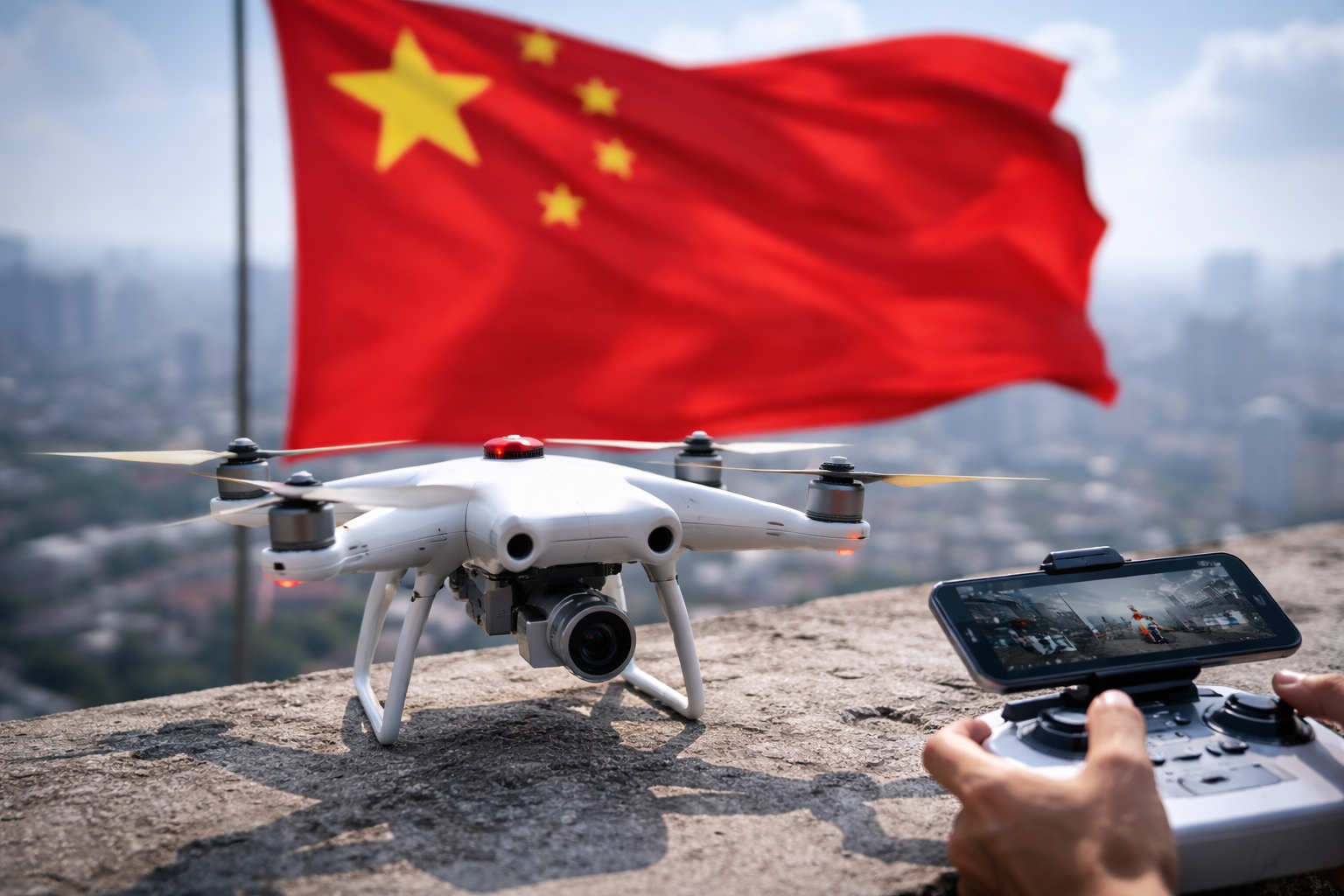
China is tightening its grip on drones with a layered regulatory shift that combines stricter technical standards, tighter traceability, new aviation-law obligations, and, in Beijing, some of the toughest local drone controls seen anywhere in the country.
What makes this especially important is the contrast at the heart of it.
China is one of the world’s most important drone markets and the home base of major manufacturers, while at the same time pushing hard to grow its broader low-altitude economy. Yet the same authorities promoting that growth are now building a much tighter compliance system around who can own, activate, fly, track, transport, and in some places even store drones.
Beijing wants expansion, but on terms it can monitor closely.
The Short Version of What Changed in China Drone Laws
There are three big pieces to understand.
First, China has issued two mandatory national standards for civil drones that take effect on May 1, 2026. One standard ties drones to a real-name registration and activation system. The other requires operational identification, meaning drones must actively transmit identifying and flight-related information so authorities can monitor operations more reliably.
Second, China’s revised Civil Aviation Law takes effect on July 1, 2026. That law formally pulls drones deeper into the national aviation legal framework. It requires a unique product identification code for each civil unmanned aircraft and sets up airworthiness certification obligations for relevant entities, unless exempted under national rules.
Third, Beijing has adopted its own municipal drone regulation, also taking effect on May 1, 2026. It requires prior approval for all outdoor drone flights in the capital, sets up dedicated flight zones for certain approved activities, and tightens rules around operations, sales, transport, and storage. The Beijing measure also restricts the sale or lease of drones and 17 designated core components without public-security approval, limits how many drones or core components can be stored within the sixth ring road, and restricts bringing new drones or components into the city except in specific verified cases.
Put simply, China is moving from a system that already had registration and flight controls into one that is more integrated, more technical, more traceable, and much harder to bypass.
This Is Not China’s First Drone Regulatory Move
These restrictions did not come out of nowhere. China already had a real-name registration framework for civil unmanned aircraft years ago. In a CAAC translation of the earlier Regulations on Real-name Registration of Civil Unmanned Aircraft Systems, the rules applied to civil UAS with a maximum takeoff weight of more than 250 grams, and the registration requirement dated back to 2017. Owners were expected to register, affix registration marks, and update information when ownership or status changed.
That older framework matters because it shows the 2026 move is not a sudden invention of registration. Instead, it is an escalation. The new standards go further by tying registration to activation and by requiring continuous operational identification from power-on through flight.
In other words, the government is not merely asking, “Who owns this drone?” It is increasingly asking, “Who activated it, who is flying it right now, where is it, and can we see that in real time?”
That is a much more surveillance-oriented compliance architecture. It turns registration from a database exercise into a live operational control system.
What the May 1 National Standards Do
The May 1 standards are the practical heart of the new regime.
- The first of the mandatory standards is called “Requirements for Real-Name Registration and Activation of Civil Unmanned Aircraft.” It requires drones to be inoperable before activation and after deactivation. That is a very important detail. A stronger lock between identity verification and the device’s ability to function at all.
- The second standard obligates drones to continuously transmit identification, location, speed, and status data to regulatory authorities from power-on through the entire flight.
CAAC itself says the standards implement legal requirements for drones to actively transmit identification information so operations can be monitored reliably.
If you fly recreationally, this means a more tightly controlled ecosystem. If you fly commercially, it means traceability is becoming a baseline compliance feature, not an optional add-on. If you manufacture or integrate systems, it means product design increasingly has to support both identity verification and operational identification in a way regulators can trust.
This is also why the new standards matter beyond China. When the biggest drone manufacturing ecosystem in the world bakes these controls into domestic governance, that can influence design norms, supply chains, and expectations far beyond one market.
What Changes on July 1 Under the Civil Aviation Law
The July 1 legal change is just as important, although it works at a different level.
The revised Civil Aviation Law formally strengthens how civil unmanned aircraft are treated under aviation law. Entities engaged in the design, production, import, maintenance, and flight activities of civil unmanned aircraft must apply for airworthiness certification in accordance with national regulations, unless they are exempt. The law also requires producers to assign a unique product identification code to each aircraft.
There’s an important practical distinction: China’s framework treats micro, light, and small civil drones more lightly, while medium and large drones must obtain approval from the CAAC. The legal revision comes after repeated airspace disruptions caused by illegal drone operations and as China continues to promote its low-altitude economy.
This has resulted in a more formal legal spine for enforcement. A technical standard can tell you how a drone should identify itself. A law can define who is responsible across the chain of design, manufacture, import, maintenance, and operation. That creates clearer liability, clearer obligations, and stronger enforcement hooks.
For serious operators, this means compliance is becoming more systemic. It is not only about pilot behavior anymore. It is also about product identity, certification, maintenance, and organizational accountability.
Beijing Is Going Further Than the National Rules
If the national picture is stricter, Beijing’s local rules are stricter still.
All outdoor drone flights in Beijing will require prior approval. The regulation also contemplates dedicated flight zones for approved activities such as research, education, and industrial testing, with Yanqing district highlighted as a location for dedicated zones and a smart flight network spanning 168 square kilometers.
Schools and universities are specifically allowed to purchase, store, and operate drones through approved channels for teaching, experiments, and technology development.
Beijing is not saying “no drones, period.” It is saying “drones, but only under structured, pre-approved, institutionally legible conditions.” Research, education, and industrial testing are not banned. They are being channeled into supervised pathways.
Beijing has also banned the sale or lease of UAVs and 17 designated “core components” without public-security approval, restricted bringing new drones or components into Beijing except for already registered drones carried by verified owners, and prohibited storing more than three drones or 10 core components at a single location within the sixth ring road.
That is a striking mix of flight control, transaction control, transport control, and storage control.
Why China Is Doing This Now
The official explanation revolves around safety, security, and order.
The new standards are meant to promote a safer, healthier, and more orderly development of the industry. Iin 2024, China had nearly 20,000 entities with UAV operation certificates, more than 2 million registered UAVs, and more than 26 million cumulative annual flight hours within the statistical scope, with a maximum of 26,000 UAVs simultaneously in the air.
Those are not hobby-scale numbers. They describe a huge and increasingly dense aviation environment at low altitude. Once you have that many drones, weak oversight stops being a niche problem and starts becoming an airspace-management problem.
China has seen illegal drone operations cause flight delays in several cities. That gives regulators a strong public-safety argument for tougher identification, certification, and legal liability.
At the same time, China is still betting heavily on its low-altitude economy. The country’s low-altitude economy was estimated at more than 500 billion yuan by the end of 2023 and was expected to rise to 2 trillion yuan by 2030. The revised aviation law is part of managing that rapid development while tightening safety rules.
So the timing makes sense. China wants a booming drone economy, but it wants one that is tightly legible to the state. Basically, growth is welcome, uncontrolled growth is not.
What New China Drone Laws Mean for Hobby Pilots
If you are a recreational pilot, the impact is pretty clear.
At the national level, the barrier between purchase, ownership, and actual flight is getting tighter. Real-name registration is being bound to activation, and operational identification will be more visible to authorities. That means casual flying becomes less anonymous and less forgiving.
In Beijing, it gets even harder. Outdoor flights require prior approval, and local rules are explicitly tougher around transport, storage, sales, and approved use channels. If you were imagining a typical consumer experience where you buy a drone, toss it in a bag, and take it out for a quick scenic flight, Beijing is moving far away from that model.
This does not necessarily mean hobby flying disappears everywhere in China. But it does mean the space for spontaneous, lightly regulated consumer use is shrinking. The system is moving toward permissioned use rather than casual use, especially in sensitive urban areas.
What This Means for Commercial Operators
For commercial operators, the story is not simply “bad news.” It is more complicated than that.
Yes, compliance is becoming heavier. Operators will need to take registration, identity transmission, and legal obligations more seriously. Some classes of operations and aircraft will face stricter certification pathways, and enforcement will likely become easier once authorities can tie real-time flight data to registered identities and product codes.
But there is another side to it. Professional operators often benefit when regulators squeeze out grey-zone flying and illegal competition. A market with better traceability, clearer liability, and dedicated approved flight zones can actually become more favorable for serious enterprise work, especially in inspection, logistics, mapping, and industrial testing. Beijing’s explicit carve-outs for research, education, and industrial testing point in that direction.
In other words, the system seems designed to discourage informal drone use while making room for supervised, institutionally approved drone activity. If you are a compliant enterprise operator, that can create a more structured market. If you are a casual commercial flyer used to loose enforcement, it creates a much tougher one.
What This Means for Manufacturers Like DJI
Manufacturers are in an awkward position.
China remains central to global drone manufacturing, and companies such as DJI sit at the center of that ecosystem. Reuters specifically notes that the revised law would affect manufacturers such as DJI and EHang. That is not surprising. Once every aircraft needs unique product identification and some categories face stronger certification obligations, compliance starts earlier in the product life cycle, not just at the point of flight.
For manufacturers, this can raise costs, complexity, and regulatory exposure. Devices may need tighter integration with activation controls, identification transmission systems, and traceability frameworks. The compliance burden is no longer only about how the user flies. It also reaches into how the device is designed, documented, activated, sold, and supported.
At the same time, large manufacturers may be better positioned than smaller players to absorb these requirements. Big firms generally have more engineering, legal, and compliance capacity. So while stricter rules can create friction, they can also deepen the advantage of companies that are already sophisticated enough to build within tighter regulatory rails.
The Bigger Global Signal
China’s new restrictions matter far beyond China because the country is one of the key places where drone technology is designed, manufactured, scaled, and exported.
When a market this important moves toward stronger identity controls, activation locks, remote traceability, and expanded legal accountability, the effects can ripple outward. Product design choices made for one large domestic market often influence global platforms. Compliance expectations can travel through supply chains. Policymakers in other countries may also look at these changes and ask whether their own drone oversight is too loose, too fragmented, or too dependent on voluntary compliance.
There is also a political signal here. China is trying to do two things at once: champion the low-altitude economy and clamp down on uncontrolled drone use. That combination shows how governments increasingly view drones. They are not only consumer gadgets or industrial tools. They are also data-emitting, airspace-occupying, security-relevant systems. Once a state sees them that way, tighter regulation becomes much more likely.
FAQs About China’s 2026 Drone Restrictions
What are the new drone restrictions in China?
China has introduced tighter rules on how drones are registered, activated, tracked, and regulated. The changes include new national standards for real-name registration and operational identification, a revised Civil Aviation Law, and stricter local controls in Beijing covering flight approvals, sales, transport, and storage.
When do the new drone rules take effect?
The new rules take effect in stages. The national standards and Beijing’s municipal regulation begin on May 1, 2026, while the revised Civil Aviation Law comes into force on July 1, 2026.
Is China banning drones altogether?
No, China is not banning drones across the board. It is allowing drone use under a more controlled system that places greater emphasis on identity verification, approval, traceability, and compliance.
What do the new national standards require?
The new national standards require drones to be linked to real-name registration and activation. They also require drones to transmit identifying and flight-related information so authorities can monitor operations more closely.
Can a drone work without activation under the new system?
No, a drone is expected to remain unusable until it has been properly activated. The new framework ties functionality to the activation process, which makes registration and identity checks much more central to legal operation.
What kind of data will drones have to transmit?
Drones will have to send operational identity data during use. This includes information such as identification details, location, speed, and operating status.
Did China already have drone registration rules before this?
Yes, China already had drone registration requirements before these latest changes. The difference now is that registration is being tied more tightly to activation and live operational monitoring.
How are the 2026 rules different from the older registration system?
The 2026 rules go further than the earlier framework. Instead of simply requiring owners to register a drone, the new system connects identity, activation, and live flight visibility in a much more integrated way.
What changes under the revised Civil Aviation Law?
The revised Civil Aviation Law places drones more firmly under the national aviation legal framework. It introduces product identification requirements and strengthens certification and legal obligations for entities involved in design, production, import, maintenance, and operation.
What is a unique product identification code for a drone?
A unique product identification code is a distinct identifier assigned to each aircraft. It helps regulators and authorities track a drone more clearly through its lifecycle.
Will all drones be regulated in exactly the same way?
No, different categories of drones are not treated identically. Smaller drones are handled more lightly, while medium and large civil drones face stricter approval and certification requirements.
Why is Beijing’s approach getting so much attention?
Beijing’s approach stands out because it goes further than the national framework in several areas. It adds local approval requirements for outdoor flights and tighter controls over how drones are sold, brought into the city, and stored.
Do you need approval to fly a drone in Beijing?
Yes, outdoor drone flights in Beijing require prior approval under the municipal regulation. That makes flying in the capital far more controlled than a casual takeoff-and-go model.
Are there still places in Beijing where drone activity is allowed?
Yes, Beijing is setting aside approved flight zones for certain activities. These include areas for research, education, and industrial testing under structured and supervised conditions.
Can schools and universities still use drones in Beijing?
Yes, schools and universities can still use drones in Beijing through approved channels. The rules allow them to purchase, store, and operate drones for teaching, experiments, and technology development.
What restrictions has Beijing placed on drone sales and leasing?
Beijing has tightened controls over the sale and lease of drones and certain core components. According to reporting on the measure, these activities require public-security approval.
Are there limits on storing drones in Beijing?
Yes, Beijing has introduced limits on how many drones and certain key components can be stored at one location in parts of the city. This reflects the city’s broader effort to control drone-related hardware more closely.
Can people freely bring new drones into Beijing?
No, bringing new drones or designated core components into Beijing is more restricted under the local rules. The system appears to favor already verified and registered cases rather than open movement.
Will casual drone flying become harder in China?
Yes, casual flying is likely to become harder, especially in sensitive urban areas. The rules move the system away from spontaneous recreational use and toward more permission-based operation.
What does this mean for commercial drone operators?
Commercial operators will face heavier compliance demands, but they may also benefit from a more structured market. Tighter rules can reduce grey-area competition and make it easier for serious operators to work within approved channels.
Could stricter rules actually help some drone businesses?
Yes, stricter rules could help compliant businesses by creating a more orderly market. Operators already working professionally may benefit if enforcement squeezes out informal or unlawful competitors.
What does this mean for drone manufacturers like DJI?
Manufacturers such as DJI may face more compliance pressure at the product level. The new environment puts greater focus on identification, activation controls, certification, and traceability from the design stage onward.
Will these rules affect how drones are designed?
Yes, the rules are likely to influence drone design. Manufacturers may need to build products that support activation controls, identity transmission, and stronger traceability features.