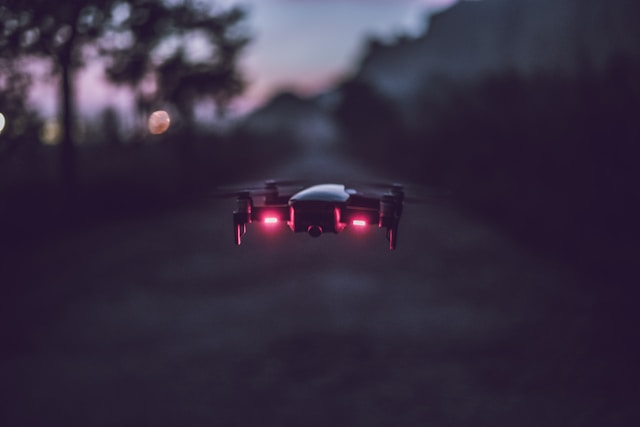
You look up at the night sky and wonder, “What are those mysterious lights? Is someone spying on me??”
Lately, conversations about drones over US airspace have exploded, fueled by viral videos, news reports, and a fair share of wild theories. It’s easy to feel concerned or curious – are these high-tech spy gadgets, harmless hobbyist toys, or something else entirely?
In late 2024 for instance, a wave of unexplained drone sightings across multiple East Coast states captured headlines and imaginations. Night after night, witnesses shared videos of bright objects above New Jersey, New York, Maryland, Virginia, and beyond, sparking conspiracy theories ranging from foreign spies to UFOs.
What You’re Seeing and Why It’s Happening
Before we get swept up in speculation, let’s ground ourselves. Drones are becoming incredibly common in America’s skies – 837,513 are registered with the FAA as of February 2026, and on any given day thousands of commercial, hobbyist, and law enforcement drones are flying legally overhead.
In other words, seeing a drone (or something that looks like one) is usually not a sign of something nefarious.
When that surge of alleged “drone swarms” had residents from New Jersey to Colorado on edge, investigators found most reports were false alarms or benign activity. According to a joint federal statement, the vast majority of those sightings turned out to be ordinary things: authorized drones, airplanes, helicopters, even stars and planets misidentified as mysterious craft.
Officials found no evidence of any anomalous or threatening objects in those cases. In fact, they stress that America’s adversaries have far easier ways to spy (like satellites) than blatantly flying conspicuous drones over U.S. cities.
Granted, there are broader concerns about unknown or unauthorized drones in American airspace. This includes high-profile events like the Chinese spy balloon of February 2023, which wasn’t a drone per se but alerted Americans to aerial intrusions.
Add to that recurring reports of drones near sensitive sites (nuclear plants, military bases) and the perennial worry: “Is someone or something surveilling us from above?” People concerned about drones over the US are often looking for reassurance and clarity. They want to know what those flying objects are, why they’re there, and if they should be concerned.
Most drones over US are not spying on your neighborhood or heralding an invasion. They’re usually either legitimate drones on normal missions or not drones at all. That said, legitimate or not, unexplained lights in the sky can understandably spook people – especially when communication is lacking. Misinformation and sensational coverage can fill the gap, feeding a cycle of worry.
Next time you see a weird light above, remember that odds are it’s something routine.
The Most Common Explanations Sightings of Drones Over US
Here are the usual suspects, ranked from the most likely explanation to the least likely:
1. Misidentified Conventional Aircraft or Objects
The number one explanation is simple mistaken identity. Many “drones” turn out to be manned airplanes or helicopters at a distance. At night, a high-flying plane’s lights can appear to hover or move oddly, especially if it’s coming toward you or circling. In one case, what coastguardsmen thought were a dozen drones “swarming” their boat were later proven to be commercial jets lining up to land (their flight path gave the illusion of hovering).
Read more about it here:
Stars and planets are another culprit – bright celestial objects like Venus or Orion’s belt can seem like hovering drones on a clear night. Weather phenomena (like ball lightning or meteor trails) also occasionally fool observers. Bottom line: human eyes can play tricks, so many reported “drones” are not drones at all.
2. Legitimate Hobbyist or Commercial Drones (Authorized Flights)
The next most likely explanation is an actual drone, but one being flown legally for innocent purposes. The U.S. has over a half a million licensed drone pilots. That strange quadcopter over your house at 7 PM might be someone’s hobby drone capturing sunset photos, or a real estate photographer’s drone taking aerial shots. It could also be a commercial drone delivering a package or inspecting power lines.
Many large companies (and startups) are testing drone deliveries and services across the country – often with FAA authorization. Even in the New Jersey drone scare, officials eventually revealed that many of those drones were hobbyists or authorized research drones flying with FAA approval. In his interview with TWZ, Brett Feddersen (former FAA official) noted that a “majority of the flights were known and approved by the FAA” – routine training exercises or test flights that just happened to catch public attention. In other words, a lot of “mystery” drones are only mysterious because onlookers weren’t aware of the perfectly normal activities taking place.
>> Can You Fly Drones Over Private Property?
3. Government or Law Enforcement Drones
It’s also quite possible the drone you see is operated by authorities. Law enforcement agencies use drones for search-and-rescue, crowd monitoring, or crime scene mapping. The military trains with drones on bases and testing areas that might be near communities. For example, in the Northeast drones over US sightings, some were National Guard units training with reconnaissance drones or other military exercises that were coordinated with the FAA. Police in New Jersey even launched their own drones to chase the mystery drones (essentially drones looking for drones). These official drones usually follow the rules (flying in allowed airspace, with lights and coordination), but to the casual observer they can look just as strange. If you live near a military base, training range, or border area, chances increase that “mystery drones” could be government-operated (whether you’re meant to see them or not).
4. Rogue Drones or Illegal Operators
Now we get into the less common, but possible, explanations.
A portion of sightings are indeed drones flying where or how they shouldn’t – basically rogue operators. This could be a prankster or enthusiast ignoring the rules (for instance, flying a drone near an airport or over people without permission).
It could also be someone with criminal intent, such as drones used for smuggling contraband (a known issue along borders and prisons) or a snooping neighbor violating privacy.
During the 2024 incidents, police did make a few arrests – for example, two men were caught flying a drone dangerously close to Boston’s Logan Airport (tipped off by drone detection tech).
Such rogue cases are serious but relatively rare. Most people obey drone laws, and very few individuals have drones capable of long-range or stealthy operations.
Still, if something is truly a drone behaving badly, it might fall into this category.
5. Foreign Surveillance or Spying Drones
Given all the speculation, let’s address this – the idea that an enemy nation is sending swarms of drones over U.S. territory. While not impossible, officials say it’s unlikely and not the primary explanation for most sightings. During the New Jersey scare, wild theories about an “Iranian mothership” launching drones were flatly denied by the Pentagon. U.S. security experts point out that overt drone flights would be a clumsy way to spy; satellites can do the job quietly from space.
That said, there have been a few troubling cases of foreign nationals using drones on U.S. soil – for example, a Chinese citizen caught flying a drone over Vandenberg Space Force Base in California to take photos, which is against federal law.
Some defense officials do suspect that a handful of the unexplained intrusions over military installations could be foreign surveillance testing the waters. Those cases, if they exist, are classified and still under investigation.
Importantly, no public evidence has confirmed widespread foreign drone incursions in the 2024 sightings – authorities said “no foreign connection” was found in the reports. So while it makes dramatic headlines, this is far down the list of likely explanations for drones over U.S. communities.
Northern California man arrested for allegedly flying drone over and photographing Vandenberg Space Force Base https://t.co/91o7yf3m0R
— US Attorney L.A. (@USAO_LosAngeles) December 11, 2024
6. Extraterrestrials or Sci-Fi Scenarios
We’d be remiss not to mention the least likely but oft-discussed theory – that some drones or flying objects might be alien technology or something out of a sci-fi movie. Let’s be clear: there is no evidence that UFOs or aliens are behind these drone sightings. In the heat of the moment, social media buzzed with “UFO” hashtags and X-Files memes, but investigators have debunked those claims. As fun as it is to imagine, that light above your backyard is almost certainly not E.T.’s drone coming to beam you up. Myths and fringe theories can take root when people don’t get quick answers (we’ll tackle those myths later on), but for now, keep your skepticism handy. Terrestrial explanations cover 99.9% of what people are seeing – and that’s where our focus should stay.
Most sightings can be explained by numbers 1, 2, or 3 on this list, with a smattering of number 4. Explanations 5 and 6 make headlines but are extremely rare or purely speculative.
Of Drone Tech, Public Anxiety & Belief Contagion
Certainly, social media frenzy magnifies the issue. A Facebook group dedicated to the New Jersey Mystery Drones has amassed over 82,000 members, trading theories from aliens to Chinese tech. Misleading videos went viral, some showing unrelated lights or even doctored footage. This online fervor contributed to what experts called a “mass panic” or social contagion – people seeing drones because they expected to see them.
As we’ve covered, people were seeing a mix of normal things – commercial drones, hobby drones, police drones, plus planes, helicopters, and even stars being mistaken for drones. New Jersey’s own senator Andy Kim, after getting briefed, said almost all the supposed drones people pointed out to him “were almost certainly planes”.
After going out with police to observe reports of possible drones, I was with the help of civilian pilots and others able to do deeper analysis and concluded that most of the possible drone sightings that were pointed out to me were almost certainly planes. Let me explain: THREAD pic.twitter.com/ljIOnYQzjF
— Andy Kim (@AndyKimNJ) December 14, 2024
So, what we know is the bulk of incidents have prosaic explanations. Out of 5,000+ tips, fewer than 100 needed deeper investigation. Yes, “no threat” doesn’t mean “no drones at all.” Homeland Security acknowledged “no question” some people actually did see drones over New Jersey. However, these turned out to be mostly lawful operations.
Legitimate drones plus poor communication led to a public “hysteria” – essentially a panic over largely normal activity. What’s still unclear here? Only a few of the drone operators were specifically identified by name, since many flights were routine or automated. But broadly, credible reporting has identified the major sources of these drones (e.g. tech center tests, military drills, hobby fliers).
Some unauthorized drones did appear near sensitive sites, with military personnel logging some genuine unknown drones over bases. For example, drones were confirmed over New Jersey’s Picatinny Arsenal and Naval Weapons Station Earle in that timeframe. The joint chiefs memo admitted certain sightings over bases were unexplained at the time, though they saw no evidence of foreign involvement. These base incursions are “not new” – U.S. defense officials say small drones regularly wander over installations, often harmlessly. By late 2024, the Pentagon even created a rapid response unit to respond to such incursions and began testing advanced counter-drone tech.
What we don’t fully know is who was behind the specific base incursions. There’s speculation (could be curious civilians, wayward hobby drones, or potential spies), but no public confirmation like with the Vandenberg case where the Chinese national was caught. Details on drone tracking at military sites remain murky.
>> Drone Challenges To Privacy And Homeland Security
Across all credible sources, a consistent message is that the drone sightings did not signal a coordinated hostile campaign. The FBI and DHS stated there was “no evidence” of a national security threat or foreign plot. These assurances are echoed by security experts, who note that if an enemy wanted to surveil us, they likely wouldn’t do it in a way that creates thousands of eyewitnesses and media coverage.
How To Verify Drones Over Your Airspace
Heard a neighbor swear there’s a spy drone above? Spot a weird light in the sky and want to play detective? Fortunately, you don’t need a degree in aerospace to verify a drone sighting quickly and safely.
Step 1: Rule Out Aircraft First
The first step is to make sure it’s not a conventional aircraft. This is crucial because, as we learned, many drone reports end up being planes or helicopters. How do you check? Start by observing the object’s behavior and lights:
- Position & Movement: Is it moving in a straight line or smoothly curving? If so, it could be a plane at a distance (even if it appears slow). Drones tend to hover or make quick, jerky moves, whereas planes have steady trajectories. Also note if it’s at high altitude – small consumer drones usually fly below 400 feet by law, so a tiny light way up could be a plane or even a satellite.
- Lights: Commercial aircraft have distinct patterns – a blinking white strobe and red/green navigation lights on wingtips. Drones also have lights, but if you see a red blinking light alternating with green, that’s a strong clue it’s a plane. Many witnesses in 2024 described “drones” with red and green lights – classic airplane markers – and indeed they were planes on routine routes.
>> Guide to Night Vision Drones for After Dark Tasks
- Sound: Listen carefully. A low-flying helicopter or plane often makes a rumble or roar. Drones (the small quadcopter type) buzz like angry bees and are hard to hear more than a few hundred feet away. If you hear a distant jet noise, it’s likely not a drone.
- Use Flight Tracking Apps: For a definitive check, use a free flight-tracking app or website (like Flightradar24, FlightAware, etc.). These show real-time positions of many airplanes. If you spot a suspicious light, quickly open the app and see if an aircraft is indicated at that location. You’d be surprised – many “mystery” night lights neatly match a scheduled commercial flight on the map. In fact, some New Jersey “drone swarm” videos were debunked this way, matching lights to airliner routes into Newark and JFK airports.
- Check Star Charts: If the object seems stationary for long periods, compare with a star map app (or even Google Sky). Bright stars or planets like Venus can appear as hovering or slowly drifting lights. Multiple reports to the FBI turned out to be folks fixating on celestial bodies.

By Farajiibrahim - Own work, CC BY-SA 4.0, Link
Spend a few minutes on these checks. If you find an obvious match (e.g. your “drone” is exactly where a flight from Chicago should be at 10,000 feet), congratulations – you’ve likely solved it. You can breathe easier knowing it’s not a rogue drone at all. If nothing matches – no sound, no flight path, unusual hovering – proceed to the next step.
Step 2: Check If You’re In Restricted Airspace
Next, consider your location. Is the area even allowed for drone flights? In the U.S., there are strict no-drone zones such as near airports, military bases, national security sites, and over certain stadium events. If you’re seeing a drone-like object in these zones, it significantly narrows the possibilities (and raises suspicion).
- Use the FAA B4UFLY Service or Maps: B4UFLY apps show where drones can’t be flown. Within a few taps, you can see if your exact location is under a flight restriction. For example, a 5-mile radius around major airports is typically controlled airspace where drones need permission to fly. The same goes for areas around military installations and critical infrastructure – many are designated no-drone zones. If you find you are in a restricted area (say, 2 miles from an Air Force base or inside a temporary flight restriction for a VIP visit), then any drone you see is likely unauthorized (or operated by authorities with a waiver).
- Consider Temporary Flight Restrictions (TFRs): Big events (like NFL games, large concerts) often have TFRs banning drones over the venue and a buffer zone. If you see a drone-like object near a packed stadium or during a presidential visit, it’s almost certainly not allowed unless it’s a police drone. Knowing this can help you decide your next move (likely to report it).
- Altitude Clues: Is the object flying very high (several thousand feet)? Recreational and small commercial drones by law should stay under 400 feet. Military or larger drones can go higher, but those aren’t usually flown over populated areas. A pinpoint light at high altitude could be a military UAV transit or, again, a plane – but if it truly has drone characteristics at high altitude, it’s an oddity worth noting.
- Local Drone Laws: Beyond FAA rules, some cities or states have their own restrictions (like no drones in certain parks or over private property without consent). It might not be immediately obvious without a quick search. If your city forbids night drone flights and you see one, that’s a clue it’s either law enforcement or an unlawful flight.
Examples of unique state drone laws: Utah, New York, California, Texas
By checking the airspace rules, you’ll get context. Seeing a “drone” over a military base or airport runway? – very likely an issue. Seeing one in a suburban neighborhood where flying is generally allowed? – could be a harmless hobbyist. This will guide whether you should be concerned or simply curious. If the airspace is clear and it could be a legal drone, move to Step 3 to dig deeper.
Step 3: Use Remote ID the Right Way
Drone Remote ID is basically a digital license plate broadcast by drones. U.S. regulations now require most drones to transmit an ID signal that can be picked up by smartphones or receivers, revealing the drone’s identity and location. This is extremely handy for curious citizens and law enforcement alike. Here’s how to leverage Remote ID:
- Get a Drone-Detection App: There are free apps (for Android and iOS) such as Drone Scanner, Air Sentinel, DroneScout, etc., that turn your phone into a drone detector. These apps listen for the Bluetooth/Wi-Fi signals that compliant drones emit. If you suspect a drone overhead, launch the app and scan. If the drone is broadcasting Remote ID and you’re within range (typically a few hundred feet to maybe a quarter mile), you’ll see a dot or icon for it on your screen.
- What Info You’ll See: Remote ID broadcasts include a unique drone ID number, the drone’s GPS location, altitude, and the location of its operator’s controller (i.e. roughly where the pilot is). Some apps will show the make/model if available. This means if a drone is flying nearby, you could potentially find out “Oh, that’s Drone ID #1234 belonging to Joe’s Roofing Co., flying 300 ft up, pilot standing by that white van across the street.” Knowing the operator location is especially useful – it might show you that the pilot is right under the drone (typical for a hobbyist) or somewhere odd (if it’s being controlled from afar).
- Identify Legitimate vs Suspicious: If you do pick up a Remote ID, odds are it’s a legitimate flight. Law-abiding pilots will have their Remote ID on. You might even approach the pilot if it’s safe and ask what they’re up to (often they’re friendly and might demonstrate their drone). On the other hand, if no Remote ID signal is found but you clearly see a drone, two possibilities arise: 1) it’s an older or small toy drone not required to have Remote ID (drones under 0.55 lbs used recreationally are exempt for now), or 2) it’s a larger drone that is non-compliant/being flown illegally without the ID. By March 2024, essentially all drones over 250 grams in the US had to be Remote ID compliant, so a conspicuous drone with no ID is a red flag.
- Use the Data Responsibly: If you detect an ID, don’t misuse it – it’s meant for awareness and safety. But you can log the details. For example, note the serial or operator location if you plan to report a concern. Keep in mind, authorities (like police) have devices that read Remote ID too, with more info (like the registered owner’s name). So if needed, you can tell law enforcement “I spotted a drone, my app showed ID XYZ at these coordinates” which can greatly help them follow up.
Using Remote ID tech empowers you as a citizen to separate benign drones from potentially problematic ones. It’s the “techie” part of these steps, but even if you skip the app, understanding that compliant drones broadcast their identity helps you reason out what might be flying.
If after all this you still have a drone that seems to be operating illegally or unsafely, move to the final step.
Step 4: Capture Proof Without Putting Yourself at Risk
If you genuinely suspect a drone is operating unlawfully – say it’s hovering over a crowd, peeking in windows, or flying near critical infrastructure – you should document it safely and alert the proper authorities rather than intervening yourself. Here’s how:
- Take Photos or Video: Use your phone or camera to get footage of the drone in action, if possible. Zoom in to capture its lights or shape. This visual evidence is valuable for investigators. It also helps differentiate the object – sometimes on video you can later tell it was a plane or bird. Do this from a safe position; don’t chase the drone down the street (it can move faster than you in most cases).
- Note the Details: Jot down the date, time, and location of the sighting. Estimate the drone’s altitude and direction. Did it take off from a nearby location you can identify? (E.g., “I saw it launch from the empty field on 3rd street.”) How long did it hover? The more specifics you have, the better you can report it.
- Do NOT Attempt to Disable the Drone: It’s tempting to think, “I’ll just knock it down” – do not do this. Shooting at a drone or using jamming devices is illegal and dangerous. The FAA explicitly warns that private citizens cannot shoot down drones; a drone is considered an aircraft, and firing at one is a federal crime (not to mention you could harm people if it crashes). Also, don’t launch your own drone to engage in some Top Gun dogfight – that could create a hazard or legal liability.
- Maintain Personal Safety: Don’t position yourself directly under a suspicious drone (in case it’s heavy and crashes). If it’s truly behaving erratically, keep a reasonable distance. Also, avoid confronting the drone operator if you spot them and feel uncomfortable. While a friendly conversation is fine in normal cases, if you believe the pilot is intentionally doing something malicious, it’s better to involve authorities than to escalate on your own.
- Contact Authorities if Needed: We’ll cover specifics in the next section, but generally, if the situation warrants (drone near airport, or endangering people, etc.), call local law enforcement or the relevant authority after you’ve gathered some evidence. Tell them exactly what you observed. You can also report unsafe drone operations to the FAA online, but if immediate risk is present, police can respond in real time. The FBI has actually asked the public to send in photos/videos of the mystery drones to aid their investigation. So your documentation can make a difference.
>> Can Private Security Shoot Down Drones?
Myths About Drones Over US
Myth #1: “The Government Can Track Every Drone, So if we don’t know what it is, it must be something secret.”
Reality: Not true – at least not yet. There’s a belief that the FAA or military has eyes on every drone in the sky in real time. In reality, the drone tracking infrastructure is still in progress. Remote ID is helping, but only drones built or retrofitted with it broadcast their ID, and you need receivers nearby to catch those signals. Radar systems that track aircraft often filter out small slow objects like hobby drones (otherwise they’d be overwhelmed by birds).
So, gaps exist – which is exactly why authorities sometimes say “we don’t know” initially. It doesn’t automatically mean it’s a super-sophisticated mystery craft. It usually means our current systems aren’t comprehensive. Work is underway to improve this (dedicated drone radar, networked Remote ID databases, etc.), but we’re not there yet. So a reported drone that isn’t immediately identified isn’t necessarily an alien or a stealth spy – it’s often just a blind spot in our monitoring.
Myth #2: “If a drone is over my property, I have the right to shoot it down.”
Reality: This is a dangerous falsehood. As mentioned, shooting a drone is a federal crime because aircraft are protected. Some homeowners think of drones as pesky trespassers they can eliminate like vermin – but the law doesn’t see it that way. Even if a drone is being a nuisance, you must go through legal channels to deal with it.
Not only could you hurt someone or damage property by firing a weapon skyward, but you’d likely face charges for discharging a firearm illegally and for destroying an aircraft. Instead, gather evidence and call the police.
There have been cases where frustrated individuals shot down drones (one famous case in Tulsa, for example) – those individuals were the ones who got into legal hot water. Don’t risk it.
Myth #3: “Drones can’t fly high or far, so if you see one high up, it’s definitely a plane/UFO.”
Reality: It’s true that hobby drones have practical limits – most consumer quadcopters fly under a few hundred feet normally and have range limits (also FAA’s 400 ft rule). But some drones can go much higher/farther (illegally or with special permission). Racing drones or custom builds can scream thousands of feet up. There are fixed-wing drones that look like small airplanes which can fly at several thousand feet altitude and miles away on autopilot.
So while it’s likely a high object is a plane, don’t assume drones are physically incapable of reaching higher. For instance, in 2021 a drone was recorded at 12,000 feet near an aircraft in Arizona – highly illegal, but physically it happened. Also, military drones like Reapers regularly fly at tens of thousands of feet (though those wouldn’t usually be in civilian areas without clearance). The point is, drones’ capabilities vary. Thus investigators in 2024 didn’t dismiss some sightings over 2,000 ft as impossible – they looked closer and found many were planes, but they also remain open-minded that a few might have been larger drone systems at higher altitudes.
Myth #4: “All drones have to keep their lights on at night, so if it has no lights, it’s something covert.”
Reality: FAA rules do require anti-collision lights for drones flying at night – they should be visible for 3 miles. However, lights can be turned off or not present. A rogue operator, or a drone built from scratch, might not follow rules. Many small hobby drones have programmable LEDs that can be shut off. In the New Jersey case, officials noted reports of drones flying “with their lights turned off” to avoid detection. That doesn’t mean they were super-secret military craft; it could just mean someone was deliberately operating without lights (which is illegal, but possible). Don’t assume an unlit object is extraterrestrial or government – it could just be a person flouting the law. Conversely, some drones might use infrared lights or very dim navigational lights not easily seen from certain angles. So absence of visible lights complicates identification but isn’t proof of anything extraordinary on its own.
Myth #5: “If we don’t get an explanation from authorities immediately, they’re hiding the truth.”
Reality: The government certainly has classified programs and doesn’t share everything, but in the context of these drone sightings, the delays or vagueness in communication are often because they themselves are figuring it out. The 2024 drone frenzy is a case in point: agencies took weeks to publicly conclude it was benign because they had to gather data from various sources (FAA radar, FBI tips, etc.). It wasn’t a grand cover-up; it was bureaucracy and caution. Officials are also careful not to speculate out loud – which is frustrating to the public. As Rep. Jim Himes said, when people are anxious and there’s a vacuum of info, “people will fill a vacuum with their fears and anxieties”.
So yes, the lack of immediate answers can breed mistrust, but it’s usually not because “they found aliens and won’t tell us.” It’s usually because either they truly don’t know yet or the answer is mundane and they are verifying. In the New Jersey case, once the facts were in, the White House openly said it: these were FAA-authorized and hobby drones, “not the enemy”.
Myth #6: “Every drone is spying or up to no good.”
Reality: This is a blanket fear that’s simply not true. The vast majority of drones in the sky are doing useful or at least harmless things. Your neighbor’s kid’s drone isn’t filming you; he’s racing his buddy in the next yard. The city contractor’s drone isn’t snooping; it’s inspecting the roof of the library. Drones are tools – they can be used for bad purposes, sure, but assuming every drone is a peeping tom or a weapon is like assuming every person with a camera is a stalker.
Maintaining perspective is important. One reason myths flourish is because the negative uses get amplified in media more than the positive. We hear about the one in a thousand drones that did something bad, and not about the 999 that quietly helped firefighters or entertained a hobbyist. Most drone sightings are explainable and non-threatening.
Frequently Asked Questions About Drones Over US
Q: What’s the big concern about drones over the US people keep talking about recently?
A: It refers to a spike in mysterious drone sightings at night reported across parts of the US. After investigations, most turned out to be misidentified stars or airplanes, as well as some authorized drones (hobby or research) flying legally. There wasn’t an invasion of unknown craft – mostly a combination of false alarms and normal drone activity that caught public attention.
Q: How do I know if I’m seeing a drone or something else (like a plane or UFO)?
A: Look at the movement and lights. Drones (especially quadcopters) often hover or move in spurts, and have a distinct buzzing sound at close range. Planes have steady paths and standard red/green/white flashing lights. If it’s very high up or moving fast in a straight line, it’s likely a plane. If it’s hovering for a long time silently, could be a drone or even a star/planet if it’s not moving at all. Using flight tracker apps or drone detector apps can help identify it. Remember, 9 times out of 10, it’s something ordinary, not a “black project” craft.
Q: Can I report a drone that I think is suspicious? Who do I call?
A: Yes, you should report it if it’s doing something unsafe or illegal. For immediate dangers (near airport, over big crowd, interfering with emergency operations), call 911 or local police on the spot. They can respond or relay info to FAA and security agencies. For less urgent cases (like a recurring privacy concern), you can still involve local law enforcement. The FAA also has an online reporting form for drone incidents, but law enforcement is a good first stop, especially since local laws might be in play. If it’s around critical infrastructure, definitely report – you could also contact the security office of that facility.
Q: What is Remote ID and how does it help me as an average person?
A: Remote ID is like a digital license plate signal that most drones in the U.S. now must broadcast. With a smartphone and the right app, you can pick up these signals to see basic info on drones flying nearby (ID number, location, altitude, and sometimes where the pilot is). For the average person, this means if a drone is bothering you, you might identify who’s operating it or at least confirm it’s a known/registered drone. It adds transparency – for example, police responding to a complaint can quickly see if that drone is a known authorized flight or something truly unknown.
Q: Are drones allowed to fly at night?
A: Yes, drones can fly at night legally as long as they follow certain rules. The FAA requires that the drone have anti-collision lights visible for 3 miles when flying at night. Pilots also need to have passed a knowledge test about night flying. In 2021, the FAA updated regulations to permit routine night operations for drones that meet the lighting requirement. So if you see a drone at night with a blinking light, it’s likely following those rules. If it has no lights, then it’s either breaking the rule or it’s something else entirely (maybe not a drone or a very small toy).
Q: Can drones fly over residential areas or backyards legally?
A: Generally, yes. U.S. airspace is federally regulated, and as long as the drone is in uncontrolled airspace (Class G) and below 400 feet, flying over a residential area is allowed under FAA rules. The pilot shouldn’t be flying directly over people not involved in the flight unless the drone is very small or has a special certification. But flying over property isn’t illegal per se. However, if they are harassing people or peeking into homes, that can violate privacy or nuisance laws. So, legal from an airspace perspective – but context matters (it shouldn’t endanger or harass).
Q: What should I do if a drone is repeatedly flying low over my house and I feel it’s invasive?
A: First, try to figure out who’s operating it. Often it could be a neighbor or someone nearby. If you can talk to them politely, do so – sometimes they may not realize they’re making you uncomfortable. If it continues and you suspect they’re filming you or trespassing, document it (video evidence) and contact local law enforcement. They can determine if any local ordinances or laws are being broken. Do not attempt to jam it or knock it down – that could get you in trouble. Using the steps we outlined (Remote ID scanning, etc.) can also give you info to provide to police.
Q: I heard stories of drones near military bases and power plants – are those true?
A: Yes, there have been reports of drones near such sensitive locations. Officials acknowledge unauthorized drones do appear near bases occasionally. There have also been instances around critical infrastructure. These are taken very seriously by authorities, such as the incident involving Tennessee’s Skyler Philippi. If you personally ever see drones around these types of facilities, it’s good to report it, as it could be important.
Q: Can I fly my own drone to check out a “mystery drone”?
A: It’s not advisable to send your drone chasing another. That could lead to mid-air collisions or you accidentally breaking rules yourself (like leaving your line of sight or entering restricted space). Plus, two drones in the same area complicate things. Focus on observing from the ground. Leave the drone interception to law enforcement or professionals.
Q: Are there drone detectors I can buy for home use?
A: Besides smartphone apps, there are more advanced detectors but they’re pricey. Some companies sell RF (radio frequency) scanners or acoustic sensors that can alert you to drones nearby. These are usually used by businesses or security teams rather than private individuals, due to cost and complexity. For personal use, the phone apps are a great start, and they’re improving as Remote ID becomes universal.